Und dann auf "Zum Home-Bildschirm [+]".

Stöbern
genialokal zum Startbildschirm hinzufügen
Installieren Sie die genialokal App auf Ihrem Startbildschirm für einen schnellen Zugriff und eine komfortable Nutzung.
Installieren Sie die genialokal App auf Ihrem Startbildschirm für einen schnellen Zugriff und eine komfortable Nutzung.
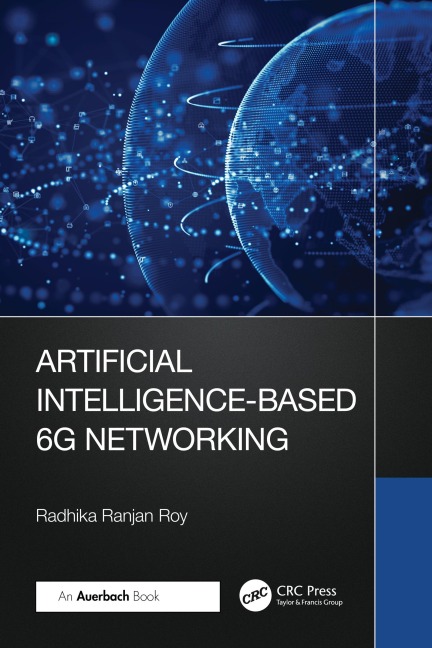
Artificial Intelligence-Based 6G Networking focuses exclusively on the upcoming sixth-generation (6G) network and services slated for implementation by 2030. It explores the paradigm shift that is 6G. It discusses the deep integration of computing and communication, supported by artificial intelligence (AI) across network elements like cloud, edge, and terminals. It also examines how AI-native interfaces will permeate various network components, from radio access networks to application servers and databases. Proposing a unified AI-enabled framework for optimizing networks and applications as a single integrated system, the book covers how network service providers can tailor network baselines, reduce noise, and accurately identify issues. The book delves into the potential of AI-driven networks to self-correct, predict, and rectify service degradations proactively, enhancing uptime and troubleshooting efficiency. It outlines the "Connection, Communication, Collaboration, Curation, and Community" framework to enhance network effects, aiding operators in automation, cost reduction, and providing optimal user experiences. Covering topics from MIMO and Massive MIMO to holographic communications, cybersecurity and quantum communications, the book explores cutting-edge technologies shaping the future of 6G networks. It anticipates a future where AI, along with machine learning and deep learning, enables continuous learning, self-optimization, and predictive maintenance, even with full automation, that will be the hallmark of a new era in network connectivity and innovation.
Radhika Ranjan Roy is an Electronics Engineer (Research), United States, Engineering & Systems Integration Directorate, Command Control, Computers, Communications, Cyber, Intelligence, Surveillance and Reconnaissance (C5ISR) Center, Aberdeen Proving Ground (APG), Maryland, since 2009. Before joining to US Army Research, he worked in various capacities in CACI, SAIC, AT&T/Bell Laboratories, CSC, and PDB since his graduation. He holds a PhD in electrical engineering with major in computer communications from the City University of New York, New York, in 1984, and MS in electrical engineering from the Northeastern University, Boston, Massachusetts, in 1978. He received his BS in electrical engineering from the Bangladesh University of Engineering and Technology, Dhaka, Bangladesh, in 1967. He has published more than 50 technical papers. He is holding and/or has submitted over 35 patents. In addition, Dr. Roy has authored five books: Networked Artificial IntelligenceAI-enabled 5G Networking, CRC Press, 2024, Handbook on Networked Multipoint Multimedia Conferencing and Multistream Immersive Telepresence using SIP, CRC Press, 2021, Handbook of SDP for Multimedia Session Negotiations: SIP and WebRTC IP Telephony, CRC Press, 2018, Handbook on Session Initiation Protocol: Networked Multimedia Communications for IP Telephony, CRC Press, 2016, and Handbook of Mobile Ad Hoc Networks for Mobility Models, Springer Nature Customer Service Center LLC., October 2010.
1. Overview 2. MIMO 3. Massive MIMO 4. Ultra-Massive MIMO 5. Vehicle-to-Everything Ultra-Massive MIMO Communications 7. Cell-Free Communications 8. Non-Terrestrial Communications 9. Massive MIMO Radar 10. Massive MIMO Radar for Target Detection 11. Massive MIMO Radar Scaling 12. Ultra-Massive MIMO Radar Sensors and Multi-User Communications 13. Device-to-Device Communications with Mesh Networking 14. Vehicle-to-Vehicle and Vehicle-to-Everything Communications 15. V2V Communications Network 16. Peer-to-Peer V2V Communication 17. V2V Massive MIMO Channels 18. V2X Communications Network 19. V2X Millimeter Wave MIMO Radar Communications 20. Robotics and Autonomous System Communications 21. Virtual, Augmented, Mixed Reality and Extended Reality 22. Unmanned Aerial Vehicles Communication Systems 23. Unmanned Robot Network with Swarm Capabilities 24. Digital Twins 25. Quantum Communications 26. 6G Cybersecurity
Dieses eBook wird im PDF-Format geliefert und ist mit einem Adobe Kopierschutz (DRM) versehen. Sie können dieses eBook mit allen Geräten lesen, die das PDF-Format und den Adobe Kopierschutz (DRM) unterstützen.
Zum Beispiel mit den folgenden Geräten:
• tolino Reader
Laden Sie das eBook direkt über den Reader-Shop auf dem tolino herunter oder übertragen Sie das eBook auf Ihren tolino mit einer kostenlosen Software wie beispielsweise Adobe Digital Editions.
• Sony Reader & andere eBook Reader
Laden Sie das eBook direkt über den Reader-Shop herunter oder übertragen Sie das eBook mit der kostenlosen Software Sony READER FOR PC/Mac oder Adobe Digital Editions auf ein Standard-Lesegeräte mit epub- und Adobe DRM-Unterstützung.
• Tablets & Smartphones
Möchten Sie dieses eBook auf Ihrem Smartphone oder Tablet lesen, finden Sie hier unsere kostenlose Lese-App für iPhone/iPad und Android Smartphone/Tablets.
• PC & Mac
Lesen Sie das eBook direkt nach dem Herunterladen mit einer kostenlosen Lesesoftware, beispielsweise Adobe Digital Editions, Sony READER FOR PC/Mac oder direkt über Ihre eBook-Bibliothek in Ihrem Konto unter „Meine eBooks“ - „online lesen“.
Schalten Sie das eBook mit Ihrer persönlichen Adobe ID auf bis zu sechs Geräten gleichzeitig frei.
Bitte beachten Sie, dass die Kindle-Geräte das Format nicht unterstützen und dieses eBook somit nicht auf Kindle-Geräten lesbar ist.