Und dann auf "Zum Home-Bildschirm [+]".

Stöbern
genialokal zum Startbildschirm hinzufügen
Installieren Sie die genialokal App auf Ihrem Startbildschirm für einen schnellen Zugriff und eine komfortable Nutzung.
Installieren Sie die genialokal App auf Ihrem Startbildschirm für einen schnellen Zugriff und eine komfortable Nutzung.
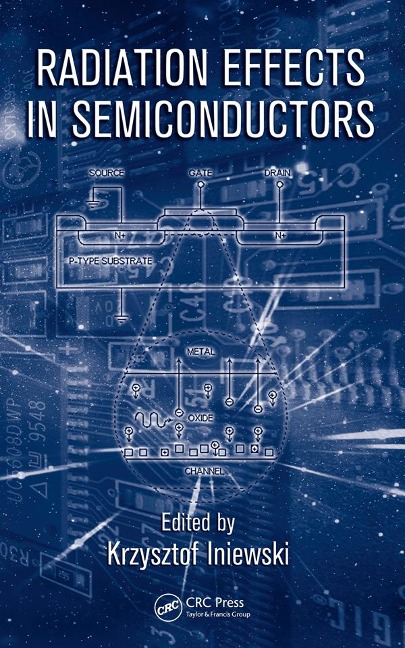
Space applications, nuclear physics, military operations, medical imaging, and especially electronics (modern silicon processing) are obvious fields in which radiation damage can have serious consequences, i.e., degradation of MOS devices and circuits. Zeroing in on vital aspects of this broad and complex topic, Radiation Effects in Semiconductors addresses the ever-growing need for a clear understanding of radiation effects on semiconductor devices and circuits to combat potential damage it can cause. Features a chapter authored by renowned radiation authority Lawrence T. Clark on Radiation Hardened by Design SRAM Strategies for TID and SEE Mitigation This book analyzes the radiation problem, focusing on the most important aspects required for comprehending the degrading effects observed in semiconductor devices, circuits, and systems when they are irradiated. It explores how radiation interacts with solid materials, providing a detailed analysis of three ways this occurs: Photoelectric effect, Compton effect, and creation of electron-positron pairs. The author explains that the probability of these three effects occurring depends on the energy of the incident photon and the atomic number of the target. The book also discusses the effects that photons can have on matter-in terms of ionization effects and nuclear displacement Written for post-graduate researchers, semiconductor engineers, and nuclear and space engineers with some electronics background, this carefully constructed reference explains how ionizing radiation is creating damage in semiconducting devices and circuits and systems-and how that damage can be avoided in areas such as military/space missions, nuclear applications, plasma damage, and X-ray-based techniques. It features top-notch international experts in industry and academia who address emerging detector technologies, circuit design techniques, new materials, and innovative system approaches.
Krzysztof (Kris) Iniewski is managing R&D chip development activities at Redlen Technologies Inc., a start-up company in British Columbia. His research interests are in VLSI circuits for medical and security applications. From 2004 to 2006 he was an Associate Professor at the Electrical Engineering and Computer Engineering Department of University of Alberta where he conducted research on low-power wireless circuits and systems. During his tenure in Edmonton he wrote "Wireless Technologies: Circuits, Systems and Devices" (CRC Press). From 1995 to 2003, he was with PMC-Sierra and held various technical and management positions. Prior to joining PMC-Sierra, from 1990 to 1994 he was an Assistant Professor at the University of Toronto's Electrical Engineering and Computer Engineering. Dr. Iniewski has published more than 100 research papers in international journals and conferences. He holds 18 international patents granted in USA, Canada, France, Germany, and Japan. He received his Ph.D. degree in electronics (honors) from the Warsaw University of Technology (Warsaw, Poland) in 1988.
Section I: Devices Radiation Damage in Silicon. Radiation-Tolerant CMOS Single-Photon Imagers for Multiradiation Detection Effects of Hydrogen on the Radiation Response of Field-Oxide. Field-Effect Transistors and High-K Dielectrics. Novel Total Dose and Heavy-Ion Charge Collection Phenomena in a New SiGe HBT on Thin-Film SOI Technology. Radiation-Hard Voltage and Current References in Standard CMOS Technologies. Nanocrystal Memories: An Evolutionary Approach to Flash Memory Scaling and a Class of Radiation-Tolerant Devices. Section II: Circuits and Systems Radiation Hardened by Design SRAM Strategies for TID and SEE Mitigation. A Complete Guide to Multiple Upsets in SRAMs Processed in Decananometric CMOS Technologies. Real-Time Soft Error Rate Characterization of Advanced SRAMs. Fault Tolerance Techniques and Reliability Modeling for SRAM-Based FPGAs Assuring Robust Triple Modular Redundancy Protected Circuits in SRAM-Based FPGAs. SEU/SET Tolerant Phase-Locked Loops. Autonomous Detection and Characterization of Radiation-Induced Transients in Semiconductor Integrated Circuits. Soft Errors in Digital Circuits: Overview and Protection Techniques for Digital Filters. Fault-Injection Techniques for Dependability Analysis: An Overview. Index.
Dieses eBook wird im PDF-Format geliefert und ist mit einem Adobe Kopierschutz (DRM) versehen. Sie können dieses eBook mit allen Geräten lesen, die das PDF-Format und den Adobe Kopierschutz (DRM) unterstützen.
Zum Beispiel mit den folgenden Geräten:
• tolino Reader
Laden Sie das eBook direkt über den Reader-Shop auf dem tolino herunter oder übertragen Sie das eBook auf Ihren tolino mit einer kostenlosen Software wie beispielsweise Adobe Digital Editions.
• Sony Reader & andere eBook Reader
Laden Sie das eBook direkt über den Reader-Shop herunter oder übertragen Sie das eBook mit der kostenlosen Software Sony READER FOR PC/Mac oder Adobe Digital Editions auf ein Standard-Lesegeräte mit epub- und Adobe DRM-Unterstützung.
• Tablets & Smartphones
Möchten Sie dieses eBook auf Ihrem Smartphone oder Tablet lesen, finden Sie hier unsere kostenlose Lese-App für iPhone/iPad und Android Smartphone/Tablets.
• PC & Mac
Lesen Sie das eBook direkt nach dem Herunterladen mit einer kostenlosen Lesesoftware, beispielsweise Adobe Digital Editions, Sony READER FOR PC/Mac oder direkt über Ihre eBook-Bibliothek in Ihrem Konto unter „Meine eBooks“ - „online lesen“.
Schalten Sie das eBook mit Ihrer persönlichen Adobe ID auf bis zu sechs Geräten gleichzeitig frei.
Bitte beachten Sie, dass die Kindle-Geräte das Format nicht unterstützen und dieses eBook somit nicht auf Kindle-Geräten lesbar ist.