Und dann auf "Zum Home-Bildschirm [+]".

Stöbern
genialokal zum Startbildschirm hinzufügen
Installieren Sie die genialokal App auf Ihrem Startbildschirm für einen schnellen Zugriff und eine komfortable Nutzung.
Installieren Sie die genialokal App auf Ihrem Startbildschirm für einen schnellen Zugriff und eine komfortable Nutzung.
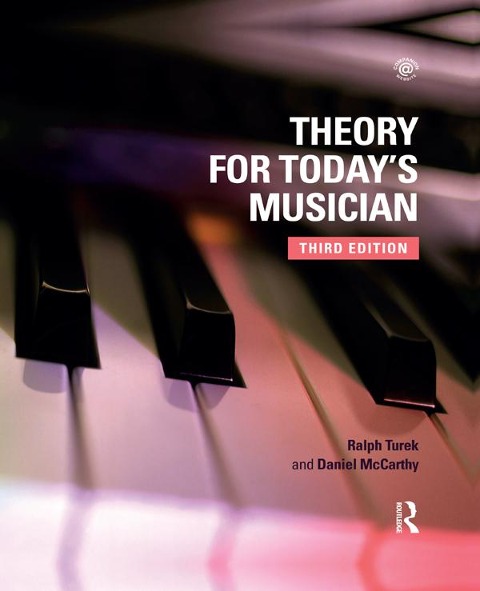
Theory for Today's Musician, Third Edition, recasts the scope of the traditional music theory course to meet the demands of the professional music world, in a style that speaks directly and engagingly to today's music student. It uses classical, folk, popular, and jazz repertoires with clear explanations that link music theory to musical applications. The authors help prepare students by not only exploring how music theory works in art music, but how it functions within modern music, and why this knowledge will help them become better composers, music teachers, performers, and recording engineers. This broadly comprehensive text merges traditional topics such as part writing and harmony (diatonic, chromatic, neo-tonal and atonal), with less traditional topics such as counterpoint and musical process, and includes the non-traditional topics of popular music songwriting, jazz harmony and the blues. The accompanying companion website provides interactive exercises that allow students to practice foundational theory skills. Written by experienced authors, both active classroom teachers for many years, Theory for Today's Musician is the complete and ideal theory text to enable today's student to accomplish their musical goals tomorrow. Updated and corrected throughout, the Third Edition includes: - Expanded coverage of atonality and serialism, now separated into two chapters. - Broadened treatment of cadences, including examples from popular music. - Substantially rewritten chapter on songwriting. - Interactive features of the text simplified to two types, "Concept Checks" and "Review and Reinforcement," for greater ease of use. - New and updated musical examples added throughout. - Charts, illustrations, and musical examples revised for increased clarity. - Audio of musical examples now provided through the companion website. The accompanying Workbook offers exercises and assignments to accompany each chapter in the book. A companion website houses online tutorials with drills of basic concepts, as well as audio. The hardback TEXTBOOK is also paired with the corresponding paperback WORKBOOK in a discounted PACKAGE (9780815371731).
Ralph Turek is a theorist, composer, author, jazz pianist, Professor Emeritus at The University of Akron, and a veteran of 35 years of teaching in the music theory classroom. Daniel McCarthy is a familiar name in contemporary American music. As a composer, he has received distinguished faculty research/creativity awards at Indiana State University and The University of Akron, where he is Chair of the Composition and Theory Section in the School of Music.
PART ONE: IN LIEU OF FUNDAMENTALS / 1 Assorted Preliminaries / 2 Intervals / PART TWO: DIATONIC HARMONY / 3 Basic Harmonic Structures /4 Musical Shorthand: Lead Sheets and Figured Bass / 5 Harmonies of the Major and Minor Scales / 6 Cadences/Harmonic Rhythm / PART THREE: MELODY / 7 Melodic Pitch and Rhythm /8 Embellishing Tones / 9 Melodic Form /PART FOUR: VOICE LEADING / 10 Melodic Principles of Part Writing: The Outer-Voice Framework / 11 The Melodic Factor in Four-Voice Part Writing: Voicing and Connecting Chords / 12 The Chorale: Part Writing with Root-Position Triads /13 Part Writing with Triads in Inversion / 14 Part Writing Seventh Chords / PART FIVE: BASIC CHROMATIC HARMONY / 15 Secondary Function I / 16 Secondary Function II / 17 Modulation I / PART SIX: COUNTERPOINT / 18 The Art of Countermelody /19 The Fugue /PART SEVEN: ADVANCED CHROMATIC HARMONY /20 Mixing Modes / 21 Altered Pre-Dominants / 22 Other Chromatic Harmonies /23 Modulation II /24 Harmonic Extensions and Chromatic Techniques / PART EIGHT: FORM / 25 Binary and Ternary Forms /26 Sonata Form /27 The Rondo / PART NINE: MUSIC IN THE TWENTIETH CENTURY AND BEYOND / 28 Syntax and Vocabulary / 29 New Tonal Methods / 30 Non-Serial Atonality / 31 Serial Atonality /32 Harmonic Principles in Jazz / 33 The Blues / 34 Shaping a Song / Appendix A: Pitch / Appendix B: Rhythm / Appendix C: Lead-Sheet Symbols / Appendix D: Part Writing Guidelines
Dieses eBook wird im PDF-Format geliefert und ist mit einem Adobe Kopierschutz (DRM) versehen. Sie können dieses eBook mit allen Geräten lesen, die das PDF-Format und den Adobe Kopierschutz (DRM) unterstützen.
Zum Beispiel mit den folgenden Geräten:
• tolino Reader
Laden Sie das eBook direkt über den Reader-Shop auf dem tolino herunter oder übertragen Sie das eBook auf Ihren tolino mit einer kostenlosen Software wie beispielsweise Adobe Digital Editions.
• Sony Reader & andere eBook Reader
Laden Sie das eBook direkt über den Reader-Shop herunter oder übertragen Sie das eBook mit der kostenlosen Software Sony READER FOR PC/Mac oder Adobe Digital Editions auf ein Standard-Lesegeräte mit epub- und Adobe DRM-Unterstützung.
• Tablets & Smartphones
Möchten Sie dieses eBook auf Ihrem Smartphone oder Tablet lesen, finden Sie hier unsere kostenlose Lese-App für iPhone/iPad und Android Smartphone/Tablets.
• PC & Mac
Lesen Sie das eBook direkt nach dem Herunterladen mit einer kostenlosen Lesesoftware, beispielsweise Adobe Digital Editions, Sony READER FOR PC/Mac oder direkt über Ihre eBook-Bibliothek in Ihrem Konto unter „Meine eBooks“ - „online lesen“.
Schalten Sie das eBook mit Ihrer persönlichen Adobe ID auf bis zu sechs Geräten gleichzeitig frei.
Bitte beachten Sie, dass die Kindle-Geräte das Format nicht unterstützen und dieses eBook somit nicht auf Kindle-Geräten lesbar ist.