Und dann auf "Zum Home-Bildschirm [+]".

Stöbern
genialokal zum Startbildschirm hinzufügen
Installieren Sie die genialokal App auf Ihrem Startbildschirm für einen schnellen Zugriff und eine komfortable Nutzung.
Installieren Sie die genialokal App auf Ihrem Startbildschirm für einen schnellen Zugriff und eine komfortable Nutzung.
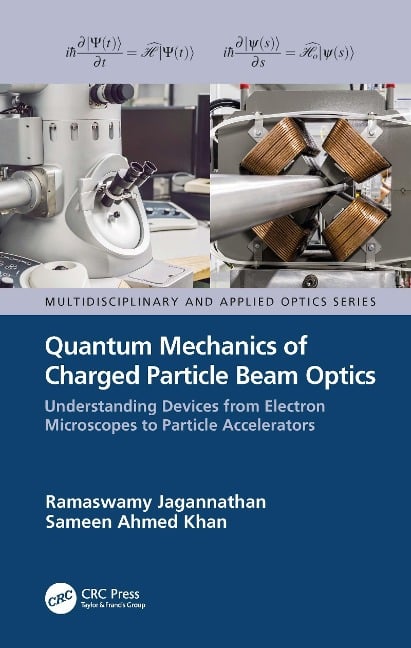
Classical Charged Particle Beam Optics used in the design and operation of all present-day charged particle beam devices, from low energy electron microscopes to high energy particle accelerators, is entirely based on classical mechanics. A question of curiosity is: How is classical charged particle beam optics so successful in practice though the particles of the beam, like electrons, are quantum mechanical? Quantum Mechanics of Charged Particle Beam Optics answers this question with a comprehensive formulation of 'Quantum Charged Particle Beam Optics' applicable to any charged particle beam device.
Professor Ramaswamy Jagannathan retired in 2009 as a senior professor of physics from The Institute of Mathematical Sciences (IMSc), Chennai, India. He is currently an adjunct professor of physics at the Chennai Mathematical Institute (CMI), Chennai. He got his PhD (Theor. Phys.) from the University of Madras, Chennai, India, in 1976, working at IMSc. His PhD work on generalized Clifford algebras was done under the guidance of Professor Alladi Ramakrishnan, the founder director of IMSc known popularly as MATSCIENCE at that time. He has authored/coauthored about 80 research papers in various branches of Physical Mathematics, like Generalized Clifford Algebras and Their Physical Applications, Finite-Dimensional Quantum Mechanics, Applications of Classical Groups, Quantum Groups, Nonlinear Dynamics, Deformed Special Functions, and Quantum Theory of Charged Particle Beam Optics with Applications to Electron Microscopy and Accelerator Optics. In particular, his paper with Professors R. Simon, E. C. G. Sudarshan, and N. Mukunda (1989) on the quantum theory of magnetic electron lenses based on the Dirac equation initiated a systematic study of the Quantum Theory of Charged Particle Beam Optics. This theory was subsequently developed vastly by him and his collaborators (in particular, his PhD student Dr Sameen Ahmed Khan). Dr Sameen Ahmed Khan is an associate professor at the Department of Mathematics and Sciences, College of Arts and Applied Sciences, Dhofar University, Salalah, Sultanate of Oman (http://du.edu.om/). He got his PhD (Theor. Phys.) at the University of Madras, Chennai, India, in 1997. His PhD thesis, done at The Institute of Mathematical Sciences (IMSc), Chennai, under the supervision of Professor Ramaswamy Jagannathan, was on the quantum theory of charged particle beam optics. He did postdoctoral research at INFN, Padova, Italy, and Universidad Nacional Autonoma de Mexico, Cuernavaca, Mexico. He has 16 years of teaching experience in Oman. He has developed a unified treatment of light beam optics and light polarization using quantum methodologies. This formalism describes the beam optics and light polarization from a parent Hamiltonian which is exact and derived from Maxwell's equations. He has authored three books, fifteen book chapters, and about 75 technical publications in journals and proceedings of repute. He has more than 250 publications on science popularization. Dr Sameen is one of the founding members of the Ibn al Haytham LHiSA Light: History, Science, and Applications (LHiSA) International Society set up during the International Year of Light and Light-based Technologies. He is a signatory to six of the reports on the upcoming International Linear Collider.
Introduction. An Introductory Review of Classical Mechanics. An Introductory Review of Quantum Mechanics. An Introduction to Classical Charged Particle Beam Optics. Quantum Charged Particle Beam Optics: Scalar Theory for Spin-0 and Spinless Particles. Quantum Charged Particle Beam Optics: Spinor Theory for Spin- 1/2 Particles. Concluding Remarks and Outlook on Further Development of Quantum Charged Particle Beam Optics
Dieses eBook wird im PDF-Format geliefert und ist mit einem Adobe Kopierschutz (DRM) versehen. Sie können dieses eBook mit allen Geräten lesen, die das PDF-Format und den Adobe Kopierschutz (DRM) unterstützen.
Zum Beispiel mit den folgenden Geräten:
• tolino Reader
Laden Sie das eBook direkt über den Reader-Shop auf dem tolino herunter oder übertragen Sie das eBook auf Ihren tolino mit einer kostenlosen Software wie beispielsweise Adobe Digital Editions.
• Sony Reader & andere eBook Reader
Laden Sie das eBook direkt über den Reader-Shop herunter oder übertragen Sie das eBook mit der kostenlosen Software Sony READER FOR PC/Mac oder Adobe Digital Editions auf ein Standard-Lesegeräte mit epub- und Adobe DRM-Unterstützung.
• Tablets & Smartphones
Möchten Sie dieses eBook auf Ihrem Smartphone oder Tablet lesen, finden Sie hier unsere kostenlose Lese-App für iPhone/iPad und Android Smartphone/Tablets.
• PC & Mac
Lesen Sie das eBook direkt nach dem Herunterladen mit einer kostenlosen Lesesoftware, beispielsweise Adobe Digital Editions, Sony READER FOR PC/Mac oder direkt über Ihre eBook-Bibliothek in Ihrem Konto unter „Meine eBooks“ - „online lesen“.
Schalten Sie das eBook mit Ihrer persönlichen Adobe ID auf bis zu sechs Geräten gleichzeitig frei.
Bitte beachten Sie, dass die Kindle-Geräte das Format nicht unterstützen und dieses eBook somit nicht auf Kindle-Geräten lesbar ist.