Und dann auf "Zum Home-Bildschirm [+]".

Stöbern
genialokal zum Startbildschirm hinzufügen
Installieren Sie die genialokal App auf Ihrem Startbildschirm für einen schnellen Zugriff und eine komfortable Nutzung.
Installieren Sie die genialokal App auf Ihrem Startbildschirm für einen schnellen Zugriff und eine komfortable Nutzung.
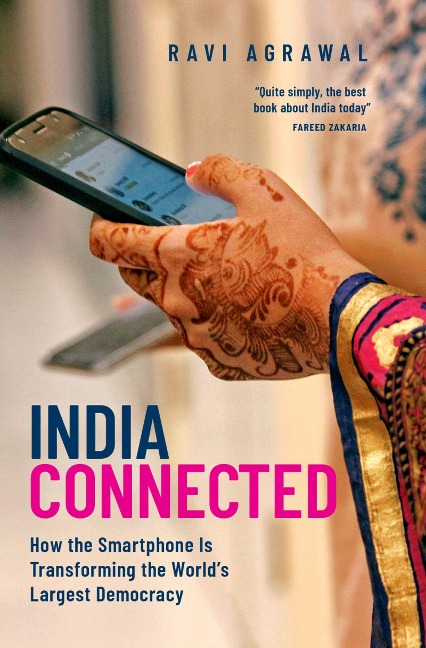
India is connecting at a dizzying pace. In 2000, roughly 20 million Indians had access to the internet. In 2017, 465 million were online, with three new people logging on for the first time every second. By 2020, the country's online community is projected to exceed 700 million; more than a billion Indians are expected to be online by 2025. While users in Western countries progressed steadily over the years from dial-up connections on PCs, to broadband access, wireless, and now 4G data on phones, in India most have leapfrogged straight into the digital world with smartphones and affordable data plans. What effect is all this having on the ancient and traditionally rural culture dominated by family and local customs? Ravi Agrawal explores that very question, seeking out the nexuses of change and those swept up in them. Smartphones now influence arranged marriages, create an extension of one's social identity that moves beyond caste, bring within reach educational opportunities undreamed of a generation ago, bridge linguistic gaps, provide outlets and opportunities for start-ups, and are helping to move the entire Indian economy from cash- to credit-based. The effects are everywhere, and they are transformative. While they offer immediate access to so much for so many, smartphones are creating no utopia in a culture still struggling with poverty, illiteracy, corruption, gender inequality, and income disparity. Internet access has provided greater opportunities to women and altered how India's outcasts interact with the world; it has also made pornography readily available and provided an echo chamber for rumor and prejudice. Under a government determined to control content, it has created tensions. And in a climate of hypernationalism, it has fomented violence and even terrorism. The influence of smartphones on the world's largest democracy is pervasive and irreversible, disruptive and creative, unsettling and compelling. Agrawal's fascinating book gives us the people and places reflecting what the internet hath wrought. India Connected reveals both its staggering dimensions and implications, illuminating how it is affecting the progress of progress itself.
Ravi Agrawal is an award-winning journalist and media executive. He is currently the managing editor of Foreign Policy and previously worked at CNN for over a decade in London, New York, and New Delhi, where he served as the network's India bureau chief. Agrawal was born in London, grew up in Kolkata, and attended college at Harvard. He splits his time between Brooklyn and Washington, DC.
Introduction: The Magic Device Part One: Opportunity 1. Google's Saathi: Women and the Smartphone 2. Hello Macaulay: Fixing Education 3. Missed Call: The Smartphone and Job Creation Part Two: Society 4. Lord Kamadeva's Digital Bow: Dating and Marriage 5. Cyber Sutra: The Internet Is for Porn 6. India's iGen: Growing Up with Nomophobia Part Three: The State 7. Big Brothers: Internet Shutdowns and Internet.org 8. The Great Indian Currency Scramble: Digital Money Conclusion: The Everything Device Acknowledgments Notes Selected Bibliography Index
Dieses eBook wird im PDF-Format geliefert und ist mit einem Adobe Kopierschutz (DRM) versehen. Sie können dieses eBook mit allen Geräten lesen, die das PDF-Format und den Adobe Kopierschutz (DRM) unterstützen.
Zum Beispiel mit den folgenden Geräten:
• tolino Reader
Laden Sie das eBook direkt über den Reader-Shop auf dem tolino herunter oder übertragen Sie das eBook auf Ihren tolino mit einer kostenlosen Software wie beispielsweise Adobe Digital Editions.
• Sony Reader & andere eBook Reader
Laden Sie das eBook direkt über den Reader-Shop herunter oder übertragen Sie das eBook mit der kostenlosen Software Sony READER FOR PC/Mac oder Adobe Digital Editions auf ein Standard-Lesegeräte mit epub- und Adobe DRM-Unterstützung.
• Tablets & Smartphones
Möchten Sie dieses eBook auf Ihrem Smartphone oder Tablet lesen, finden Sie hier unsere kostenlose Lese-App für iPhone/iPad und Android Smartphone/Tablets.
• PC & Mac
Lesen Sie das eBook direkt nach dem Herunterladen mit einer kostenlosen Lesesoftware, beispielsweise Adobe Digital Editions, Sony READER FOR PC/Mac oder direkt über Ihre eBook-Bibliothek in Ihrem Konto unter „Meine eBooks“ - „online lesen“.
Schalten Sie das eBook mit Ihrer persönlichen Adobe ID auf bis zu sechs Geräten gleichzeitig frei.
Bitte beachten Sie, dass die Kindle-Geräte das Format nicht unterstützen und dieses eBook somit nicht auf Kindle-Geräten lesbar ist.