Und dann auf "Zum Home-Bildschirm [+]".

Stöbern
genialokal zum Startbildschirm hinzufügen
Installieren Sie die genialokal App auf Ihrem Startbildschirm für einen schnellen Zugriff und eine komfortable Nutzung.
Installieren Sie die genialokal App auf Ihrem Startbildschirm für einen schnellen Zugriff und eine komfortable Nutzung.
Ihr gewünschter Artikel ist in 0 Buchhandlungen vorrätig - wählen Sie hier eine Buchhandlung in Ihrer Nähe aus:

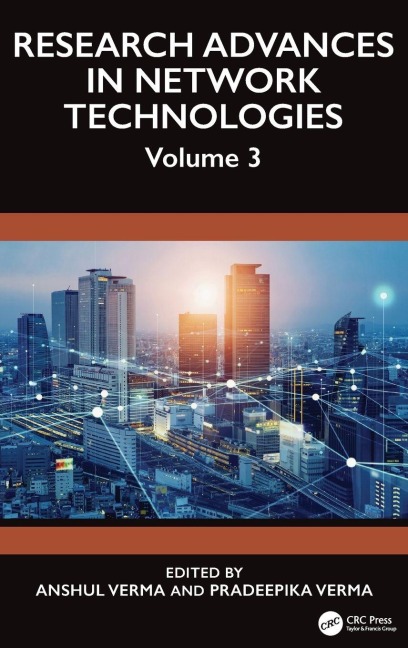
In the digital age, information is the most vital asset and network technologies are the invisible threads that connect our world. From homes and businesses to smart cities and autonomous vehicles, these technologies enable seamless communication, efficient data processing, and intelligent decision-making across a wide range of applications. Research Advances in Network Technologies: Volume 3 offers a comprehensive exploration of modern network technologies, tracing their evolution from traditional wired systems to cutting-edge wireless solutions such as Bluetooth, satellite networks, and the Internet of Things (IoT). The book delves into the transformative impact of software-defined networking, cloud and edge computing, and next-generation cellular technologies like LTE, VoLTE, and 5G. Bridging theory and practice, the book presents real-world case studies, emerging research trends, and future directions in the field. It highlights the contributions of academia and industry in shaping the networked world and addresses the challenges and opportunities that lie ahead. This book: - Explores highly relevant, real-life applications of network technologies across various domains, supported by detailed case studies that illustrate practical implementations and industry use cases - Provides in-depth analysis of current research developments and highlights future directions in network technologies, offering valuable insights for researchers and advanced learners - Presents a balanced mix of theoretical foundations, algorithmic strategies, simulation techniques, and implementation-based research, enabling readers to understand and apply network technologies from multiple perspectives - Adopts a structured approach that caters to both beginners and advanced readers, covering fundamental theories for newcomers and practical simulation and implementation techniques for experienced professionals and researchers This book is intended for academics, researchers, developers, engineers, and practitioners engaged in or interested in the research, design, and applications of modern network technologies. It also serves as a valuable reference for professionals working in the domain of computer and cellular networks, and as a resource for graduate and postgraduate students in computer science and engineering, information technology, and electronics and communication engineering.
Anshul Verma received his M.Tech. and Ph.D. degrees in Computer Science and Engineering from ABV-Indian Institute of Information Technology and Management (IIITM), Gwalior, India. He pursued his postdoctoral research at the Indian Institute of Technology (IIT) Kharagpur, India. He is currently serving as an Assistant Professor in the Department of Computer Science, Institute of Science, Banaras Hindu University (BHU), Varanasi, India, with over 10 years of academic and research experience. Prior to joining BHU, he was associated with the Department of Computer Science and Engineering at Motilal Nehru National Institute of Technology (MNNIT) Allahabad and the National Institute of Technology (NIT) Jamshedpur as a faculty member. His research interests span Cloud Computing, Distributed Systems, Mobile Ad-hoc Networks, and Formal Verification. He has successfully organized four editions of the International Conference on Advanced Network Technologies and Intelligent Computing (ANTIC) as General Chair and Convener since 2021. He has published extensively in renowned journals, books, and conferences. He is currently leading three externally funded and three institutionally funded research projects as Principal Investigator/Co-Principal Investigator. He also contributes actively to the academic publishing community, serving as an Associate Editor of the Journal of Scientific Research of the Banaras Hindu University and as an Editorial Board Member of Scientific Reports of Springer. Pradeepika Verma received her Ph.D. degree in Computer Science and Engineering from the Indian Institute of Technology (ISM) Dhanbad, India. She has received M.Tech in Computer Science and Engineering from Banasthali University, Rajasthan, India. Currently, she is working as a Faculty Fellow in Technical Innovation Hub at Indian Institute of Technology, Patna, India. She has worked as a Post-Doctoral Fellow in Department of Computer Science and Engineering at Indian Institute of Technology (BHU), Varanasi, India. She has also worked as an Assistant Professor in the Department of Computer Science and Engineering at Pranveer Singh Institute of Technology, Kanpur, India, and as a Faculty Member in the Department of Computer Application at the Institute of Engineering and Technology, Lucknow, India. Her current research interests include Natural Language Processing, Optimization Approaches, Artificial Intelligence, Cloud Computing, and Distributed Systems.
1. A Novel Technique for Security Augmentation of Cryptographic Algorithms, 2. IoT Smart Parking System Using ESP32, 3. Multi-Chain NFTs: A Secure and Sustainable Approach to Interoperability in Blockchain, 4. IoT-Driven Autonomous Sowing Robot for Sustainable and Scalable Crop Production, 5. Aerial Data Protection Using Blockchain for UAV Communication, 6. A Blockchain-Integrated Framework for IoV Systems and Autonomous Driving, 7. Streamlined NDN Routing with Regular Expression: Filtering and Traffic Efficiency, 8. Mule Trace: An AI-Driven Model for Detecting Illicit Bank Accounts and Payment Wallets, 9. Intelligent Road Lane-Lines Detection in Real Time for Advanced Driving Assistance Systems, 10. Dynamic Edge Offloading for Congestion Control in Massive Machine-Type Communications, 11. Intelligent Architecture for Data-Driven Network Traffic Prediction and Adaptive Bandwidth Optimization, 12. ProtectSIGN: Detection and Anonymization of Sensitive Non-Biometric Identifiers in Publicly Accessible Multimedia Documents, 13. Advanced Threat Detection Using Deep Learning, 14. PolyCode Studio: A Scalable and Secure Cloud- Based Compiler, 15. A Comparative Study of Code-Based Asymmetric Encryption Frameworks for Post Quantum Communication, 16. Empowering Kubernetes with Artificial Intelligence and Deep Learning for Scalable Cloud and Edge Computing, 17. Choosing Appropriate Data Structure for E-Commerce Platforms, 18. Intelligent Edge-Computing Framework for Real-Time Environmental Monitoring, 19. A Comparative Analysis of Continuous Integration/Continuous Deployment Optimization Techniques: Enhancing DevOps Pipeline Efficiency through Modern Practices, 20. Simulation-Based Analysis of Interoperability, Integration, and Management in Smart Device Networks, 21. Quadratically Fast Searching in Quantum Computation: An Overview, 22. Intelligent IoT Healthcare Infrastructure Using HIPCARE Algorithm and Artificial Intelligence Innovations, 23. Reliable and Efficient Data Transmission in Body Area Networks with Context-Aware Hybrid Secure Routing, 24. Autonomous Resource Orchestration Using Multi-Agent Proximal Policy Optimization in 6G Edge-Fog Environments, 25. Quantum-Powered Cryptographic Enhancements through Hybrid Approaches in Network Security