Und dann auf "Zum Home-Bildschirm [+]".

Stöbern
genialokal zum Startbildschirm hinzufügen
Installieren Sie die genialokal App auf Ihrem Startbildschirm für einen schnellen Zugriff und eine komfortable Nutzung.
Installieren Sie die genialokal App auf Ihrem Startbildschirm für einen schnellen Zugriff und eine komfortable Nutzung.
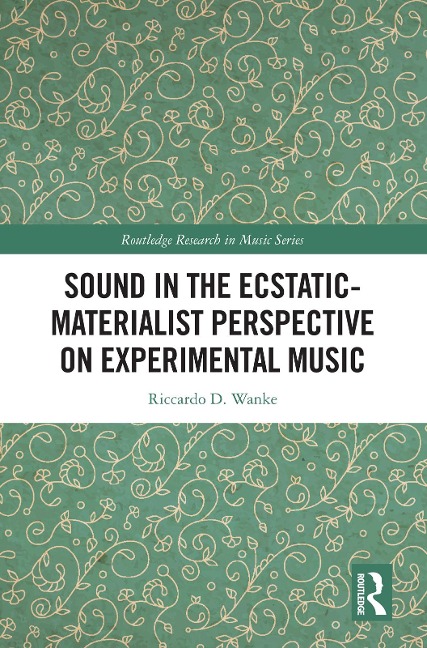
What does a one hour contemporary orchestral piece by Georg Friedrich Haas have in common with a series of glitch-noise electronic tracks by Pan Sonic? This book proposes that, despite their differences, they share a particular understanding of sound that is found across several quite distinct genres of contemporary art music: the ecstatic-materialist perspective. Sound in the ecstatic-materialist perspective is considered as a material mass or element, unfolding in time, encountered by a listener, for whom the experience of that sound exceeds the purely sonic without becoming entirely divorced from its materiality. It is "material" by virtue of the focus on the texture, consistency, and density of sound; it is "ecstatic" in the etymological sense, that is to say that the experience of this sound involves an instability; an inclination to depart from material appearance, an ephemeral and transitory impulse in the very perception of sound to something beyond - but still related to - it. By examining musical pieces from spectralism to electroacoustic domains, from minimalism to glitch electronica and dubstep, this book identifies the key intrinsic characteristics of this musical perspective. To fully account for this perspective on sonic experience, listener feedback and interviews with composers and performers are also incorporated. Sound in the ecstatic-materialist perspective is the common territory where composers, sound artists, performers, and listeners converge.
Riccardo D. Wanke is musician, academic, and member of the Centre for the Study of Sociology and Aesthetics of Music at NOVA University of Lisbon, Portugal. His interests cover experimental music, sound perception, and electronic sound manipulation. He has performed live worldwide and published for international labels.
Introduction A multifaceted approach Overview Remarks and limitations Notes 1 Sound in 20th-century music Scelsi and the centrality of sound Key aspects of sound in the ecstatic-materialist perspective From music to sound From the beginning of the century up to 1980: a plural emancipation Spectral line Minimalist line Musique concrète and avant-garde lines From the 1980s onwards: a non-linear expansion Sonic map Case studies: selection of pieces Closing remarks Notes 2 Morphology and structure of musical works Starting points of the analysis Sequential method Step 1: Identification of common characteristics and morphologies Step 2: Identification of common developments (unfolding structures) Results Low-level attributes (A) An expanded spectrum (B) Microtonal variations (C) Systematic glissandi (D) Rhythmic development (E) Static masses (F) Repetitive clusters (G) Dynamic and timbric contrasts High-level attributes (H) Hypnotic reiterations (I) A plastic and sculptural arrangement of sound (J) Restricted number of elements conceived globally (K) Limited dialectic among elements (L) Sonic challenges (M) Micro-/macroconstructions Specific piece: in vain Perceptual grammar Closing remarks Notes 3 Listening Listening to experimental music The experimental music blind spot in studies on musical perception The auditory process of E-M music Early-stage perception Late-stage perception Listening survey Results Music training discrimination Cross-genre connections Modes of listening The internal-external immanent domain Towards a multifaceted listening mode The aesthetic attitude Closing remarks Notes 4 Composers and performers Dialogues Musical contexts and genres Perception and the space of listening Compositional practice Sound and time Closing remarks Notes 5 The ecstatic-materialist perspective The ecstatic and the materialist Phenomenological materiality: the imprint of sound Ecstatic potential: sound-as-trace External-internal Sound in the ecstatic-materialist perspective Unity Unstable presence Coherence and convergence Personality and intention Intimate temporality and repetition Space-matter: the materiality of space in sound Vertical time: the ecstatic potential of space-matter Musical communication Closing remarks Notes 6 Going beyond sound-in-itself The conceptual and the sensorial-perceptual paradigms Sonic materialism and the philosophical debate around sound The materiality of the ecstatic-materialist perspective The proximal hypothesis: the material presence of space-matter The embodied cognitive level Going beyond sound through sound Notes 7 Epilogue: The ecstatic-materialist perspective in context The ecstatic-materialist context Empowered listening Closing remarks Notes Discography Bibliography Glossary Index
Dieses eBook wird im PDF-Format geliefert und ist mit einem Adobe Kopierschutz (DRM) versehen. Sie können dieses eBook mit allen Geräten lesen, die das PDF-Format und den Adobe Kopierschutz (DRM) unterstützen.
Zum Beispiel mit den folgenden Geräten:
• tolino Reader
Laden Sie das eBook direkt über den Reader-Shop auf dem tolino herunter oder übertragen Sie das eBook auf Ihren tolino mit einer kostenlosen Software wie beispielsweise Adobe Digital Editions.
• Sony Reader & andere eBook Reader
Laden Sie das eBook direkt über den Reader-Shop herunter oder übertragen Sie das eBook mit der kostenlosen Software Sony READER FOR PC/Mac oder Adobe Digital Editions auf ein Standard-Lesegeräte mit epub- und Adobe DRM-Unterstützung.
• Tablets & Smartphones
Möchten Sie dieses eBook auf Ihrem Smartphone oder Tablet lesen, finden Sie hier unsere kostenlose Lese-App für iPhone/iPad und Android Smartphone/Tablets.
• PC & Mac
Lesen Sie das eBook direkt nach dem Herunterladen mit einer kostenlosen Lesesoftware, beispielsweise Adobe Digital Editions, Sony READER FOR PC/Mac oder direkt über Ihre eBook-Bibliothek in Ihrem Konto unter „Meine eBooks“ - „online lesen“.
Schalten Sie das eBook mit Ihrer persönlichen Adobe ID auf bis zu sechs Geräten gleichzeitig frei.
Bitte beachten Sie, dass die Kindle-Geräte das Format nicht unterstützen und dieses eBook somit nicht auf Kindle-Geräten lesbar ist.