Und dann auf "Zum Home-Bildschirm [+]".

Stöbern
genialokal zum Startbildschirm hinzufügen
Installieren Sie die genialokal App auf Ihrem Startbildschirm für einen schnellen Zugriff und eine komfortable Nutzung.
Installieren Sie die genialokal App auf Ihrem Startbildschirm für einen schnellen Zugriff und eine komfortable Nutzung.
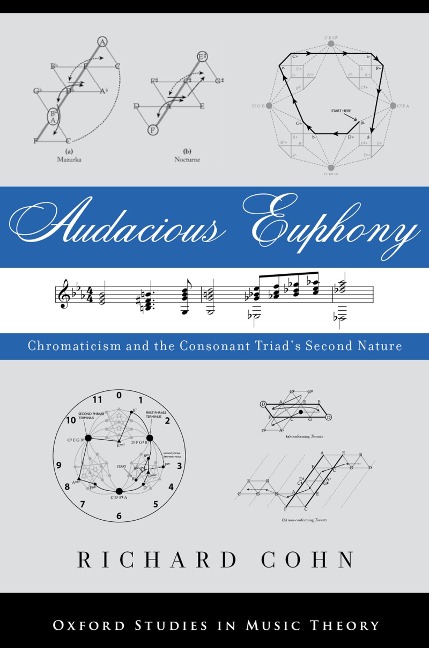
Music theorists have long believed that 19th-century triadic progressions idiomatically extend the diatonic syntax of 18th-century classical tonality, and have accordingly unified the two repertories under a single mode of representation. Post-structuralist musicologists have challenged this belief, advancing the view that many romantic triadic progressions exceed the reach of classical syntax and are mobilized as the result of a transgressive, anti-syntactic impulse. In Audacious Euphony, author Richard Cohn takes both of these views to task, arguing that romantic harmony operates under syntactic principles distinct from those that underlie classical tonality, but no less susceptible to systematic definition. Charting this alternative triadic syntax, Cohn reconceives what consonant triads are, and how they relate to one another. In doing so, he shows that major and minor triads have two distinct natures: one based on their acoustic properties, and the other on their ability to voice-lead smoothly to each other in the chromatic universe. Whereas their acoustic nature underlies the diatonic tonality of the classical tradition, their voice-leading properties are optimized by the pan-triadic progressions characteristic of the 19th century. Audacious Euphony develops a set of inter-related maps that organize intuitions about triadic proximity as seen through the lens of voice-leading proximity, using various geometries related to the 19th-century Tonnetz. This model leads to cogent analyses both of particular compositions and of historical trends across the long nineteenth century. Essential reading for music theorists, Audacious Euphony is also a valuable resource for music historians, performers and composers.
Richard Cohn is Battell Professor of Music Theory at Yale University. His work on chromatic harmony has been the topic of a series of summer seminars convened by the late John Clough, and has been developed in about a dozen doctoral dissertations, at Chicago, Indiana, Yale, Harvard, and SUNY-Buffalo. His articles have twice earned the Society for Music Theory's Outstanding Publication Award. Cohn edits the Oxford Studies in Music Theory series. In preparation is a general model of meter with applications for European, African, and African-diasporic music, and a co-edited collection on David Lewin's phenomenological writings.
Table of Contents 1. Mapping the Triadic Universe Three Methods for Calculating Triadic Distance Triads in Chromatic Space Remarks on Syntax and Maps 2. Hexatonic Cycles: A First Preliminary Model of Triadic Space A Minimal-Work Model of the Triadic Universe The Hexatonic Trance Contrary Motion and Balance Hexatonic Progressions, Tonnetz Representations, and Voice-Leading Transformations Near Evenness, Minimal Voice Leading, and the Central Role of the Augmented Triad Remarks on Dualism Triadic Structure Generates Pan-Triadic Syntax Triads are Homophonous Diamorphs 3. Reciprocity The Historical Emergence of Augmented Triads Consonance/Dissonance Reciprocity Two Early-Century Examples: Beethoven and Schubert Three Late-Century Examples: Liszt, Rimsky-Korsakov, Fauré Reciprocity in Weitzmann's Der Ubermässige Dreiklang 4. Weitzmann Regions: A Second Preliminary Model of Triadic Space The Structure of a Weitzmann Region Weitzmann Transformations and N/R Cycles Remarks on the Tonnetz Historical Origins of Weitzmann Regions The Double-Agent Complex Expanded N/R Chains Weitzmann Regions without Sequences: Wagner and Strauss 5. A Unified Model of Pan-Triadic Space How Hexatonic and Weitzmann Regions Interact Chromatic Sequences Transformational Substitutions Voice Leading Zones Remarks on Disjunction and Entropy 6. Navigating the Triadic Universe: Three Scripts Neighborhoods and Pitch-Retention Loops Departure Þ Return Scripts Continuous Upshifts 7. Integrating Dissonant Harmonies into the Model Four Eighteenth-century Approaches to Dissonance Reduction to a Triadic Subset Hexatonic Poles in Parsifal The Tristan Genus as Nearly-Even Tetrachord Circumnavigating the Tristan-Genus Universe Scriabin's Mystic Species and Generalized Weitzmann Regions 8. Syntactic Interaction and the Convertible Tonnetz Some Previous Proposals The Diatonic Tonnetz Horizontal Extensions Vertical Extensions The Convertible Tonnetz Two Analytical Vignettes: Wagner and Brahms 9. Double Syntax and the Soft Revolution A Summary Example from Schubert Double Syntax and its Skeptics Code Switching and Double Determination Cognitive Opacity The Soft Revolution On Musical Overdetermination
Dieses eBook wird im PDF-Format geliefert und ist mit einem Adobe Kopierschutz (DRM) versehen. Sie können dieses eBook mit allen Geräten lesen, die das PDF-Format und den Adobe Kopierschutz (DRM) unterstützen.
Zum Beispiel mit den folgenden Geräten:
• tolino Reader
Laden Sie das eBook direkt über den Reader-Shop auf dem tolino herunter oder übertragen Sie das eBook auf Ihren tolino mit einer kostenlosen Software wie beispielsweise Adobe Digital Editions.
• Sony Reader & andere eBook Reader
Laden Sie das eBook direkt über den Reader-Shop herunter oder übertragen Sie das eBook mit der kostenlosen Software Sony READER FOR PC/Mac oder Adobe Digital Editions auf ein Standard-Lesegeräte mit epub- und Adobe DRM-Unterstützung.
• Tablets & Smartphones
Möchten Sie dieses eBook auf Ihrem Smartphone oder Tablet lesen, finden Sie hier unsere kostenlose Lese-App für iPhone/iPad und Android Smartphone/Tablets.
• PC & Mac
Lesen Sie das eBook direkt nach dem Herunterladen mit einer kostenlosen Lesesoftware, beispielsweise Adobe Digital Editions, Sony READER FOR PC/Mac oder direkt über Ihre eBook-Bibliothek in Ihrem Konto unter „Meine eBooks“ - „online lesen“.
Schalten Sie das eBook mit Ihrer persönlichen Adobe ID auf bis zu sechs Geräten gleichzeitig frei.
Bitte beachten Sie, dass die Kindle-Geräte das Format nicht unterstützen und dieses eBook somit nicht auf Kindle-Geräten lesbar ist.