Und dann auf "Zum Home-Bildschirm [+]".

Stöbern
genialokal zum Startbildschirm hinzufügen
Installieren Sie die genialokal App auf Ihrem Startbildschirm für einen schnellen Zugriff und eine komfortable Nutzung.
Installieren Sie die genialokal App auf Ihrem Startbildschirm für einen schnellen Zugriff und eine komfortable Nutzung.

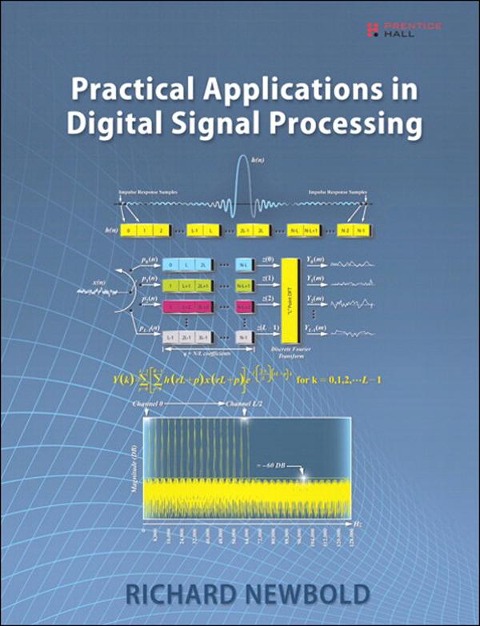
The Only DSP Book 100% Focused on Step-by-Step Design and Implementation of Real Devices and Systems in Hardware and Software Practical Applications in Digital Signal Processing is the first DSP title to address the area that even the excellent engineering textbooks of today tend to omit. This book fills a large portion of that omission by addressing circuits and system applications that most design engineers encounter in the modern signal processing industry. This book includes original work in the areas of Digital Data Locked Loops (DLLs), Digital Automatic Gain Control (dAGC), and the design of fast elastic store memory used for synchronizing independently clocked asynchronous data bit streams. It also contains detailed design discussions on Cascaded Integrator Comb (CIC) filters, including the seldom-covered topic of bit pruning. Other topics not extensively covered in other modern textbooks, but detailed here, include analog and digital signal tuning, complex-to-real conversion, the design of digital channelizers, and the techniques of digital frequency synthesis. This book also contains an appendix devoted to the techniques of writing mixed-language C\C++ Fortran programs. Finally, this book contains very extensive review material covering important engineering mathematical tools such as the Fourier series, the Fourier transform, the z transform, and complex variables. Features of this book include . Thorough coverage of the complex-to-real conversion of digital signals . A complete tutorial on digital frequency synthesis . Lengthy discussion of analog and digital tuning and signal translation . Detailed coverage of the design of elastic store memory . A comprehensive study of the design of digital data locked loops . Complete coverage of the design of digital channelizers . A detailed treatment on the design of digital automatic gain control . Detailed techniques for the design of digital and multirate filters . Extensive coverage of the CIC filter, including the topic of bit pruning . An extensive review of complex variables . An extensive review of the Fourier series, and continuous and discrete Fourier transforms . An extensive review of the z transform
Richard Newbold has been a digital hardware design engineer for more than thirty years. His designs have included special-purpose signal processing computers and systems, multirate filters, direct sequence spread spectrum processors, high-speed gallium arsenide ASIC design, wideband channelizers, fault-tolerant signal processors, adaptive beam forming, data lock loops, multirate PCM processing, adaptive filters, tuners, frequency synthesizers, digital automatic gain control, and much more. His practical design experience encompasses every topic covered in this text.
Preface xiii Acknowledgments xxi About the Author xxiii Chapter 1: Review of Digital Frequency 1 1.1 Definitions 2 1.2 Defining Digital Frequencies 2 1.3 Mathematical Representation of Digital Frequencies 9 1.4 Normalized Frequency 12 1.5 Representation of Digital Frequencies 13 Chapter 2: Review of Complex Variables 15 2.1 Cartesian Form of Complex Numbers 17 2.2 Polar Form of Complex Numbers 21 2.3 Roots of Complex Numbers 27 2.4 Absolute Value of Complex Numbers 35 2.5 Exponential Form of Complex Numbers 36 2.6 Graphs of the Complex Variable z 38 2.7 Limits 40 2.8 Analytic Functions 41 2.9 Singularity 42 2.10 Entire Functions 42 2.11 The Complex Number 42 2.12 Complex Differentiation 43 2.13 Cauchy-Riemann Equations 47 2.14 Simply Connected Region 51 2.15 Contours 51 2.16 Line Integrals 52 2.17 Real Line Integrals 54 2.18 Complex Line Integrals 84 2.19 Cauchy's Theorem 96 2.20 Table of Common Integrals 109 2.21 Cauchy's Integral 109 2.22 Residue Theory 120 2.23 References 127 Chapter 3: Review of the Fourier Transform 129 3.1 A Brief Review of the Fourier Series 129 3.2 A Brief Review of the Fourier Transform 157 3.3 Review of the Discrete Fourier Transform (DFT) 187 3.4 DFT Processing Gain 254 3.5 Example DFT Signal Processing Application 261 3.6 Discrete Time Fourier Transform (DTFT) 263 3.7 Fast Fourier Transform (FFT) 267 3.8 References 268 Chapter 4: Review of the Z-Transform 271 4.1 Complex Number Representation 271 4.2 Mechanics of the Z-Transform 274 4.3 Left-Sided Z-Transform 277 4.4 Right-Sided Z-Transform 278 4.5 Two-Sided Z-Transform 278 4.6 Convergence of the Z-Transform 279 4.7 System Stability 290 4.8 Properties of the Z-Transform 292 4.9 Common Z-Transform Pairs 304 4.10 Inverse Z-Transform 308 4.11 Pole and Zero Standard Form Plug-In Equations 334 4.12 Applications of the Z-Transform 350 4.13 Summary of Useful Equations 380 4.14 References 381 Chapter 5: Finite Impulse Response Digital Filtering 383 5.1 Review of Digital FIR Filters 384 5.2 Parks-McClellan Method of FIR Filter Design 392 5.3 PM Implementation of Half Band Filters 425 5.4 References 433 Chapter 6: Multirate Finite Impulse Response Filter Design 435 6.1 Poly Phase Filter (PPF) 436 6.2 Half Band Filter 465 6.3 Cascaded Integrator Comb (CIC) Filter 470 6.4 References 531 Chapter 7: Complex to Real Conversion 533 7.1 A Typical Digital Signal Processing (DSP) System 534 7.2 Conversion of a Complex Signal to a Real Signal 540 7.3 Complex to Real Simulation Results 560 7.4 Reference 573 Chapter 8: Digital Frequency Synthesis 575 8.1 Numerically Controlled Oscillator (NCO) 575 8.2 Enhanced NCO Phase Accumulator 608 8.3 NCO Synthesized Output Frequency Error 613 8.4 Adding a Programmable Phase Offset to the NCO Output 622 8.5 Design of an Industry-Grade NCO 628 8.6 NCO Phase Dither 641 8.7 References 644 Chapter 9: Signal Tuning 645 9.1 Continuous Time (Analog) Fourier Transform 647 9.2 Discrete Time (Digital) Fourier Transform 689 9.3 Useful Equations 754 9.4 References 759 Chapter 10: Elastic Store Memory 761 10.1 Example Application of an Elastic Store Memory 762 10.2 PCM Multiplexing Hierarchy 763 10.3 DS-1C Multiplexer Design Overview 768 10.4 Design of the Elastic Store Memory 774 10.5 Hardware Implementation of the Elastic Store Memory 792 10.6 Overall DS-1C Multiplexer Design Block Diagram 801 10.7 Additional Information 803 10.8 References 805 Chapter 11: Digital Data Locked Loops 807 11.1 Digital Data Locked Design 808 11.2 Digital Data Locked Steady State Behavior 829 11.3 Digital Data Locked Transient Behavior 834 11.4 Data Locked Loop Bit-Level Simulation 845 11.5 Engineering Note 869 11.6 Summary of Useful Equations 869 11.7 References 871 Chapter 12: Channelized Filter Bank 873 12.1 Introductory Description 873 12.2 Channelizer Functional Overview 877 12.3 Channelizer Detailed Design Concepts 919 12.4 Channelizer Software Simulation Results 962 12.5 Channelizer Hardware Design Example 967 12.6 Summary of Useful Equations 974 12.7 References 975 Chapter 13: Digital Automatic Gain Control 977 13.1 Design of a Type I RMS AGC Circuit 981 13.2 Design of a Type II RMS AGC Circuit 1044 13.3 References 1047 Appendix A: Mixed Language C/C++ FORTRAN Programming 1049 A.1 Writing a C/C++ Main Program 1051 A.2 Calling Subroutines and Functions from a C/C++ Main 1051 A.3 Writing a FORTRAN Subroutine 1054 A.4 Writing a FORTRAN Function 1055 A.5 Passing Integer Arguments 1055 A.6 Passing Floating Point Arguments 1057 A.7 Passing Array Arguments 1059 A.8 Passing Pointer Arguments 1060 A.9 Compile/Link Mixed Language C/C++ FORTRAN Programs 1063 A.10 Parks-McClellan FORTRAN Subroutine Called from C Main 1064 A.11 References 1091 Index 1093