Und dann auf "Zum Home-Bildschirm [+]".

Stöbern
genialokal zum Startbildschirm hinzufügen
Installieren Sie die genialokal App auf Ihrem Startbildschirm für einen schnellen Zugriff und eine komfortable Nutzung.
Installieren Sie die genialokal App auf Ihrem Startbildschirm für einen schnellen Zugriff und eine komfortable Nutzung.
Ihr gewünschter Artikel ist in 0 Buchhandlungen vorrätig - wählen Sie hier eine Buchhandlung in Ihrer Nähe aus:

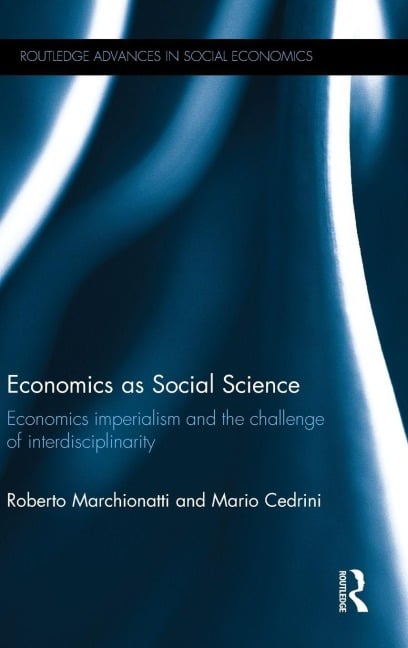
This book focuses on a territory that persists to be largely intractable using the postulates of economics: that of primitive societies. In retracing the origins of economics imperialism back to the birth of the discipline, this volume argues that it offers a reductionist interpretation that is poor in interpretative power. By engaging with the neglected traditions of sociological and anthropological studies, the analysis offers suggestions for a more democratic cooperation between the social sciences.
Roberto Marchionatti is Professor of Economics at the University of Torino, Italy, where he teaches economics, history of economic theory and economic anthropology. Mario Cedrini is Assistant Professor of Economics at the University of Turin, Italy, where he teaches macroeconomics, international economics, history of economic thought and economic anthropology.
INTRODUCTION PART I AT THE ROOTS OF ECONOMICS IMPERIALISM. CLASSICAL AND NEOCLASSICAL ECONOMICS AND THE ISSUE OF PRIMITIVE SOCIETIES1 The distant origins of economics imperialism. Classical economists and primitive societies2 Economics imperialism revealed. Neoclassical economists and the primitive man3 Primitive society in the interpretation of classical and neoclassical economics: a common modelPART II ECONOMICS AND THE CHALLENGE OF PRIMITIVE SOCIETIES: ANTHROPOLOGICAL NON-FORMALIST APPROACHES4 The primitive system of gift-exchange discovered: Marcel Mauss's Essai sur le don 5 The substantivist perspective on the role of the economy in societies: Karl Polanyi's and Marshall Sahlins's contributions6 The intelligibility of primitive economic organization: Sahlins, Lévi-Strauss and Clastres on Mauss's political philosophyPART III THE PROBLEM OF THE 'OTHER': ECONOMICS AND UNSELFISH BEHAVIOR 7 Economics on altruism, giving and reciprocity 8 A unified framework for behavioral sciences? On Herbert Gintis's proposalPART IV THE THEORETICAL AND PRACTICAL RELEVANCE OF MAUSS'S GIFT TO THE DEVELOPMENT OF A NON-IMPERIALIST ECONOMICS9 The gift in social sciences10 Mauss's research programme revisited: the Mouvement anti-utilitariste dans les sciences sociales (M.A.U.S.S.)11 A new Maussian perspective in economicsCONCLUSIONS