Und dann auf "Zum Home-Bildschirm [+]".

Stöbern
genialokal zum Startbildschirm hinzufügen
Installieren Sie die genialokal App auf Ihrem Startbildschirm für einen schnellen Zugriff und eine komfortable Nutzung.
Installieren Sie die genialokal App auf Ihrem Startbildschirm für einen schnellen Zugriff und eine komfortable Nutzung.
Ihr gewünschter Artikel ist in 0 Buchhandlungen vorrätig - wählen Sie hier eine Buchhandlung in Ihrer Nähe aus:

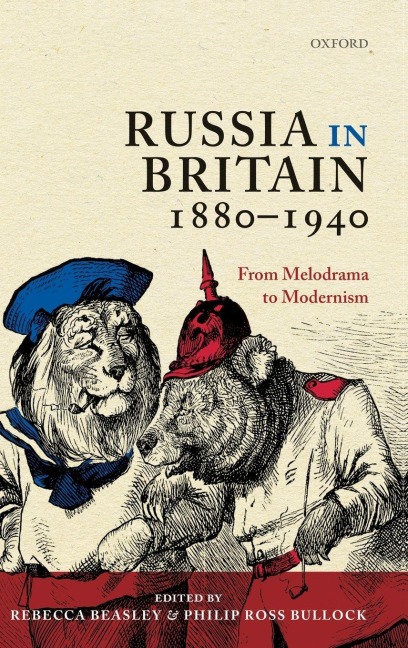
Russia in Britain offers the first comprehensive account of the breadth and depth of the British fascination with Russian and Soviet culture, tracing its transformative effect on British intellectual life from the 188s, the decade which saw the first sustained interest in Russian literature, to 194, the eve of the Soviet Union's entry into the Second World War. By focusing on the role played by institutions, disciplines and groups, libraries, periodicals, government agencies, concert halls, publishing houses, theatres, and film societies, this collection marks an important departure from standard literary critical narratives, which have tended to highlight the role of a small number of individuals, notably Sergei Diaghilev, Constance Garnett, Theodore Komisarjevsky, Katherine Mansfield, George Bernard Shaw and Virginia Woolf. Drawing on recent research and newly available archives, Russia in Britain shifts attention from individual figures to the networks within which they operated, and uncovers the variety of forces that enabled and structured the British engagement with Russian culture. The resulting narrative maps an intricate pattern of interdisciplinary relations and provides the foundational research for a new understanding of Anglo-Russian/Soviet interaction. In this, it makes a major contribution to the current debates about transnationalism, cosmopolitanism and 'global modernisms' that are reshaping our knowledge of nineteenth- and early twentieth-century British culture.
Rebecca Beasley is Tutorial Fellow in English at The Queen's College, Oxford, and University Lecturer in English at the University of Oxford. She is the author of Ezra Pound and the Visual Culture of Modernism (Cambridge University Press, 2007) and Theorists of Modernist Poetry (Routledge, 2007), and is currently working on a book-length study of the impact of Russian culture on British literary modernism. She has also published essays on modernism and translation, the British 'intelligentsia', and the history of comparative literature.
Philip Ross Bullock is Tutorial Fellow in Russian at Wadham College, Oxford, and University Lecturer in Russian at the University of Oxford. He is the author of The Feminine in the Prose of Andrey Platonov (Legenda, 2005), and Rosa Newmarch and Russian Music in Late Nineteenth and Early Twentieth-Century England (Royal Musical Association Monographs/ Ashgate, 2009), the first book-length study of Newmarch, and of the Edwardian discovery of Russian music more generally. He has published an annotated edition of the letters of Newmarch and Jean Sibelius. He has also written about questions of translation and reception in Russia and Britain, the influence of Walter Pater on Isaak Babel, Soviet translations of Oscar Wilde, and nineteenth-century Russian reactions to Darwin.
Introduction
"For God, for Tsar, and for Fatherland!" Russians on the British Stage from Napoleon to the Great War
Oscar Wilde's Vera; or The Nihilists
Britain and the International Tolstoyan Movement
The Free Russian Library in London, 1898-1917
'Avert Your Eyes and Hold Your Noses': Non-Chekhovian Russian and Soviet Drama on the British Stage, 1900-1940
Tsar's Hall: Russian Music in London, 1895-1926
Le Sacre du printemps in London: The Politics of Embodied Freedom in Early Modern Dance and Suffragette Protest
Russian Aesthetics in Britain: Kandinsky, Sadleir, and Rhythm'
Reading Russian: Russian Studies and the Literary Canon
The Translation of Soviet Literature: John Rodker and PresLit
Russia and the British Intellectuals: The Significance of the Stalin-Wells Talk
British Film Culture and Soviet Cinema
Soviet Films and British intelligence in the 1930s: The Case of Kino Films and MI5
Afterword: A Time and a Place for Everything: On Russia, Britain, and Being Modern