Und dann auf "Zum Home-Bildschirm [+]".

Stöbern
genialokal zum Startbildschirm hinzufügen
Installieren Sie die genialokal App auf Ihrem Startbildschirm für einen schnellen Zugriff und eine komfortable Nutzung.
Installieren Sie die genialokal App auf Ihrem Startbildschirm für einen schnellen Zugriff und eine komfortable Nutzung.
Ihr gewünschter Artikel ist in 0 Buchhandlungen vorrätig - wählen Sie hier eine Buchhandlung in Ihrer Nähe aus:

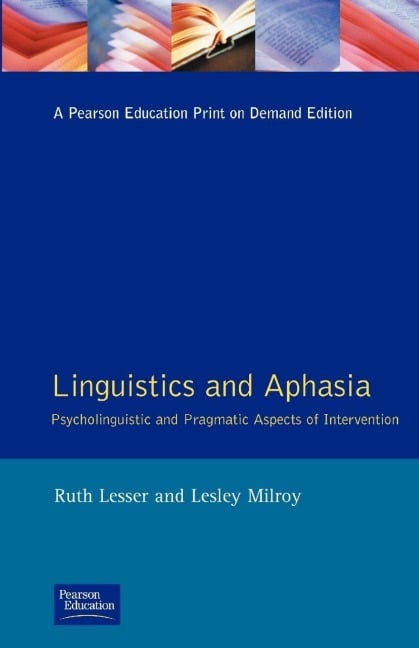
Linguistics and Aphasia is a major study of recent developments in applying psycholinguistics and pragmatics to the study of acquired language disorders (aphasia) and their remediation.
Psycholinguistic analyses of aphasia interpret disorders in terms of damaged modules and processes within what was once a normal language system. These analyses have progressed to the point that they now routinely provide a model-based rationalefor planning patient therapy. Through a series of case studies, the authors show how the psycholinguistic analysis of aphasia can be assessed for its effectiveness in clinical practice.
Pragmatic approaches to the study of aphasia are of more recent origin. Ruth Lesser and Lesley Milroy evaluate their considerable significance to the study of aphasia and their relevance to practical issues of diagnosis and treatment. Controversial analysis, in particular, offers a fruitful and productive framework within which to assess the functional adequacy of the language used by aphasic speakers in everyday contexts.
Ruth Lesser is Emeritus Professor at Newcastle University. Lesley Milroy is Visiting Professor at University of York and Professor Emerita at the University of Michigan.
General Editor's Preface Transcription conventions Part I: Background 1. Introduction 2. Aphasia - the clinical background Part II: Models and Methods 3. Applying linguistics in aphasia research and therapy 4. Psycholinguistic models, lexical processing 5. Psycholinguistic models, sentence processing 6. Pragmatics, theoretical issues 7. Coherence in discourse 8. The structure of conversation 9. Conversation as a collaborative achievement: some conversational management procedures Part III: Implications and Applications 10. Applying psycholinguistics to intervention: some preliminary considerations 11. Applying psycholinguistics to intervention: some clinical studies 12. Applying pragmatics in intervention 13. Contrast and complement: some concluding remarks References Index