Und dann auf "Zum Home-Bildschirm [+]".

Stöbern
genialokal zum Startbildschirm hinzufügen
Installieren Sie die genialokal App auf Ihrem Startbildschirm für einen schnellen Zugriff und eine komfortable Nutzung.
Installieren Sie die genialokal App auf Ihrem Startbildschirm für einen schnellen Zugriff und eine komfortable Nutzung.
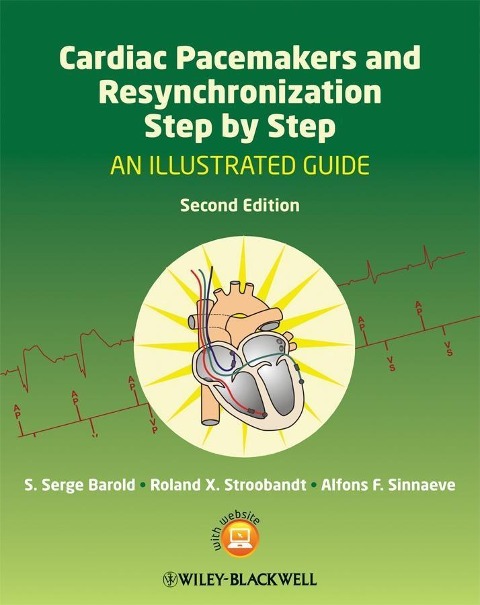
This new edition of the bestselling step-by-step introduction to cardiac pacemakers now includes additional material on CRT and an accompanying website. It retains the effective use of full-page illustrations and short explanations that gained the book such enormous popularity and now provides information on recent advances in cardiac pacing, including biventricular pacing for the treatment of heart failure.
S. Serge Barold, University of South Florida College of Medicine, Tampa, FL, USA Roland X. Stroobandt Alfons F. Sinnaeve
Preface to the first edition. Preface to the second edition. Abbreviations. Color Plate Section. What is a pacemaker? Recording pacemaker activity. Fundamentals of electricity. Ventricular stimulation. Pacing leads. Sensing - basic concepts. Sensing - advanced concepts. Basic pacemaker electrocardiography. Other single chamber pacemakers. DDD pacemakers - basic functions. DDD pacemakers - upper rate response. Atrioventricular interval. Retrograde ventriculoatrial synchrony in dual chamberpacemakers. All dual chamber pacemakers function in the DDD mode. Types of lower rate timing. Atrial capture. Automatic mode switching. Pacemaker radiography. Oversensing. Troubleshooting. Pacemaker hemodynamics and rate-adaptive pacing. Pacemaker tachycardias - Part 1. Pacemaker tachycardias - Part 2. Treatment of tachycardia. Pacemaker interference. Pacemaker follow-up. Remote pacemaker monitoring. Special functions. Biventricular pacing and cardiac resynchronization. Conclusion. Text: Overview of cardiac pacing and cardiacresynchronization Cardiac pacing. Implantation. Basic function. Power source. Rate or interval? Single chamber pacemakers. Basic electricity. Chronic pacing threshold and safety margin. Sensing. Polarity: unipolar versus bipolar pacing and sensing. Ventricular fusion and pseudofusion beats. Operational characteristics of a simple DDD pacemaker. Crosstalk and crosstalk intervals. Increasing complexity: our simple DDD pacemaker grows to nineintervals. Upper rate response of DDD pacemakers. Lower rate timing of dual chamber pacemakers. Phantom programming. Programmability of lower rate. Endless loop tachycardia. Repetitive non-reentrant VA synchrony: the cousin of endlessloop tachycardia. Types of dual chamber pacemakers. Overdrive suppression and the underlying rhythm. Pacemaker hemodynamics. Rate-adaptive pacemakers. The pacemaker stimulus. Magnet mode. Normal QRS patterns during right ventricular pacing. Left ventricular endocardial pacing. Manifestations of myocardial infarction in the paced rhythm. Cardiac memory. Pacemaker alternans. Complications of pacemakers. Non-electrical complications. Electrical complications. Automatic mode switching. Minimizing right ventricular pacing. Effect of drugs and electrolyte imbalance. Magnet application. Capture verification algorithms. Keeping good records. Factors influencing pacemaker longevity. Pacemaker follow-up. The pacemaker as an implantable Holter system. Special functions of pacemakers. Cardiac resynchronization (CRT). CRT hemodynamics. CRT with only left ventricular pacing. New York Heart Association class I and II patients with leftbundle branch block and depressed left ventricular function. Right bundle branch block. CRT in patients with a narrow QRS complex. Impact of CRT. Alternative routes to left ventricular pacing. What is a CRT responder? Complications of CRT implantation. Impact of comorbidities. Programming of CRT devices. Atrial fibrillation and atrial tachyarrhythmia. Congestive heart failure after CRT. Arrhythmias after CRT. Appendix: Guidelines. American guidelines for pacemaker implantation. European guidelines for pacemaker implantation. Commentary. Further reading. Index.
Dieses eBook wird im PDF-Format geliefert und ist mit einem Adobe Kopierschutz (DRM) versehen. Sie können dieses eBook mit allen Geräten lesen, die das PDF-Format und den Adobe Kopierschutz (DRM) unterstützen.
Zum Beispiel mit den folgenden Geräten:
• tolino Reader
Laden Sie das eBook direkt über den Reader-Shop auf dem tolino herunter oder übertragen Sie das eBook auf Ihren tolino mit einer kostenlosen Software wie beispielsweise Adobe Digital Editions.
• Sony Reader & andere eBook Reader
Laden Sie das eBook direkt über den Reader-Shop herunter oder übertragen Sie das eBook mit der kostenlosen Software Sony READER FOR PC/Mac oder Adobe Digital Editions auf ein Standard-Lesegeräte mit epub- und Adobe DRM-Unterstützung.
• Tablets & Smartphones
Möchten Sie dieses eBook auf Ihrem Smartphone oder Tablet lesen, finden Sie hier unsere kostenlose Lese-App für iPhone/iPad und Android Smartphone/Tablets.
• PC & Mac
Lesen Sie das eBook direkt nach dem Herunterladen mit einer kostenlosen Lesesoftware, beispielsweise Adobe Digital Editions, Sony READER FOR PC/Mac oder direkt über Ihre eBook-Bibliothek in Ihrem Konto unter „Meine eBooks“ - „online lesen“.
Schalten Sie das eBook mit Ihrer persönlichen Adobe ID auf bis zu sechs Geräten gleichzeitig frei.
Bitte beachten Sie, dass die Kindle-Geräte das Format nicht unterstützen und dieses eBook somit nicht auf Kindle-Geräten lesbar ist.