Und dann auf "Zum Home-Bildschirm [+]".

Stöbern
genialokal zum Startbildschirm hinzufügen
Installieren Sie die genialokal App auf Ihrem Startbildschirm für einen schnellen Zugriff und eine komfortable Nutzung.
Installieren Sie die genialokal App auf Ihrem Startbildschirm für einen schnellen Zugriff und eine komfortable Nutzung.
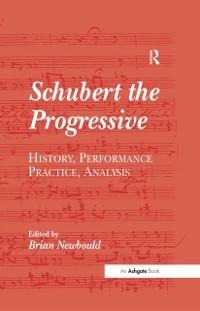
The eleven essays that comprise this volume represent some of the most significant strands of current Schubert research. Arising from an international conference organized by the Schubert Institute (UK) and the University of Leeds in 2000, the emphasis of the papers is on issues of performance practice, analysis and hermeneutics. In the opening essay of the book, Charles Rosen illuminates some of Schubert's compositional practices and their implications for performers. Further performance problems are explored by Walther D rr who highlights the paradox between Schubert's precise notation of pitches and rhythm and his imprecision in relation to dynamics and articulation. As Roy Howat makes clear in his essay, the performer needs to read between the lines of even the best Schubert editions.Aspects of Schubert's style are explored in other essays. Clive McClelland discusses the composer's use of ombra style, while Brian Newbould examines Schubert's techniques of compression and expansion as illustrated in his dances and in sonata movements. Robert Hatten explores the G major Piano Sonata as pastoral, and James Sobaskie and Nicholas Rast provide complementary analyses of the A minor Quartet.The organization of musical time in Schubert and his relationship in this regard to later composers is the subject of Susanne Kogler's essay, while Walburga Litschauer discusses Schubert's early piano sonatas and previously unknown versions of them. Various enigmas surrounding Schubert's life and music are discussed by Roger Neighbour.With contributions from both internationally acclaimed and younger scholars, this volume represents a further step in the multifaceted direction that Schubert research is taking.
Brian Newbould
Contents: Preface; Schubert and the example of Mozart, Charles Rosen; Death and the composer: the context of Schubert's supernatural Lieder, Clive McClelland; Notation and performance: dynamic marks in Schubert's manuscripts, Walther Dürr; Tonal implication and the gestural dialectic in Schubert's A Minor Quartet, James William Sobaskie; Schöne Welt, wo bist du?: motive and form in Schubert's A Minor String Quartet, Nicholas Rast; Timelessness and 'released time' - Franz Schubert and composition today, Susanne Kogler; Unknown versions of Schubert's early piano sonatas, Walburga Litschauer; Cornered in the middle eight: dance miniaturism vis-à-vis sonata, Brian Newbould; Reading between the lines of tempo and rhythm in the B Flat Sonata, D960, Roy Howat; The Doppelgänger revealed?, Roger Neighbour; Schubert's Pastoral: the Piano Sonata in G Major, D894, Robert Hatten; General Index; Index of works by Schubert referred to in the text.
Dieses eBook wird im PDF-Format geliefert und ist mit einem Adobe Kopierschutz (DRM) versehen. Sie können dieses eBook mit allen Geräten lesen, die das PDF-Format und den Adobe Kopierschutz (DRM) unterstützen.
Zum Beispiel mit den folgenden Geräten:
• tolino Reader
Laden Sie das eBook direkt über den Reader-Shop auf dem tolino herunter oder übertragen Sie das eBook auf Ihren tolino mit einer kostenlosen Software wie beispielsweise Adobe Digital Editions.
• Sony Reader & andere eBook Reader
Laden Sie das eBook direkt über den Reader-Shop herunter oder übertragen Sie das eBook mit der kostenlosen Software Sony READER FOR PC/Mac oder Adobe Digital Editions auf ein Standard-Lesegeräte mit epub- und Adobe DRM-Unterstützung.
• Tablets & Smartphones
Möchten Sie dieses eBook auf Ihrem Smartphone oder Tablet lesen, finden Sie hier unsere kostenlose Lese-App für iPhone/iPad und Android Smartphone/Tablets.
• PC & Mac
Lesen Sie das eBook direkt nach dem Herunterladen mit einer kostenlosen Lesesoftware, beispielsweise Adobe Digital Editions, Sony READER FOR PC/Mac oder direkt über Ihre eBook-Bibliothek in Ihrem Konto unter „Meine eBooks“ - „online lesen“.
Schalten Sie das eBook mit Ihrer persönlichen Adobe ID auf bis zu sechs Geräten gleichzeitig frei.
Bitte beachten Sie, dass die Kindle-Geräte das Format nicht unterstützen und dieses eBook somit nicht auf Kindle-Geräten lesbar ist.