Und dann auf "Zum Home-Bildschirm [+]".

Stöbern
genialokal zum Startbildschirm hinzufügen
Installieren Sie die genialokal App auf Ihrem Startbildschirm für einen schnellen Zugriff und eine komfortable Nutzung.
Installieren Sie die genialokal App auf Ihrem Startbildschirm für einen schnellen Zugriff und eine komfortable Nutzung.
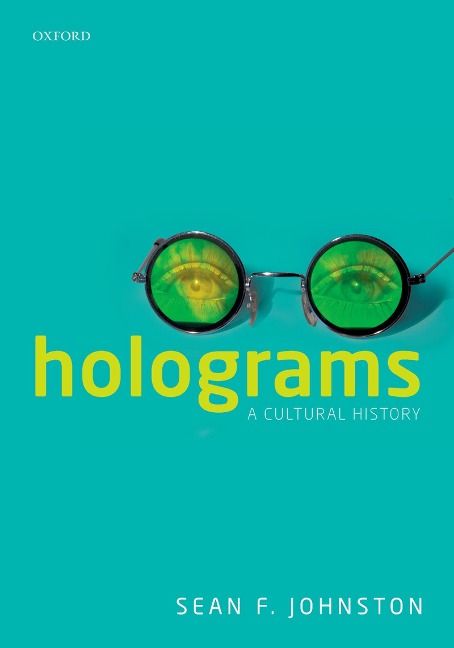
Holograms have been in the public eye for over a half-century, but their influences have deeper cultural roots. No other visual experience is quite like interacting with holograms; no other cultural product melds the technological sublime with magic and optimism in quite the same way. As holograms have evolved, they have left their audiences alternately fascinated, bemused, inspired or indifferent. From expressions of high science to countercultural art to consumer security, holograms have represented modernity, magic and materialism. Their most pervasive impact has been to galvanise hopeful technological dreams.
Engineers, artists, hippies and hobbyists have played with, and dreamed about, holograms. This book explores how holograms found a place in distinct cultural settings. It is aimed at readers attracted to pop culture, visual studies and cultural history, scholars concerned with media history, fine art and material studies and, most of all, cross-disciplinary audiences intrigued about how this ubiquitous but still-mysterious visual medium grew up in our midst and became entangled in our culture.
This book explores the technical attractions and cultural uses of the hologram, how they were shaped by what came before them, and how they have matured to shape our notional futures. Today, holograms are in our pockets (as identity documents) and in our minds (as gaming fantasies and 'faux hologram' performers). Why aren't they more often in front of our eyes?
Sean F. Johnston is Professor of Science, Technology and Society at the University of Glasgow, UK, a Fellow of the Higher Education Academy and a Chartered Physicist (Institute of Physics). He has worked both as an historian and as a scientist. Johnston is a recipient of the Paul Bunge Prize, administered by the Gesellschaft Deutscher Chemiker, for the history of scientific instruments and of the George E. Davis Medal of the Institution of Chemical Engineers, for a history of chemical engineering co-written with Colin Divall. He lives in southern Scotland, where he teaches and researches the historical, social and philosophical aspects of science and technology.
- 1: Introduction - Part A: Visual culture and modernity: the backstory to holograms - 2: Scientific imagery and visual novelty - 3: Grassroots modernity - Part B: Making sense of holograms - 4: Hologram secrets - 5: Holograms as magic - 6: Holograms and progress - Part C: Hologram Cultures - 7: Holograms for enthusiasts - 8: Hologram communities - 9: Holograms on display - 10: Consuming holograms - 11: Channelling dreams
Dieses eBook wird im PDF-Format geliefert und ist mit einem Adobe Kopierschutz (DRM) versehen. Sie können dieses eBook mit allen Geräten lesen, die das PDF-Format und den Adobe Kopierschutz (DRM) unterstützen.
Zum Beispiel mit den folgenden Geräten:
• tolino Reader
Laden Sie das eBook direkt über den Reader-Shop auf dem tolino herunter oder übertragen Sie das eBook auf Ihren tolino mit einer kostenlosen Software wie beispielsweise Adobe Digital Editions.
• Sony Reader & andere eBook Reader
Laden Sie das eBook direkt über den Reader-Shop herunter oder übertragen Sie das eBook mit der kostenlosen Software Sony READER FOR PC/Mac oder Adobe Digital Editions auf ein Standard-Lesegeräte mit epub- und Adobe DRM-Unterstützung.
• Tablets & Smartphones
Möchten Sie dieses eBook auf Ihrem Smartphone oder Tablet lesen, finden Sie hier unsere kostenlose Lese-App für iPhone/iPad und Android Smartphone/Tablets.
• PC & Mac
Lesen Sie das eBook direkt nach dem Herunterladen mit einer kostenlosen Lesesoftware, beispielsweise Adobe Digital Editions, Sony READER FOR PC/Mac oder direkt über Ihre eBook-Bibliothek in Ihrem Konto unter „Meine eBooks“ - „online lesen“.
Schalten Sie das eBook mit Ihrer persönlichen Adobe ID auf bis zu sechs Geräten gleichzeitig frei.
Bitte beachten Sie, dass die Kindle-Geräte das Format nicht unterstützen und dieses eBook somit nicht auf Kindle-Geräten lesbar ist.