Und dann auf "Zum Home-Bildschirm [+]".

Stöbern
genialokal zum Startbildschirm hinzufügen
Installieren Sie die genialokal App auf Ihrem Startbildschirm für einen schnellen Zugriff und eine komfortable Nutzung.
Installieren Sie die genialokal App auf Ihrem Startbildschirm für einen schnellen Zugriff und eine komfortable Nutzung.
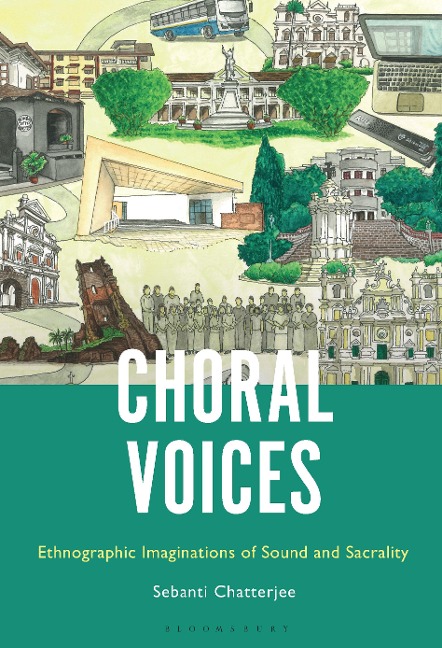
Choral Voices: Ethnographic Imaginations of Sound and Sacrality is about sacred and secular choirs in Goa and Shillong across churches, seminaries, schools, auditoriums, classrooms, reality TV shows, and festivals. Voice and genre emerge as social objects annotated by tradition, nostalgia, and innovation. Piety literally and metaphorically shapes the Christian lifeworld, predominantly those belonging to the Presbyterian and Catholic denominations. Indigeneity structures the political and cultural motifs in the making of the Christian musical traditions. Located at the intersection of Sociology, Anthropology, and Ethnomusicology, the choral voices emplace 'affect' and the visual-aural dispatch. Thus, sonic spectrum holds space for indigenous and global musicality.
This ethnographic work will be useful for scholars researching music and sound studies, religious studies, cultural anthropology, and sociology of India.
Sebanti Chaterjee is a sound anthropologist and a senior academic fellow at National Law School India University, Bengaluru. She is a recipient of India Foundation of Arts Research Grant, the Ryoichi Sasakawa Young Leaders Fellowship Fund (SRA FY 2016), the Indian Council of Social Science Research fellowship, and former editorial member of Serenade Magazine.
ListofIllustrations
Prologue: Warming Up
1 Introduction: Choral beginnings: Inside the chapel and a home studio
1.1 A biography of community- delineating the Sacred and the Heritage
1.2 Establishing a musical cadence
1.3 Framing choral music within Christian landscapes
1.4 Aural Intentions: Summary of chapters
2 Making of the Indigenous
2.1 Interrogating the Indigenous
2.2 Emplacing the Indigenous
2.3 Understanding Indigeneity, Inculturality and Decoloniality
2.4 Music and Decoloniality
2.5 Exploring the relationship between Indigeneity and Sacrality
2.6 Indigenous Possibilities in curricula and performance: Field narratives
2.7 Towards Sonic Interculturality
3 From Loft to the Recording Studio: Shillong Diaries
3.1 What brings you to Shillong? Introduction
3.2 Cusp of Sacrality, new Technologies and Creative Processes
3.3 Choral Voices as ethnographic objects
3.4 Short Historical Snippets about Christianity and Musicality in Khasi and Lushai Hills
3.5 Discussing Genre, Intertextuality and Territorialisation
3.6 Shillong Chamber Choir
3.7 Repertoire- Medleys/Crossovers
3.8 Beyond performance
3.9 Aroha Choir
3.10 Conclusion
4 The Language of Music: Notes from a Goan Seminary
4.1 Inhabiting the Seminary
4.2 Outlining Goan Sacred Music
4.3 A brief history of music and language in Goa
4.4 Entering the field site
4.5 Rachol Seminary
4.6 Introducing the seminarians
4.7 Syncretic musical experimentations in Goan Sacred music
4.8 Goan Sacred music- Motets
4.9 Conclusion
5 Mapping Choral Voices: Role of People and Places
5.1 Introduction
5.2 Hierarchization of voices
5.3 Indigeneity and Christian Music Tradition
5.4 Music Performance
5.5 Conclusion
6 Tutti: Concluding Section
6.1 The Musical Clef Notating Certainty- Uncertainty
6.2 Positing the Vocal Phrasing
Acknowledgments
Bibliography
Glossary
Appendix
Documentary - Da Capo
Index
Dieses eBook wird im PDF-Format geliefert und ist mit einem Adobe Kopierschutz (DRM) versehen. Sie können dieses eBook mit allen Geräten lesen, die das PDF-Format und den Adobe Kopierschutz (DRM) unterstützen.
Zum Beispiel mit den folgenden Geräten:
• tolino Reader
Laden Sie das eBook direkt über den Reader-Shop auf dem tolino herunter oder übertragen Sie das eBook auf Ihren tolino mit einer kostenlosen Software wie beispielsweise Adobe Digital Editions.
• Sony Reader & andere eBook Reader
Laden Sie das eBook direkt über den Reader-Shop herunter oder übertragen Sie das eBook mit der kostenlosen Software Sony READER FOR PC/Mac oder Adobe Digital Editions auf ein Standard-Lesegeräte mit epub- und Adobe DRM-Unterstützung.
• Tablets & Smartphones
Möchten Sie dieses eBook auf Ihrem Smartphone oder Tablet lesen, finden Sie hier unsere kostenlose Lese-App für iPhone/iPad und Android Smartphone/Tablets.
• PC & Mac
Lesen Sie das eBook direkt nach dem Herunterladen mit einer kostenlosen Lesesoftware, beispielsweise Adobe Digital Editions, Sony READER FOR PC/Mac oder direkt über Ihre eBook-Bibliothek in Ihrem Konto unter „Meine eBooks“ - „online lesen“.
Schalten Sie das eBook mit Ihrer persönlichen Adobe ID auf bis zu sechs Geräten gleichzeitig frei.
Bitte beachten Sie, dass die Kindle-Geräte das Format nicht unterstützen und dieses eBook somit nicht auf Kindle-Geräten lesbar ist.