Und dann auf "Zum Home-Bildschirm [+]".

Stöbern
genialokal zum Startbildschirm hinzufügen
Installieren Sie die genialokal App auf Ihrem Startbildschirm für einen schnellen Zugriff und eine komfortable Nutzung.
Installieren Sie die genialokal App auf Ihrem Startbildschirm für einen schnellen Zugriff und eine komfortable Nutzung.


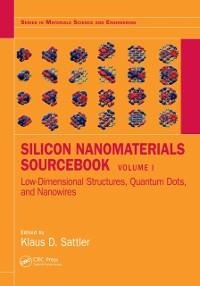
This comprehensive tutorial guide to silicon nanomaterials spans from fundamental properties, growth mechanisms, and processing of nanosilicon to electronic device, energy conversion and storage, biomedical, and environmental applications. It also presents core knowledge with basic mathematical equations, tables, and graphs in order to provide the reader with the tools necessary to understand the latest technology developments. From low-dimensional structures, quantum dots, and nanowires to hybrid materials, arrays, networks, and biomedical applications, this Sourcebook is a complete resource for anyone working with this materials: - Covers fundamental concepts, properties, methods, and practical applications. - Focuses on one important type of silicon nanomaterial in every chapter. - Discusses formation, properties, and applications for each material. - Written in a tutorial style with basic equations and fundamentals included in an extended introduction. - Highlights materials that show exceptional properties as well as strong prospects for future applications. Klaus D. Sattler is professor physics at the University of Hawaii, Honolulu, having earned his PhD at the Swiss Federal Institute of Technology (ETH) in Zurich. He was honored with the Walter Schottky Prize from the German Physical Society, and is the editor of the sister work also published by Taylor & Francis, Carbon Nanomaterials Sourcebook, as well as the acclaimed multi-volume Handbook of Nanophysics.
Klaus D. Sattler pursued his undergraduate and master's courses at the University of Karlsruhe in Germany. He received his PhD under the guidance of Professors G. Busch and H.C. Siegmann at the Swiss Federal Institute of Technology (ETH) in Zurich, where he was among the first to study spin-polarized photoelectron emission. In 1976, he began a group for atomic cluster research at the University of Konstanz in Germany, where he built the first source for atomic clusters and led his team to pioneering discoveries such as "magic numbers" and "Coulomb explosion." He was at the University of California, Berkeley, for three years as a Heisenberg fellow, where he initiated the first studies of atomic clusters on surfaces with a scanning tunneling microscope. Dr. Sattler accepted a position as professor of physics at the University of Hawaii, Honolulu, in 1988. There, he initiated a research group for nanophysics, which, using scanning probe microscopy, obtained the first atomic-scale images of carbon nanotubes directly confirming the graphene network. In 1994, his group produced the first carbon nanocones. He has also studied the formation of polycyclic aromatic hydrocarbons (PAH) and nanoparticles in hydrocarbon flames in collaboration with ETH Zurich. Other research has involved the nanopatterning of nanoparticle films, charge density waves on rotated graphene sheets, band gap studies of quantum dots, and graphene folds. His current work focuses on novel nanomaterials and solar photocatalysis with nanoparticles for the purification of water. He is the editor of the sister reference, Carbon Nanomaterials Sourcebook (CRC Press, 2016), Fundamentals of Picoscience (CRC Press, 2014), and the seven-volume Handbook of Nanophysics (CRC Press, 2011). Among his many other accomplishments, Dr. Sattler was awarded the prestigious Walter Schottky Prize from the German Physical Society in 1983. At the University of Hawaii, he teaches courses in general physics, solid state physics, and quantum mechanics.
I. Low-Dimensional Structures. One-dimensional Porous Silicon Photonic Crystals. Two-Dimensional Silicon. Two-Dimensional Silicon Nanosheets.Nanocrystalline Silicon Thin Films. Fundamentals of Silicene. Silicene Nanoribbons. Hexagonal Honeycomb Silicon: Silicene. II. Clusters, Nanoparticles, Quantum Dots. Fluorescent Silicon Clusters. Silicon Nanoparticles from Pulsed Laser Ablation. Silicon Nanoparticles via Pulsed Laser Ablation in Liquid. Silicon Nanoparticles with Zinc-Blende Structure. Silicon Nanocrystals from Plasma Synthesis. Silicon Nanocrystals in Water. Surface-Engineered Silicon Nanocrystals. Silicon Nanocrystals Doped with Boron and Phosphorous. Organically-Capped Silicon Nanocrystals. Near-Infrared Luminescent Colloidal Silicon Nanocrystals. Hydrogen-Terminated Silicon Quantum Dots. III. Nanowires, Nanotubes. Silicon Nanowires as Electron Field Emitters. Silicon nanowires for Li-based battery Anodes. Coated Silicon Nanowires for Battery Applications. Ion-Implanted Silicon Nanowires. Silicon Nanowires for Evolutionary Nanotechnology. Fundamentals of Silicon Nanotubes. Amorphous Silicon Nanotubes. Nanotubular-Structured Porous Silicon. Porous Silicon Nanotube Arrays.
Dieses eBook wird im PDF-Format geliefert und ist mit einem Adobe Kopierschutz (DRM) versehen. Sie können dieses eBook mit allen Geräten lesen, die das PDF-Format und den Adobe Kopierschutz (DRM) unterstützen.
Zum Beispiel mit den folgenden Geräten:
• tolino Reader
Laden Sie das eBook direkt über den Reader-Shop auf dem tolino herunter oder übertragen Sie das eBook auf Ihren tolino mit einer kostenlosen Software wie beispielsweise Adobe Digital Editions.
• Sony Reader & andere eBook Reader
Laden Sie das eBook direkt über den Reader-Shop herunter oder übertragen Sie das eBook mit der kostenlosen Software Sony READER FOR PC/Mac oder Adobe Digital Editions auf ein Standard-Lesegeräte mit epub- und Adobe DRM-Unterstützung.
• Tablets & Smartphones
Möchten Sie dieses eBook auf Ihrem Smartphone oder Tablet lesen, finden Sie hier unsere kostenlose Lese-App für iPhone/iPad und Android Smartphone/Tablets.
• PC & Mac
Lesen Sie das eBook direkt nach dem Herunterladen mit einer kostenlosen Lesesoftware, beispielsweise Adobe Digital Editions, Sony READER FOR PC/Mac oder direkt über Ihre eBook-Bibliothek in Ihrem Konto unter „Meine eBooks“ - „online lesen“.
Schalten Sie das eBook mit Ihrer persönlichen Adobe ID auf bis zu sechs Geräten gleichzeitig frei.
Bitte beachten Sie, dass die Kindle-Geräte das Format nicht unterstützen und dieses eBook somit nicht auf Kindle-Geräten lesbar ist.