Und dann auf "Zum Home-Bildschirm [+]".

Stöbern
genialokal zum Startbildschirm hinzufügen
Installieren Sie die genialokal App auf Ihrem Startbildschirm für einen schnellen Zugriff und eine komfortable Nutzung.
Installieren Sie die genialokal App auf Ihrem Startbildschirm für einen schnellen Zugriff und eine komfortable Nutzung.
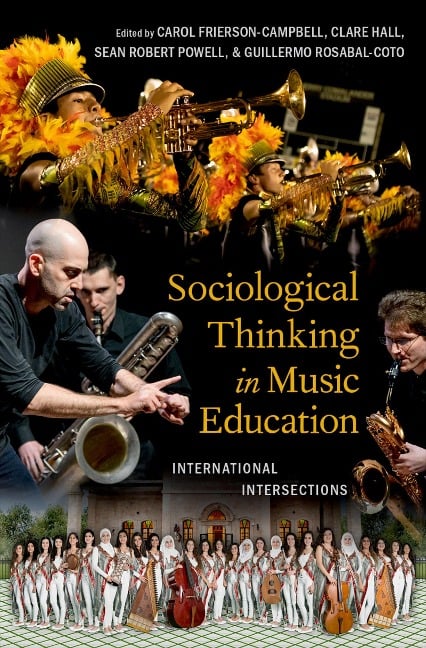
Sociological Thinking in Music Education presents new ideas about music teaching and learning as important social, political, economic, ecological, and cultural ways of being. At the book's heart is the intersection between theory and practice where readers gain glimpses of intriguing social phenomena as lived through music learning and teaching. The vital roles played by music and music education in various societies around the world are illustrated through pivotal intersections between music education and sociology: community, schooling, and issues of decolonization. In this book, emerging as well as established scholars mobilize the links between applied sociology, music, education, and music education in ways that intersect the scholarly and the personal. These interdisciplinary vantage points fulfil the book's overarching aim to move beyond mere descriptions of what is, by analyzing how social inequalities and inequities, conflict and control, and power can be understood in and through music teaching and learning at both individual and collective levels. The result is not only encountering new ideas regarding the social construction of music education practices in specific places, but also seeing and hearing familiar ones in fresh ways. Digital assets enable readers to meet the authors and the points of their inquiry via various audiovisual media, including videos, a documentary music film, and multi-lingual video précis for each chapter in English as well as in each author's language of origin.
Carol Frierson-Campbell coordinates the music education program at William Paterson University, where she teaches instrumental music pedagogy and research. Her scholarly interests include music education in marginalized communities, instrumental music education, and research pedagogy. Previous projects include the co-authored textbook Inquiry in Music Education: Concepts and Methods for the Beginning Researcher (with Hildegard Froehlich), the edited 2-volume Teaching Music in the Urban Classroom, and articles in Action, Criticism, and Theory for Music Education, Music Education Research and Arts Education Policy Review. During the 2015-2016 school year she served as Scholar in Residence at the Edward Said National Conservatory of Music in the occupied Palestinian Territories. Dr. F-C (as her students know her) also directs the WPU Music Fellows in partnership with the Paterson Music Project, providing music enrichment for children in Paterson, New Jersey. Clare Hall is Lecturer in Performing Arts, Monash University, Australia. Her research, educational and artistic practice coalesces around music, sound and performance to promote creative arts engagements across the lifespan. Her interdisciplinary scholarship bridges boundaries between the arts, education, and sociology, with her key contribution to date in music and masculinity. Her wider research agenda works to understand how the interplay of gender, class, ethnicity, race and generational differences influences arts teaching and learning as the means to produce more inclusive, diverse and sustainable cultural participation. She has served as Co-convenor of the International Symposium on the Sociology of Music Education 2016-2019 and her most recent book Masculinity, Class and Music Education was published in 2018. Sean Robert Powell is Associate Professor and Chair of Music Education at the University of North Texas where he teaches graduate courses in sociology, philosophy, qualitative research, and music teacher education. Dr. Powell is a member of the Editorial Review Boards of the Journal of Research in Music Education, Journal of Music Teacher Education, and Action, Criticism, and Theory for Music Education. He also serves as the Chair-Elect of the Society for Music Teacher Education. His work has been published widely in the top journal in the field, and he has presented research, workshops, and guest lectures at national and international venues. Dr. Powell has contributed chapters to the Oxford Handbook of Music Teacher Education in the United States and Narratives and Reflections in Music Education: Listening to Voices Seldom Heard. Guillermo Rosabal-Coto is a Professor of Music Education at Universidad de Costa Rica. He also holds teaching/research positions at the Graduate Music Program at Universidade do Estado de Santa Catarina (Brazil) and the Latin American Studies Program at the University of Toronto (Canada). He has guest edited special journal issues on music education and decolonization for ISME's Revista Internacional de Educación Musical (RIEM) and Action, Criticism and Theory in Music Education (ACT). He is currently Director of Editorial Universidad de Costa Rica.
Foreword Hildegard C. Froehlich Acknowledgements Chapter 1: Introduction Carol Frierson-Campbell, Clare Hall, Sean Robert Powell, and Guillermo Rosabal-Coto Chapter 2: Strong Voices for Sociology in Music Education in Mid and Late Twentieth-Century America: A Milestone in the Making Marie McCarthy Intersection One: Sociological Thinking about Music Education in Community Settings Chapter 3: Learning from Sociology? Revisiting the Notion of Community in Music Education Alexandra Kertz-Welzel Chapter 4: Music, Everyday Life, and Music Education: Dimensions of a Local Musical Field in Brazil Jusamara Souza Chapter 5: Singing the Revo: Memories of Music-in-Revolution and Music-as-Revolution in Grenada, West Indies Danielle Sirek Chapter 6: Toward 'Little Victories' in Music Education: Troubling Ableism through Signed-singing and d/Deaf Musicking Warren Churchill and Clare Hall Intersection Two: Sociological Thinking about Music Education in School Settings Chapter 7: Placing the Music Teacher in an Era of Reform: Synthesizing Research on Music Teacher Networks and Isolation Ryan Shaw Chapter 8: "A Perfect Mix?" Navigating Choice and Scarcity in a New York City Music Program Frank Martignetti Chapter 9: Marching on an Uneven Field: A Bourdieusian Analysis of Competitive High School Marching Band in the U.S. Jordan Stern Chapter 10: Facing Both Ways: Knowers, Knowledge and Bernstein's Pedagogic Rights in Music Education Mandy Carver Chapter 11: A Sociological Travelogue of Music Education in Palestine Carol Frierson-Campbell Intersection Three: Sociological Thinking about Issues of Colonization in Music Education Chapter 12: Towards a Decolonial Sociology for Music Learners Guillermo Rosabal-Coto Chapter 13: An Eco-Political View of the Venezuelan Cuatro Attilio Lafontant and Guillermo Rosabal-Coto Chapter 14: Making the Shift: Music Education Research as (Antiracist) Racial Projects Samuel Escalante Chapter 15: Decolonizing and Indigenizing Music Education through Self-Reflexive Sociological Research and Practice Anita Prest and J. Scott Goble Afterword Ruth Wright Bibliography Index
Dieses eBook wird im PDF-Format geliefert und ist mit einem Adobe Kopierschutz (DRM) versehen. Sie können dieses eBook mit allen Geräten lesen, die das PDF-Format und den Adobe Kopierschutz (DRM) unterstützen.
Zum Beispiel mit den folgenden Geräten:
• tolino Reader
Laden Sie das eBook direkt über den Reader-Shop auf dem tolino herunter oder übertragen Sie das eBook auf Ihren tolino mit einer kostenlosen Software wie beispielsweise Adobe Digital Editions.
• Sony Reader & andere eBook Reader
Laden Sie das eBook direkt über den Reader-Shop herunter oder übertragen Sie das eBook mit der kostenlosen Software Sony READER FOR PC/Mac oder Adobe Digital Editions auf ein Standard-Lesegeräte mit epub- und Adobe DRM-Unterstützung.
• Tablets & Smartphones
Möchten Sie dieses eBook auf Ihrem Smartphone oder Tablet lesen, finden Sie hier unsere kostenlose Lese-App für iPhone/iPad und Android Smartphone/Tablets.
• PC & Mac
Lesen Sie das eBook direkt nach dem Herunterladen mit einer kostenlosen Lesesoftware, beispielsweise Adobe Digital Editions, Sony READER FOR PC/Mac oder direkt über Ihre eBook-Bibliothek in Ihrem Konto unter „Meine eBooks“ - „online lesen“.
Schalten Sie das eBook mit Ihrer persönlichen Adobe ID auf bis zu sechs Geräten gleichzeitig frei.
Bitte beachten Sie, dass die Kindle-Geräte das Format nicht unterstützen und dieses eBook somit nicht auf Kindle-Geräten lesbar ist.