Und dann auf "Zum Home-Bildschirm [+]".

Stöbern
genialokal zum Startbildschirm hinzufügen
Installieren Sie die genialokal App auf Ihrem Startbildschirm für einen schnellen Zugriff und eine komfortable Nutzung.
Installieren Sie die genialokal App auf Ihrem Startbildschirm für einen schnellen Zugriff und eine komfortable Nutzung.
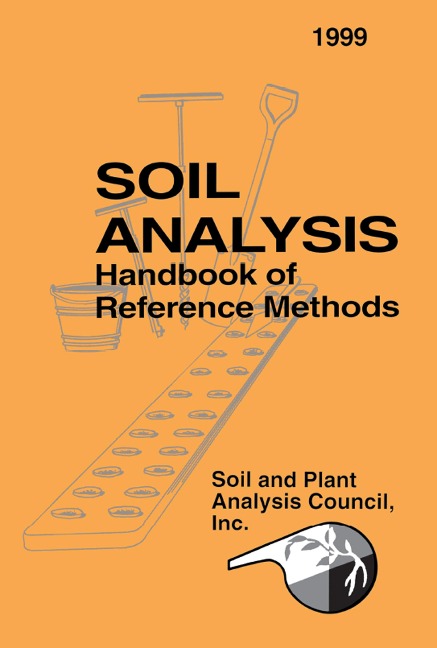
For more than 30 years, soil testing has been widely used as a basis for determining lime and fertilizer needs. Today, a number of procedures are used for determining everything from soil pH and lime requirement, to the level of extractable nutrient elements. And as the number of cropped fields being tested increases, more and more farmers and growers will come to rely on soil test results. But if soil testing is to be an effective means of evaluating the fertility status of soils, standardization of methodology is essential. No single test is appropriate for all soils. Soil Analysis Handbook of Reference Methods is a standard laboratory technique manual for the most commonly used soil analysis procedures. First published in 1974, this Handbook has changed over the years to reflect evolving needs. New test methods and modifications have been added, as well as new sections on nitrate, heavy metals, and quality assurance plans for agricultural testing laboratories. Compiled by the Soil and Plant Analysis Council, this latest edition of Soil Analysis Handbook of Reference Methods also addresses the major methods for managing plant nutrition currently in use in the United States and other parts of the world. For soil scientists, farmers, growers, or anyone with an interest in the environment, this reference will prove an invaluable guide to standard methods for soil testing well into the future.
Features
Soil and Plant Analysis Council Inc.
Preface, Contributors, Chapter 1: Introduction, Chapter 2: Sampling and Sample Preparation, Measurement, Extraction, and Storage, Chapter 3: Soil pH, and Exchangeable Acidity and Aluminum, Chapter 4: Buffer pH and Lime Requirement, Chapter 5: Conductance, Soluble Salts, and Sodicity, Chapter 6: Phosphorus, Chapter 7: Major Cations (Potassium, Calcium, Magnesium, and Sodium), Chapter 8: Micronutrients (Boron, Copper, Iron, Manganese, and Zinc), Chapter 9: Heavy Metals, Chapter 10: Ammonium- and Nitrate-Nitrogen, Chapter 11: Sulfate-Sulfur, Chapter 12: Chloride, Chapter 13: Organic and Humic Matter, Chapter 14: Organic Soils and Soilless Growth Media Analysis, Chapter 15: Quality Assurance Plans for Agricultural Testing Laboratories, Chapter 16: Methods of Instrumental Analysis, Appendices, Index
Dieses eBook wird im PDF-Format geliefert und ist mit einem Adobe Kopierschutz (DRM) versehen. Sie können dieses eBook mit allen Geräten lesen, die das PDF-Format und den Adobe Kopierschutz (DRM) unterstützen.
Zum Beispiel mit den folgenden Geräten:
• tolino Reader
Laden Sie das eBook direkt über den Reader-Shop auf dem tolino herunter oder übertragen Sie das eBook auf Ihren tolino mit einer kostenlosen Software wie beispielsweise Adobe Digital Editions.
• Sony Reader & andere eBook Reader
Laden Sie das eBook direkt über den Reader-Shop herunter oder übertragen Sie das eBook mit der kostenlosen Software Sony READER FOR PC/Mac oder Adobe Digital Editions auf ein Standard-Lesegeräte mit epub- und Adobe DRM-Unterstützung.
• Tablets & Smartphones
Möchten Sie dieses eBook auf Ihrem Smartphone oder Tablet lesen, finden Sie hier unsere kostenlose Lese-App für iPhone/iPad und Android Smartphone/Tablets.
• PC & Mac
Lesen Sie das eBook direkt nach dem Herunterladen mit einer kostenlosen Lesesoftware, beispielsweise Adobe Digital Editions, Sony READER FOR PC/Mac oder direkt über Ihre eBook-Bibliothek in Ihrem Konto unter „Meine eBooks“ - „online lesen“.
Schalten Sie das eBook mit Ihrer persönlichen Adobe ID auf bis zu sechs Geräten gleichzeitig frei.
Bitte beachten Sie, dass die Kindle-Geräte das Format nicht unterstützen und dieses eBook somit nicht auf Kindle-Geräten lesbar ist.