Und dann auf "Zum Home-Bildschirm [+]".

Stöbern
genialokal zum Startbildschirm hinzufügen
Installieren Sie die genialokal App auf Ihrem Startbildschirm für einen schnellen Zugriff und eine komfortable Nutzung.
Installieren Sie die genialokal App auf Ihrem Startbildschirm für einen schnellen Zugriff und eine komfortable Nutzung.
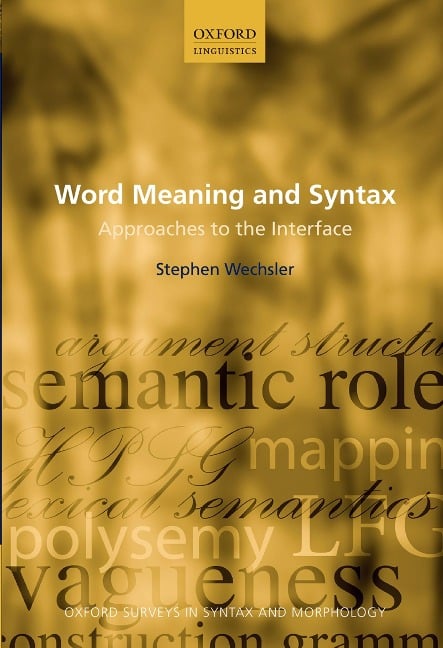
This book examines the nature of the interface between word meaning and syntax, one of the most controversial and elusive issues in contemporary linguistics. It approaches the interface from both sides of the relation, and surveys a range of views on the mapping between them, with an emphasis on lexical approaches to argument structure. Stephen Wechsler begins by analysing the fundamental problem of word meaning, with discussions of vagueness and polysemy, complemented with a look at the roles of world knowledge and normative aspects of word meaning. He then surveys the argument-taking properties of verbs and other predicators, and presents key theories of lexical semantic structure. Later chapters provide a description of formal theories and frameworks for capturing the mapping from word meaning to syntactic structure, as well as arguments in favour of a lexicalist approach to argument structure. The book will interest scholars of theoretical linguistics, particularly in the fields of syntax and lexical semantics, as well as those interested in psycholinguistics and philosophy of language.
Stephen Wechsler is Professor of Linguistics at the University of Texas. He specializes in lexicalist approaches to syntax, and his research focuses on three areas: self-reference and person systems; the interface between syntax and word meaning; and morphosyntax (case and agreement). His publications include The Semantic Basis of Argument Structure (CSLI, 1995), and, co-authored with Larisa Zlatic, The Many Faces of Agreement (CSLI, 2003). He is also co-author of the forthcoming book Lexical-Functional Syntax, 2nd edition (Blackwell).
- 1: The role of word meaning in syntax - 2: Word meaning - 3: Argument alternations and cognates - 4: Lexical semantic structure - 5: Argument mapping approaches - 6: The lexical-constructional debate - 7: Some battlegrounds in the theory wars - 8: Postscript
Dieses eBook wird im PDF-Format geliefert und ist mit einem Adobe Kopierschutz (DRM) versehen. Sie können dieses eBook mit allen Geräten lesen, die das PDF-Format und den Adobe Kopierschutz (DRM) unterstützen.
Zum Beispiel mit den folgenden Geräten:
• tolino Reader
Laden Sie das eBook direkt über den Reader-Shop auf dem tolino herunter oder übertragen Sie das eBook auf Ihren tolino mit einer kostenlosen Software wie beispielsweise Adobe Digital Editions.
• Sony Reader & andere eBook Reader
Laden Sie das eBook direkt über den Reader-Shop herunter oder übertragen Sie das eBook mit der kostenlosen Software Sony READER FOR PC/Mac oder Adobe Digital Editions auf ein Standard-Lesegeräte mit epub- und Adobe DRM-Unterstützung.
• Tablets & Smartphones
Möchten Sie dieses eBook auf Ihrem Smartphone oder Tablet lesen, finden Sie hier unsere kostenlose Lese-App für iPhone/iPad und Android Smartphone/Tablets.
• PC & Mac
Lesen Sie das eBook direkt nach dem Herunterladen mit einer kostenlosen Lesesoftware, beispielsweise Adobe Digital Editions, Sony READER FOR PC/Mac oder direkt über Ihre eBook-Bibliothek in Ihrem Konto unter „Meine eBooks“ - „online lesen“.
Schalten Sie das eBook mit Ihrer persönlichen Adobe ID auf bis zu sechs Geräten gleichzeitig frei.
Bitte beachten Sie, dass die Kindle-Geräte das Format nicht unterstützen und dieses eBook somit nicht auf Kindle-Geräten lesbar ist.