Und dann auf "Zum Home-Bildschirm [+]".

Stöbern
genialokal zum Startbildschirm hinzufügen
Installieren Sie die genialokal App auf Ihrem Startbildschirm für einen schnellen Zugriff und eine komfortable Nutzung.
Installieren Sie die genialokal App auf Ihrem Startbildschirm für einen schnellen Zugriff und eine komfortable Nutzung.
WINNER Alice Davis Hitchcock Book Award 2025, Society of Architectural Historians
WINNER Historians of British Art Book Award 2025 for Exemplary Scholarship on the Period between 1800-1960
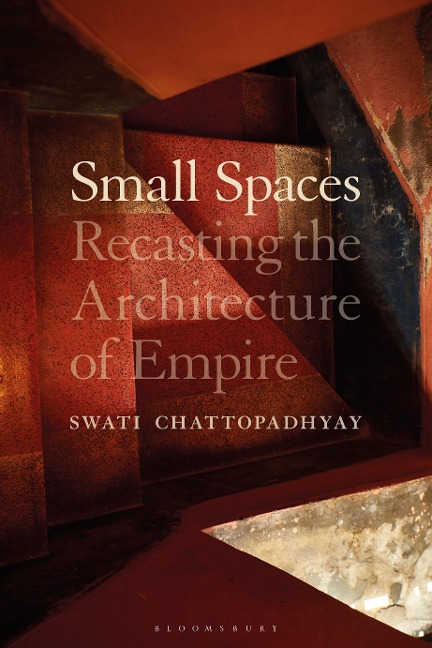
Small Spaces recasts the history of the British empire by focusing on the small spaces that made the empire possible. It takes as its subject a series of small architectural spaces, objects, and landscapes and uses them to narrate the untold stories of the marginalized people-the servants, women, children, subalterns, and racialized minorities-who held up the infrastructure of empire. In so doing it opens up an important new approach to architectural history: an invitation to shift our attention from the large to the small scale.
Taking the British empire in India as its primary focus, this book presents eighteen short, readable chapters to explore an array of overlooked places and spaces. From cook rooms and slave quarters to outhouses, go-downs, and medicine cupboards, each chapter reveals how and why these kinds of minor spaces are so important to understanding colonialism. With the focus of history so often on the large scale - global trade networks, vast regions, and architectures of power and domination - Small Spaces shows instead how we need to rethink this aura of magnitude so that our reading is not beholden such imperialist optics.
With chapters which can be read separately as individual accounts of objects, spaces, and buildings, and introductions showing how this critical methodology can challenge the methods and theories of urban and architectural history, Small Spaces is a must-read for anyone wishing to decolonize disciplinary practices in the field of architectural, urban, and colonial history. Altogether, it provides a paradigm-breaking account of how to 'unlearn empire', whether in British India or elsewhere.
Swati Chattopadhyay is Professor in the Department of History of Art and Architecture, with an affiliated appointment in the Department of Comparative Literature at the University of California, Santa Barbara, USA.
Preface and Acknowledgments
Part I. Small Spaces
1. Of Small Spaces
2. Empire of Small Spaces
Part II: Trade and Labor
3. Dependency
4. Locating the Bottlekhana
5. Potable Empire
6. Europe Goods
7. Strange Tongues
8. Making Invisible
Part III: Land Imagination
9. Vantage
10. Connective Spaces
11. Anomalous Spaces
12. An Aesthetic Episode
13. Roofscape
Part IV: A Geography of Small Spaces
14. Collections and Containment
15. Portable Geographies
16. A Good Shelf
17. A Box of Medicine
18. Epilogue
Appendix A
Index
Dieses eBook wird im PDF-Format geliefert und ist mit einem Adobe Kopierschutz (DRM) versehen. Sie können dieses eBook mit allen Geräten lesen, die das PDF-Format und den Adobe Kopierschutz (DRM) unterstützen.
Zum Beispiel mit den folgenden Geräten:
• tolino Reader
Laden Sie das eBook direkt über den Reader-Shop auf dem tolino herunter oder übertragen Sie das eBook auf Ihren tolino mit einer kostenlosen Software wie beispielsweise Adobe Digital Editions.
• Sony Reader & andere eBook Reader
Laden Sie das eBook direkt über den Reader-Shop herunter oder übertragen Sie das eBook mit der kostenlosen Software Sony READER FOR PC/Mac oder Adobe Digital Editions auf ein Standard-Lesegeräte mit epub- und Adobe DRM-Unterstützung.
• Tablets & Smartphones
Möchten Sie dieses eBook auf Ihrem Smartphone oder Tablet lesen, finden Sie hier unsere kostenlose Lese-App für iPhone/iPad und Android Smartphone/Tablets.
• PC & Mac
Lesen Sie das eBook direkt nach dem Herunterladen mit einer kostenlosen Lesesoftware, beispielsweise Adobe Digital Editions, Sony READER FOR PC/Mac oder direkt über Ihre eBook-Bibliothek in Ihrem Konto unter „Meine eBooks“ - „online lesen“.
Schalten Sie das eBook mit Ihrer persönlichen Adobe ID auf bis zu sechs Geräten gleichzeitig frei.
Bitte beachten Sie, dass die Kindle-Geräte das Format nicht unterstützen und dieses eBook somit nicht auf Kindle-Geräten lesbar ist.