Und dann auf "Zum Home-Bildschirm [+]".

Stöbern
genialokal zum Startbildschirm hinzufügen
Installieren Sie die genialokal App auf Ihrem Startbildschirm für einen schnellen Zugriff und eine komfortable Nutzung.
Installieren Sie die genialokal App auf Ihrem Startbildschirm für einen schnellen Zugriff und eine komfortable Nutzung.
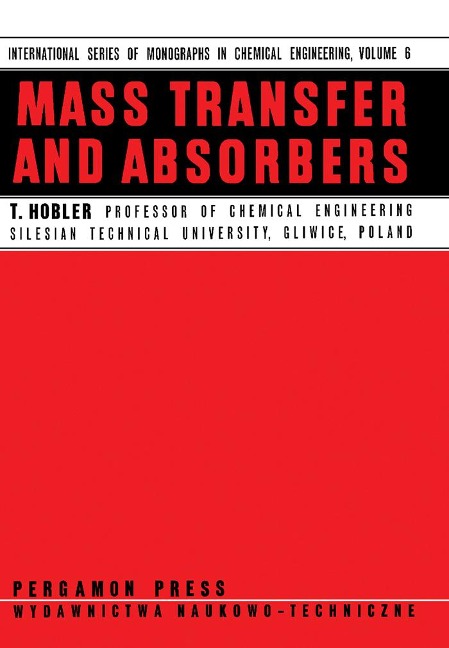
Mass Transfer and Absorbers deals with absorption and mass transfer processes and the factors to consider in designing absorbers. Calculations are supported by a uniform, generalized process driving force, complying with Maxwell's equation, and the coefficients are made as independent as possible in terms of the kind of diffusion and of the values of the concentrations. This volume is comprised of seven chapters and begins with an overview of the general principles of diffusional mass transfer, absorption and stripping, and equilibrium between gas and liquid phases. Steady-state mass transfer by diffusion is then discussed, along with mass transfer in a single phase (forced flow and unforced flow). Subsequent chapters explore design considerations for mass transfer equipment and related problems; adsorption accompanied by a chemical reaction; and problems relating to hydrodynamics. The final chapter is devoted to some practical issues, including economic flow velocity and mechanical features of packed, plate, and spray tower designs. This book is intended for practicing designers and engineers.
PrefaceNomenclature1. General Introduction 1. General Principles of Diffusional Mass Transfer 2. Absorption, Stripping 3. Various Ways of Expressing Concentration 4. Equilibrium between Gas and Liquid Phases 5. Interphase Equilibrium and the Phase Rule 6. Non-equilibrium System 7. Thermodynamic Interpretation of Interphase Equilibrium a. Basic Relations b. Fugacity of the Gaseous Phase c. Fugacity of the Liquid Phase d. Equilibrium States 8. Kinds of Mass-transfer Mechanisms a. Diffusion b. Convection Bibliography2. Steady-State Mass Transfer by Diffusion 1. Diffusion in the Gaseous Phase 2. Particular Cases of Diffusion in the Gaseous Phase a. Diffusion of One Component through an Inert Component b. Equimolar Counterdiffusion c. Diffusion of One Component through an Inert Multi-component Mixture d. Multi-component Diffusion in Various Directions e. Summary of the Equations Obtained for Rate of Diffusion 3. Diffusion in the Liquid Phase 4. Generalized Treatment of Mass Transport by Diffusion 5. Driving Modulus of Diffusion --A 6. Diffusivity (Coefficient of Diffusion) a. General Discussion b. Diffusivity in the Gas Phase c. Diffusivity in the Liquid Phase Bibliography3. Mass Transfer (In One Phase) 1. Convection a. General Discussion b. Basic Approach to the Transfer of Mass c. The Driving Modulus of Mass Transfer d. Comparison with other Approaches to Mass Transfer e. Important Cases of Mass Transfer A. Mass Transfer in Forced Flow 2. Mass Transfer in Forced Turbulent Flow (Gas Phase) 3. Mass Transfer in Forced Laminar Flow (Gas Phase). Flow through a Tube B. Mass Transfer in Unforced Flow 4. Mass Transfer in the Gravity Flow of a Liquid (Liquid Phase) 5. Mass Transfer in Free Flow (Natural Convection) 6. Mass Transfer for a Gas Bubbling through a Liquid 7. Mass Transfer and Falling Drops 8. Differential Equation for Mass Diffusion and the Similarity between Mass Transfer Processes Bibliography4. Design of Mass Transfer Equipment and Related Problems 1. The Mass Balance of a Mass Exchanger and the Operating Line 2. Mass Transfer between Phases (Interphase Mass Transfer) a. The Overall Mass Transfer Coefficient and Overall Driving Modulus b. Special Cases with Regard to the Kind of Diffusion c. General Conclusions d. Cases when the Mass Transfer Resistance in One Phase is Absent or Negligible e. Mean Driving Modulus of Interphase Mass Transfer 3. Evaluation of the Active Mass Transfer Area and the Volume of Packing 4. Effectiveness of Wetting and its Calculation for a Packed Tower a. Effectiveness of Wetting b. Calculation of a Packed Exchanger 5. Method of Calculating the Interphase Mass Transfer with the Use of the Theoretical Driving Force -pA a. Interphase Mass Transfer of One Component in the Presence of Inert Components b. Two Directional, Equimolar Interphase Mass Transfer c. Multi-component Interphase Mass Transfer in Various Directions 6. Methods in which the "Height of a Transfer Unit" is Used a. Generalized Approach b. Particular Treatment of Interphase Mass Transfer in the Presence of Inert Components, Using the Mole Ratios y-, x- c. Particular Treatment of Interphase Mass Transfer in the Presence of Inert Components, Using the Mole Fractions xA, yA d. Particular Treatment of Interphase Mass Transfer in the Presence of Inert Components, Using the Mass Ratios UA, WA e. Particular Treatment of Equimolar Interphase Mass Transfer, Using the Concentrations xA, yA f. General Discussion 7.