Und dann auf "Zum Home-Bildschirm [+]".

Stöbern
genialokal zum Startbildschirm hinzufügen
Installieren Sie die genialokal App auf Ihrem Startbildschirm für einen schnellen Zugriff und eine komfortable Nutzung.
Installieren Sie die genialokal App auf Ihrem Startbildschirm für einen schnellen Zugriff und eine komfortable Nutzung.
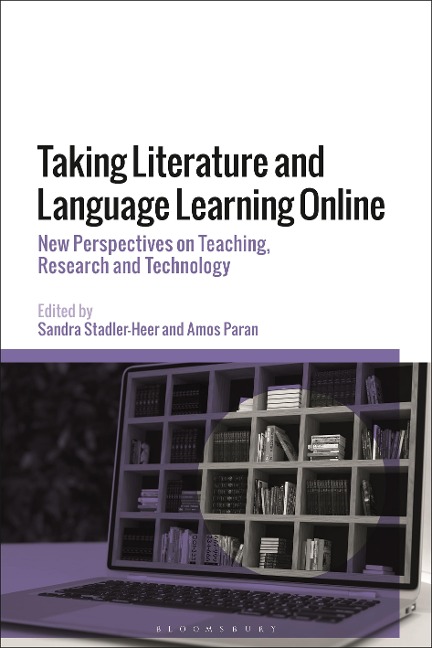
The use of literary texts in language classrooms is firmly established, but new questions arise with the transfer to remote teaching and learning. How do we teach literature online? How do learners react to being taught literature online? Will new genres emerge from the COVID-19 pandemic? Is the literary canon changing?
This volume celebrates the vitality of literary and pedagogic responses to the pandemic and presents research into the phenomena observed in this evolving field. One strand of the book discusses literary outputs stimulated by the pandemic as well as past pandemics. Another strand looks at the pedagogy of engaging learners with literature online, examining learners of different ages and of different proficiency levels and different educational backgrounds, including teacher education. Finally, a third strand looks at the affordances of various technologies for teaching online and the way they interact with literature and with language learning. The contributions in this volume take literature teaching online away from static lecturing strategies, present numerous options for online teaching, and provide research-based grounding for the implementation of these pedagogies.
Sandra Stadler-Heer is Senior Lecturer of TESOL at the Department of Linguistics and Literature, Catholic University of Eichstätt-Ingolstadt, Germany.
Amos Paran is Professor of TESOL at IOE, UCL's Faculty of Education and Society, University College London, UK.
Introduction, Amos Paran (Institute of Education, University College London, UK) and Sandra Stadler-Heer (Catholic University Eichstätt-Ingolstadt, Germany)
Part I: Literary Responses in Times of Crisis
1. Literary Narratives as Recordings of the Pandemic Present: The New York Times Magazine's Decameron Project, Ingrid Gessner (University College of Teacher Education Vorarlberg, Austria)
2. Pandemic Literature: What It Is, Why It Should Be Taught and How, Engelbert Thaler (University of Augsburg, Germany)
II. Researching and Teaching Literature for/to Young Learners
3. Identifying Quality in Asynchronous, Pre-recorded Picturebook Read-Alouds for Children Learning English as a Foreign Language, Gail Ellis (Independent Researcher, France) and Sandie Mourão (Universidade Nova de Lisboa, Portugal)
4. Digital Picturebooks in Times of Crisis: From Picturebooks about the Coronavirus to Developing Critical Environmental Literacies, Theresa Summer (University of Würzburg, Germany)
III. Researching and Teaching Literature in Online Teacher Education
5. Exploiting the Educational Potential of Literature in English Language Teaching: Continuity and Change in Digital Literature Teaching, Christine Gardemann (University of Bielefeld, Germany)
6. Conducting Story-based Activities in Times of Social Distancing, Annett Kaminski (University of Koblenz-Landau, Germany)
IV. Tools and Concepts for Teaching Literature Online
7. Implementing a Collaborative Reading Project Online: Solutions for a Pedagogically Meaningful Virtual Workshop, Jennifer Schumm Fauster (University of Graz, Austria)
8. Digital Storytelling as a Pedagogical Approach for Meaningful Learning: Alternative Implementations of Technology in the Libyan EFL Context, Fatma Abu-Baker (University of Edinburgh, UK) and Hana A. El-Badri (University of Benghazi, Lybia)
9. Simple and Engaging Fiction for Adult Beginners, Pedro Malard Monteiro (Universidade Federal de Uberlandia, Brazil), Margaret Wilkinson (Newcastle University, UK) and Martha Young-Scholten (Newcastle University, UK)
10. Annotating Literary Texts on Conceptboard: Philological Practice in the Digital Classroom, Verena Laschinger (University of Erfurt, Germany)
11. Writing the Future -Collaborative Creative Science-Fiction Writing in the Virtual EFL Classroom, Christian Ludwig and Elizabeth Shipley (University of Karlsruhe, Germany)
Afterword: Closing Reflections on the Brave New World of Literature and Language Education Online, Geoff Hall (University of Nottingham-Ningbo, China)
References
Dieses eBook wird im PDF-Format geliefert und ist mit einem Adobe Kopierschutz (DRM) versehen. Sie können dieses eBook mit allen Geräten lesen, die das PDF-Format und den Adobe Kopierschutz (DRM) unterstützen.
Zum Beispiel mit den folgenden Geräten:
• tolino Reader
Laden Sie das eBook direkt über den Reader-Shop auf dem tolino herunter oder übertragen Sie das eBook auf Ihren tolino mit einer kostenlosen Software wie beispielsweise Adobe Digital Editions.
• Sony Reader & andere eBook Reader
Laden Sie das eBook direkt über den Reader-Shop herunter oder übertragen Sie das eBook mit der kostenlosen Software Sony READER FOR PC/Mac oder Adobe Digital Editions auf ein Standard-Lesegeräte mit epub- und Adobe DRM-Unterstützung.
• Tablets & Smartphones
Möchten Sie dieses eBook auf Ihrem Smartphone oder Tablet lesen, finden Sie hier unsere kostenlose Lese-App für iPhone/iPad und Android Smartphone/Tablets.
• PC & Mac
Lesen Sie das eBook direkt nach dem Herunterladen mit einer kostenlosen Lesesoftware, beispielsweise Adobe Digital Editions, Sony READER FOR PC/Mac oder direkt über Ihre eBook-Bibliothek in Ihrem Konto unter „Meine eBooks“ - „online lesen“.
Schalten Sie das eBook mit Ihrer persönlichen Adobe ID auf bis zu sechs Geräten gleichzeitig frei.
Bitte beachten Sie, dass die Kindle-Geräte das Format nicht unterstützen und dieses eBook somit nicht auf Kindle-Geräten lesbar ist.