Und dann auf "Zum Home-Bildschirm [+]".

Stöbern
genialokal zum Startbildschirm hinzufügen
Installieren Sie die genialokal App auf Ihrem Startbildschirm für einen schnellen Zugriff und eine komfortable Nutzung.
Installieren Sie die genialokal App auf Ihrem Startbildschirm für einen schnellen Zugriff und eine komfortable Nutzung.
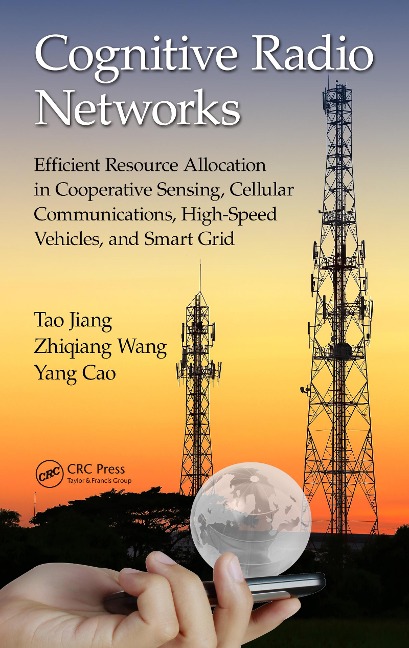
Resource allocation is an important issue in wireless communication networks. In recent decades, cognitive radio-based networks have garnered increased attention and have been well studied to overcome the problem of spectrum scarcity in future wireless communication systems. Many new challenges in resource allocation appear in cognitive radio-based networks. This book focuses on effective resource allocation solutions in several important cognitive radio-based networks, including opportunistic spectrum access networks, cooperative sensing networks, cellular networks, high-speed vehicle networks, and smart grids.
Tao Jiang is currently a chair professor in the School of Electronics Information and Communications, Huazhong University of Science and Technology, Wuhan, P. R. China (PRC). He received the Ph.D. degree in information and communication engineering from Huazhong University of Science and Technology, Wuhan, PRC in April 2004. He has authored or co-authored over 200 technical papers in major journals and conferences and six books/chapters in the areas of communications and networks. He served or is serving as associate editor of some technical journals in communications, including IEEE Transactions on Signal Processing, IEEE Communications Surveys and Tutorials, IEEE Transactions on Vehicular Technology, and IEEE Internet of Things Journal. He is a recipient of the NSFC for Distinguished Young Scholars Award in PRC. Zhiqiang Wang currently works at State Grid Shaanxi Electric Power Company Telematics. He received a B.S. from Xian Jiaotong University, Xian, PRC in 2006, and M.S. and Ph.D. degrees from Huazhong University of Science and Technology, Wuhan, PRC in 2009 and 2012, respectively. Wang's current research interests include the areas of energy management and smart grid communications. Yang Cao is currently an assistant professor in School of Electronics Information and Communications, Huazhong University of Science and Technology, Wuhan, PRC. He received Ph.D. and B.S. degrees in information and communications engineering at Huazhong University of Science and Technology, Wuhan, PRC in 2014 and 2009, respectively. His research interests include resource allocation for cellular device-to-device communications and smart grids.
Introduction. Transmission Slots Allocation in an Opportunistic Spectrum Access Network. Sensing Nodes Allocation in a Cognitive Radio Network with Cooperative Sensing. Transmission Power Allocation in a Cognitive Radio Network. White Space Allocation in a Cognitive Radio-Based High-Speed Vehicle Network. Sensing Channel Allocation in a Cognitive Radio Network for a Smart Grid.
Dieses eBook wird im PDF-Format geliefert und ist mit einem Adobe Kopierschutz (DRM) versehen. Sie können dieses eBook mit allen Geräten lesen, die das PDF-Format und den Adobe Kopierschutz (DRM) unterstützen.
Zum Beispiel mit den folgenden Geräten:
• tolino Reader
Laden Sie das eBook direkt über den Reader-Shop auf dem tolino herunter oder übertragen Sie das eBook auf Ihren tolino mit einer kostenlosen Software wie beispielsweise Adobe Digital Editions.
• Sony Reader & andere eBook Reader
Laden Sie das eBook direkt über den Reader-Shop herunter oder übertragen Sie das eBook mit der kostenlosen Software Sony READER FOR PC/Mac oder Adobe Digital Editions auf ein Standard-Lesegeräte mit epub- und Adobe DRM-Unterstützung.
• Tablets & Smartphones
Möchten Sie dieses eBook auf Ihrem Smartphone oder Tablet lesen, finden Sie hier unsere kostenlose Lese-App für iPhone/iPad und Android Smartphone/Tablets.
• PC & Mac
Lesen Sie das eBook direkt nach dem Herunterladen mit einer kostenlosen Lesesoftware, beispielsweise Adobe Digital Editions, Sony READER FOR PC/Mac oder direkt über Ihre eBook-Bibliothek in Ihrem Konto unter „Meine eBooks“ - „online lesen“.
Schalten Sie das eBook mit Ihrer persönlichen Adobe ID auf bis zu sechs Geräten gleichzeitig frei.
Bitte beachten Sie, dass die Kindle-Geräte das Format nicht unterstützen und dieses eBook somit nicht auf Kindle-Geräten lesbar ist.