Und dann auf "Zum Home-Bildschirm [+]".

Stöbern
genialokal zum Startbildschirm hinzufügen
Installieren Sie die genialokal App auf Ihrem Startbildschirm für einen schnellen Zugriff und eine komfortable Nutzung.
Installieren Sie die genialokal App auf Ihrem Startbildschirm für einen schnellen Zugriff und eine komfortable Nutzung.
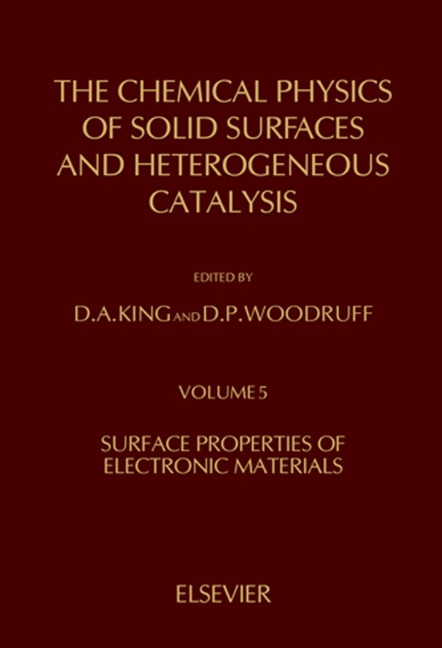
Surface Properties of Electronic Materials is the fifth volume of the series, The Chemical Physics of Solid Surfaces and Heterogeneous Catalysis. This volume indicates the present state of some basic properties of semiconductor surfaces. Chapter one summarizes the general problems in electronic materials and the areas affected by the surface science methods. The next two chapters illustrate the existing perception of the electronic and structural properties of elemental and compound semiconductor surfaces. This volume also deals with the properties of adsorption of semiconductors relating to both relevant gas phase species and metals. Chapters four to six of this volume explore compound semiconductors and elemental semiconductors. The remaining chapters of this volume explore the adsorption of metals on elemental semiconductors; aspects of growth kinetics and dynamics involved in molecular beam epitaxy; molecular beam epitaxy of silicon; insulators; and metastable phases. The last chapter covers the surface chemistry of dry etching processes.
PrefaceChapter 1 Surface science and electronic materials. An overview 1. Introduction 2. Semiconductor surfaces and interfaces 2.1 Surface states and space charge layers 2.2 Clean semiconductor surfaces 2.3 Normal semiconductor surfaces 3. Metal-semiconductor interfaces 3.1 Schottky barriers on semiconductors 3.2 Ohmic contacts 3.3 Metals on oxidised semiconductor surfaces 4. Semiconductor-semiconductor interfaces 4.1 Crystal growth 4.2 Band discontinuities 4.3 Insulators on semiconductors ReferencesChapter 2 Structural and electronic properties of elemental semiconductors and surfaces 1. Introduction 2. Bonding and electronic states in bulk silicon 3. The atomic geometry of the Si(100) (2 ×1) surface 4. The atomic geometry of the cleaved Si (111) (2 × 1) surface 5. The atomic geometry of the equilibrium Si(111) (7 × 7) surface 6. The "new reconstructions Acknowledgements ReferencesChapter 3 Atomic geometry and electronic structure of tetrahedrally coordinated compound semiconductor interfaces 1. Introduction 2. Zincblende(110) 2.1 Nomenclature and background 2.2 Structural chemistry 2.3 Theory 2.4 GaAs 2.5 Other binary semiconductors 3. Adsorbate structures on zincblende(110) 3.1 Al on GaAs(110). Reactive chemisorption 3.2 Sb on III-V(110). Saturated chemisorption 4. Polar surfaces of zincblende structure materials 4.1 GaAs(111)-(2 × 2) 4.2 GaAs(001) 4.3 GaAs(311) 5. Wurtzite structure materials. ZnO 6. Synopsis Acknowledgements ReferencesChapter 4 Adsorption and Schottky barrier formation on compound semiconductor surfaces 1. Introduction 2. Gas-phase adsorption 2.1 III-V substrates 2.2 Other compound semiconductor substrates 2.3 Future directions in gas-phase adsorption 3. Semiconductor adsorption on semiconductor substrates. Heterojunction interfaces 3.1 Band lineups. Theoretical aspects 3.2 Future directions. Band lineup control 4. Adsorption of metals. Schottky barrier formation 4.1 Historical background. A synopsis 4.2 The extended metal-semiconductor interface 4.3 Fermi level stabilization at clean interfaces 4.4 Buried metal-semiconductor interfaces 4.5 Control of interface electronic properties by atomic-scale techniques 4.6 Perspectives on Schottky barrier formation Acknowledgements ReferencesChapter 5 Adsorption on elemental semiconductors 1. Introduction 2. Preparation of clean surfaces 3. Intrinsic structure of Si surfaces 3.1 Structure model for Si(111) 2 x 1 3.2 Structure model for Si(111) 7 x 7 3.3 Structure model for Si(100) 4. Intrinsic structure of Ge surfaces 5. Adsorption on Si 5.1 The adsorption of hydrogen on Si 5.2 The adsorption of oxygen on Si 5.3 The adsorption of water on Si 5.4 The adsorption of fluorine on Si 5.5 The adsorption of noble gases on Si 6. Adsorption on Ge 6.1 The adsorption of hydrogen on Ge 6.2 The adsorption of oxygen on Ge 6.3 The adsorption of water on Ge 7. Summary Acknowledgements ReferencesChapter 6 Adsorption and reaction of metals on elemental semiconductors 1. Introduction 2. Structural evidence for the reaction at room temperature 3. The electronic states of suicides 3.1 Suicides of near noble metals 3.2 Suicides of refractory metals 3.3 Suicides of the precursors of transition metals 3.4 Noble metal-silicon systems 4. The interface reaction as seen with electronic state spectroscopy 5. A scheme for interface growth at room temperature 6.