Und dann auf "Zum Home-Bildschirm [+]".

Stöbern
genialokal zum Startbildschirm hinzufügen
Installieren Sie die genialokal App auf Ihrem Startbildschirm für einen schnellen Zugriff und eine komfortable Nutzung.
Installieren Sie die genialokal App auf Ihrem Startbildschirm für einen schnellen Zugriff und eine komfortable Nutzung.
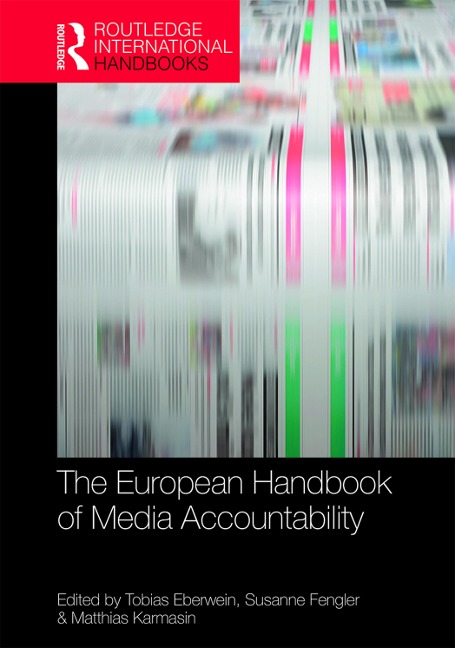
In recent years, the Leveson Inquiry in Great Britain, as well as the EU High-Level Group on Media Freedom and Pluralism, have stirred heated debates about media accountability and media self-regulation across Europe. How responsible are journalists? How well-developed are infrastructures of media self-regulation in the different European countries? How much commitment to media accountability is there in the media industry - and how actively do media users become involved in the process of media criticism via social media? With contributions from leading scholars in the field of journalism and mass communication, this handbook brings together reports on the status quo of media accountability in all EU members states as well as key countries close to Europe, such as Turkey and Israel. Each chapter provides an up-to-date overview of media accountability structures as well as a synopsis of relevant research, exploring the role of media accountability instruments in each national setting, including both media self-regulation (such as codes of ethics, press councils, ombudspersons) and new instruments that involve audiences and stakeholder groups (such as media blogs and user comment systems). A theoretically informed, cross-national comparative analysis of the state of media accountability in contemporary Europe, this handbook constitutes an invaluable basis for further research and policy-making and will appeal to students and scholars of media studies and journalism, as well as policy-makers and practitioners.
Tobias Eberwein is Senior Scientist at the Institute for Comparative Media and Communication Studies of the Austrian Academy of Sciences, Vienna, and the Alpen-Adria-Universität Klagenfurt, Austria. Susanne Fengler is Professor of International Journalism and Director of the Erich Brost Institute for International Journalism at TU Dortmund University, Germany. Matthias Karmasin is Professor at the Department of Media and Communications, Alpen-Adria-Universität Klagenfurt, and Director of the Institute for Comparative Media and Communication Studies at the Austrian Academy of Sciences and the Alpen-Adria-Universität Klagenfurt, Austria.
List of Contributors List of Figures and Tables Chapter 1. Introduction Tobias Eberwein, Susanne Fengler & Matthias Karmasin Chapter 2. Austria: Back on the Democratic Corporatist Road? Matthias Karmasin, Klaus Bichler & Andy Kaltenbrunner Chapter 3. Belgium: Divided Along Language Lines Karin Raeymaeckers & François Heinderyckx Chapter 4. Bulgaria: Regaining Media Freedom Bissera Zankova & Michal Glowacki Chapter 5. Croatia: Unfulfilled Expectations Stjepan Malovic Chapter 6. Cyprus: Behind Closed (Journalistic) Doors Dimitra L. Milioni, Lia-Paschalia Spyridou & Michalis Koumis Chapter 7. Czech Republic: The Market Governs TomáS Trampota Chapter 8. Denmark: Voluntary Accountability Driven by Political Pressure Mark Blach-Ørsten, Jannie Møller Hartley & Sofie Flensburg Chapter 9. Estonia: Conflicting Views on Accountability Practices Urmas Loit, Epp Lauk & Halliki Harro-Loit Chapter 10. Finland: The Empire Renewing Itself Jari Väliverronen & Heikki Heikkilä Chapter 11. France: Media Accountability as an Abstract Idea? Olivier Baisnée, Ludivine Balland & Sandra Vera Zambrano Chapter 12. Germany: Disregarded Diversity Tobias Eberwein, Susanne Fengler, Mariella Bastian & Janis Brinkmann Chapter 13. Greece: Between Systemic Inefficiencies and Nascent Opportunities Online Evangelia Psychogiopoulou & Anna Kandyla Chapter 14. Hungary: Difficult Legacy, Slow Transformation Agnes Urban Chapter 15. Ireland: Moving from Courts to Institutions of Accountability Roderick Flynn Chapter 16. Israel: Media in Political Handcuffs Noam Lemelshtrich Latar Chapter 17. Italy: Transparency as an Inspiration Sergio Splendore Chapter 18. Latvia: Different Journalistic Cultures and Different Accountability Within One Media System Ainars Dimants Chapter 19. Lithuania: The Ideology of Liberalism and Its Flaws in the Democratic Performance of the Media Kristina Juraite, Aukse Balcytiene & Audrone Nugaraite Chapter 20. Luxembourg: Low Priority in a Confined Milieu Mario Hirsch Chapter 21. Malta: Media Accountability as a Two-legged 'Tripod' Joseph Borg & Mary Anne Lauri Chapter 22. The Netherlands: From Awareness to Realization Harmen Groenhart & Huub Evers Chapter 23. Norway: Journalistic Power Limits Media Accountability Paul Bjerke Chapter 24. Poland: Accountability in the Making Boguslawa Dobek-Ostrowska, Michal Glowacki & Michal Kus Chapter 25. Portugal: Many Structures, Little Accountability Nuno Moutinho, Helena Lima, Suzana Cavaco & Ana Isabel Reis Chapter 26. Romania: Unexpected Pressures for Accountability Mihai Coman, Daniela-Aurelia Popa & Raluca-Nicoleta Radu Chapter 27. Russia: Media Accountability to the Public or the State? Elena Vartanova & Maria Lukina Chapter 28. Slovakia: Conditional Success of Ethical Regulation via Online Instruments Andrej skolkay Chapter 29. Slovenia: The Paper Tiger of Media Accountability Igor Vobic, Aleksander SaSo Slacek Brlek & Boris Mance Chapter 30. Spain: New Formats and Old Crises Salvador Alsius, Ruth Rodriguez-Martinez & Marcel Mauri de los Rios Chapter 31. Sweden: A Long History of Media Accountability Adaption Torbjörn von Krogh Chapter 32. Switzerland: Role Model with Glitches Colin Porlezza Chapter 33. Turkey: Sacrificing Credibility for Economic Expediency and Partisanship Ceren Sözeri Chapter 34. United Kingdom: Post-Leveson, Media Accountability is All Over the Place Mike Jempson, Wayne Powell & Sally Reardon Chapter 35. Summary: Measuring Media Accountability in Europe - and Beyond Tobias Eberwein, Susanne Fengler, Katja Kaufmann, Janis Brinkmann & Matthias Karmasin References Index
Dieses eBook wird im PDF-Format geliefert und ist mit einem Adobe Kopierschutz (DRM) versehen. Sie können dieses eBook mit allen Geräten lesen, die das PDF-Format und den Adobe Kopierschutz (DRM) unterstützen.
Zum Beispiel mit den folgenden Geräten:
• tolino Reader
Laden Sie das eBook direkt über den Reader-Shop auf dem tolino herunter oder übertragen Sie das eBook auf Ihren tolino mit einer kostenlosen Software wie beispielsweise Adobe Digital Editions.
• Sony Reader & andere eBook Reader
Laden Sie das eBook direkt über den Reader-Shop herunter oder übertragen Sie das eBook mit der kostenlosen Software Sony READER FOR PC/Mac oder Adobe Digital Editions auf ein Standard-Lesegeräte mit epub- und Adobe DRM-Unterstützung.
• Tablets & Smartphones
Möchten Sie dieses eBook auf Ihrem Smartphone oder Tablet lesen, finden Sie hier unsere kostenlose Lese-App für iPhone/iPad und Android Smartphone/Tablets.
• PC & Mac
Lesen Sie das eBook direkt nach dem Herunterladen mit einer kostenlosen Lesesoftware, beispielsweise Adobe Digital Editions, Sony READER FOR PC/Mac oder direkt über Ihre eBook-Bibliothek in Ihrem Konto unter „Meine eBooks“ - „online lesen“.
Schalten Sie das eBook mit Ihrer persönlichen Adobe ID auf bis zu sechs Geräten gleichzeitig frei.
Bitte beachten Sie, dass die Kindle-Geräte das Format nicht unterstützen und dieses eBook somit nicht auf Kindle-Geräten lesbar ist.