Und dann auf "Zum Home-Bildschirm [+]".

Stöbern
genialokal zum Startbildschirm hinzufügen
Installieren Sie die genialokal App auf Ihrem Startbildschirm für einen schnellen Zugriff und eine komfortable Nutzung.
Installieren Sie die genialokal App auf Ihrem Startbildschirm für einen schnellen Zugriff und eine komfortable Nutzung.
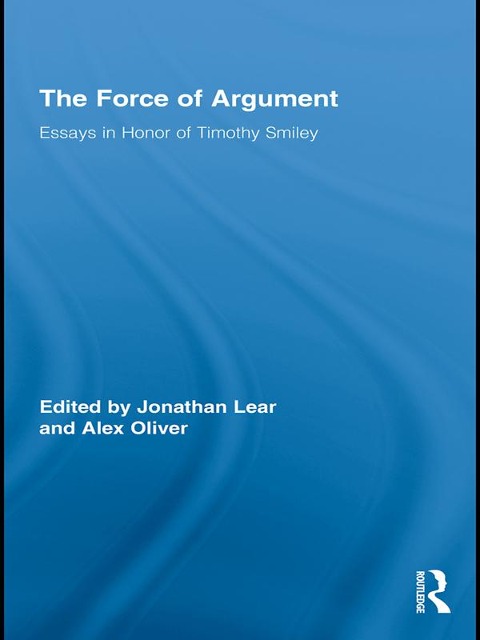
Timothy Smiley has made ground-breaking contributions to modal logic, free logic, multiple-conclusion logic, and plural logic; he has illuminated Aristotle's syllogistic, the ideas of logical form and consequence, and the distinction between assertion and rejection; and his debunking work on the theory of descriptions is a tour de force. In this volume, an international roster of contributors discuss Smiley's work to date; their essays will be of significant interest to those working across the logical spectrum-in philosophy of language, philosophical logic and mathematical logic.
Alex Oliver is Reader in Philosophy, Faculty of Philosophy, University of Cambridge, UK. Jonathan Lear is the John U. Nef Distinguished Service Professor at the Committee on Social Thought and in the Department of Philosophy, University of Chicago, USA.
Preface Acknowledgments 1. Philosophy in and out of the armchair, Kwame Anthony Appiah 2. Restricted quantifiers and logical theory, Thomas Baldwin 3. Logical form, James Cargile 4. The Socratic elenchus: no problem, James Doyle 5. What makes mathematics mathematics?, Ian Hacking 6. Smiley's distinction between rules of inference and rules of proof, Lloyd Humberstone 7. Relative validity and vagueness, Rosanna Keefe 8. The force of irony, Jonathan Lear 9. The matter of form: logic's beginnings, Alex Oliver 10. Abstractionist class theory: is there any such thing?, Michael Potter 11. A case of mistaken identity?, Graham Priest 12. Inferential semantics for first-order logic: motivating rules of inference from rules of evaluation, Neil Tennant List of contributors Bibliography of works by Timothy Smile Index
Dieses eBook wird im PDF-Format geliefert und ist mit einem Adobe Kopierschutz (DRM) versehen. Sie können dieses eBook mit allen Geräten lesen, die das PDF-Format und den Adobe Kopierschutz (DRM) unterstützen.
Zum Beispiel mit den folgenden Geräten:
• tolino Reader
Laden Sie das eBook direkt über den Reader-Shop auf dem tolino herunter oder übertragen Sie das eBook auf Ihren tolino mit einer kostenlosen Software wie beispielsweise Adobe Digital Editions.
• Sony Reader & andere eBook Reader
Laden Sie das eBook direkt über den Reader-Shop herunter oder übertragen Sie das eBook mit der kostenlosen Software Sony READER FOR PC/Mac oder Adobe Digital Editions auf ein Standard-Lesegeräte mit epub- und Adobe DRM-Unterstützung.
• Tablets & Smartphones
Möchten Sie dieses eBook auf Ihrem Smartphone oder Tablet lesen, finden Sie hier unsere kostenlose Lese-App für iPhone/iPad und Android Smartphone/Tablets.
• PC & Mac
Lesen Sie das eBook direkt nach dem Herunterladen mit einer kostenlosen Lesesoftware, beispielsweise Adobe Digital Editions, Sony READER FOR PC/Mac oder direkt über Ihre eBook-Bibliothek in Ihrem Konto unter „Meine eBooks“ - „online lesen“.
Schalten Sie das eBook mit Ihrer persönlichen Adobe ID auf bis zu sechs Geräten gleichzeitig frei.
Bitte beachten Sie, dass die Kindle-Geräte das Format nicht unterstützen und dieses eBook somit nicht auf Kindle-Geräten lesbar ist.