Und dann auf "Zum Home-Bildschirm [+]".

Stöbern
genialokal zum Startbildschirm hinzufügen
Installieren Sie die genialokal App auf Ihrem Startbildschirm für einen schnellen Zugriff und eine komfortable Nutzung.
Installieren Sie die genialokal App auf Ihrem Startbildschirm für einen schnellen Zugriff und eine komfortable Nutzung.
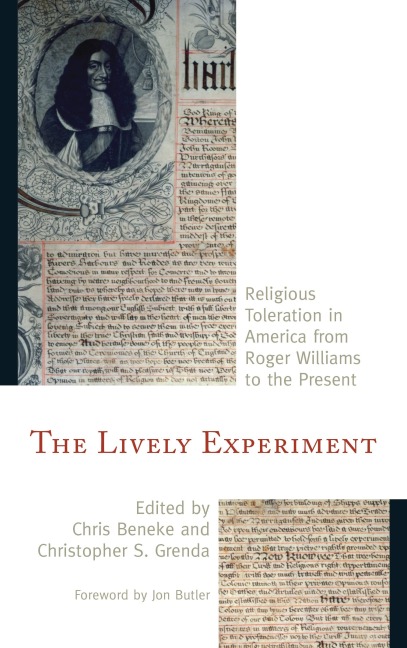
Three hundred and fifty years ago, Roger Williams launched one of the world's first great experiments in religious toleration. Insisting that religion be separated from civil power, he founded Rhode Island, a colony that welcomed people of many faiths. Though stark forms of intolerance persisted, Williams' commitments to faith and liberty of conscience came to define the nation and its conception of itself. Through crisp essays that show how Americans demolished old prejudices while inventing new ones, The Lively Experiment offers a comprehensive account of America's boisterous history of interreligious relations.
Chris Beneke is associate professor of history at Bentley University.
Christopher S. Grenda is associate professor of history at Bronx Community College of CUNY.
Introduction, Chris Beneke and Christopher S. Grenda
Part One. Roger Williams and the Seventeenth-Century's Lively Experiments
Chapter 1. "How Special was Rhode Island? The Global Context of the 1663 Charter" Evan Haefeli
Chapter 2. "'Livelie Experiment' and 'Holy Experiment': Two Trajectories of Religious Liberty" Andrew R. Murphy
Chapter 3. "Toleration and Tolerance in Early Modern England" Scott Sowerby
Chapter 4. "'When the Word of The Lord Runs Freely': Roger Williams and Evangelical Toleration" Teresa Bejan
Part Two. Toleration, Revival, and Enlightenment in the Long Eighteenth Century
Chapter 5. "Muslims, Toleration, and Civil Rights, from Roger Williams to Thomas Jefferson" Denise Spellberg
Chapter 6. "'An encroachment on our religious rights': Methodist Missions, Slavery, and Religious Toleration in the British Atlantic World" Christopher C. Jones
Chapter 7. "Between God and our own Souls: The Discussion over Toleration in Eighteenth-Century America" Keith Pacholl
Part Three. Divisions Within: Protestants and Catholics in the New Nation
Chapter 8. "'Enlightened, Tolerant, and Liberal': Catholic Influences on Religious Liberty in the New Republic." Nicholas Pellegrino
Chapter 9. "Contentious Unity and Tolerant Schisms: Partisanship and 'Internal' Toleration in Early National Charleston and New York" Susanna Linsley
Chapter 10. "The Nineteenth-Century 'School Question': An Episode in Religious Intolerance or an Expansion of Religious Freedom?" Steven Green
Part Four. Pluralism and Its Discontents: Late Nineteenth and Early Twentieth-Century Contests Over Religious Difference
Chapter 11. "There is no such thing as a reverend of no church": Incarcerated Children, Nonsectarian Religion, and Freedom of Worship in Gilded Age New York City" Jacob Betz
Chapter 12. "The Cost of Inclusion: Interfaith Unity and Intra-Faith Division in the Formation of Protestant-Catholic-Jewish America" David Mislin
Chapter 13. "Dog Tags: Religious Toleration and the Politics of American Military Identification" Ronit Stahl
Part Five. Ecumenism's Paradoxes: Religious Dissent and the Redefinition of the Modern Religious Mainstream
Chapter 14. "'This Is a Mighty Warfare that We Are Engaged In:' Pentecostals in Early Twentieth-Century New England" Evelyn Sterne
Chapter 15. "How the Persecution of Jehovah's Witnesses Changed American Law and Religion" Shawn Francis Peters
Chapter 16. "The First Mormon Moment: The Latter-Day Saints in American Culture 1940-65" Christine Hutchison-Jones
Chapter 17. "Fundamentalists Under Fire: Carl McIntire, Billy James Hargis, and State Censorship of Religious Broadcasting" Paul Matzko
Part Six. Civil or Religious?: The New Boundaries of Religious Tolerance
Chapter 18. "Neither Spiritual nor Religious: The Anti-Cult Movement, Intolerance, and the Invention of Non-religious Religions" James Bennett
Chapter 19. "America Beyond Civil Religion: The Anabaptist Experience" Kip Wedel
Dieses eBook wird im PDF-Format geliefert und ist mit einem Adobe Kopierschutz (DRM) versehen. Sie können dieses eBook mit allen Geräten lesen, die das PDF-Format und den Adobe Kopierschutz (DRM) unterstützen.
Zum Beispiel mit den folgenden Geräten:
• tolino Reader
Laden Sie das eBook direkt über den Reader-Shop auf dem tolino herunter oder übertragen Sie das eBook auf Ihren tolino mit einer kostenlosen Software wie beispielsweise Adobe Digital Editions.
• Sony Reader & andere eBook Reader
Laden Sie das eBook direkt über den Reader-Shop herunter oder übertragen Sie das eBook mit der kostenlosen Software Sony READER FOR PC/Mac oder Adobe Digital Editions auf ein Standard-Lesegeräte mit epub- und Adobe DRM-Unterstützung.
• Tablets & Smartphones
Möchten Sie dieses eBook auf Ihrem Smartphone oder Tablet lesen, finden Sie hier unsere kostenlose Lese-App für iPhone/iPad und Android Smartphone/Tablets.
• PC & Mac
Lesen Sie das eBook direkt nach dem Herunterladen mit einer kostenlosen Lesesoftware, beispielsweise Adobe Digital Editions, Sony READER FOR PC/Mac oder direkt über Ihre eBook-Bibliothek in Ihrem Konto unter „Meine eBooks“ - „online lesen“.
Schalten Sie das eBook mit Ihrer persönlichen Adobe ID auf bis zu sechs Geräten gleichzeitig frei.
Bitte beachten Sie, dass die Kindle-Geräte das Format nicht unterstützen und dieses eBook somit nicht auf Kindle-Geräten lesbar ist.