Und dann auf "Zum Home-Bildschirm [+]".

Stöbern
genialokal zum Startbildschirm hinzufügen
Installieren Sie die genialokal App auf Ihrem Startbildschirm für einen schnellen Zugriff und eine komfortable Nutzung.
Installieren Sie die genialokal App auf Ihrem Startbildschirm für einen schnellen Zugriff und eine komfortable Nutzung.


Ihr gewünschter Artikel ist in 0 Buchhandlungen vorrätig - wählen Sie hier eine Buchhandlung in Ihrer Nähe aus:

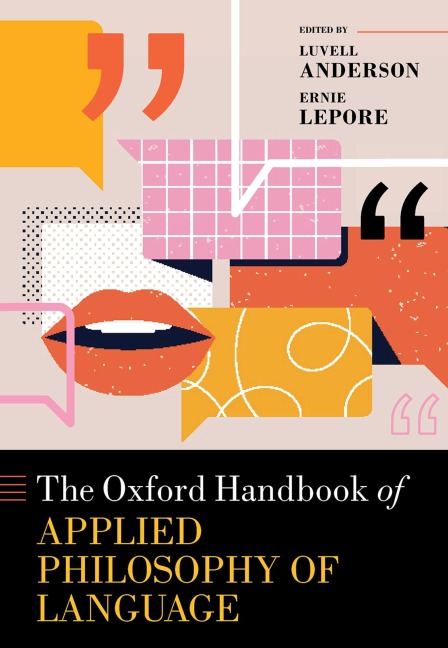
This Handbook represents a collective exploration of the emerging field of applied philosophy of language, where philosophy engages with linguistic aspects of our social world. It explores such hot topics as dehumanizing speech, dogwhistles, taboo language, pornography, appropriation, implicit bias, speech acts, and the ethics of communication.
Luvell Anderson is Associate Professor of Philosophy and Affiliate Faculty in African American Studies and Women's and Gender Studies at Syracuse University. Before coming to Syracuse, he was an assistant professor of philosophy at the University of Memphis and Alain Locke Postdoctoral Fellow at Pennsylvania State University. His research lies principally in Philosophy of Language, Philosophy of Humor, and Philosophy of Race. He has published articles on the semantics of racial slurs and racist humor, and is co-editor of the Routledge Companion to the Philosophy of Race (Routledge Press). Professor Anderson is currently working on a book, The Ethics of Racial Humor, which explores themes of race, humor, and the connection between ethics and aesthetics.
Ernie Lepore is Board of Governors Professor of Philosophy at Rutgers University. He has authored numerous books and papers in the philosophy of language, philosophical logic, metaphysics and philosophy of mind, including recently Imagination and Convention (with Matthew Stone, OUP, 2015), and Liberating Content (2016) with Herman Cappelen. He is the co-editor of The Oxford Handbook of Contemporary Philosophy of Language (with Una Stojnic, 2024) and of the series Oxford Studies in Philosophy of Language, with David Sosa.
- 1: Luvell Anderson and Ernie Lepore: Introduction
- 2: Sally Haslanger and Stephen Yablo: Amelioration as Course Correction
- 3: Ángeles Eraña and Axel Barceló: A world where many worlds fit
- 4: J. L. Dowell: Silencing and Assertion: An Account of their Conversational Dynamic
- 5: Quill R. Kukla: The Pragmatics of Technologically Mediated Online Speech: Don't @ Me!
- 6: Robin Jeshion: The Truth About Slurs
- 7: Una Stojni- and Ernie Lepore: Slurring Words
- 8: Rebecca Roache: On Passive Aggression
- 9: Timothy Jay: Taboo Word Research: Problems from the Past, Plans for the Future
- 10: Louise Antony: Speech-Act Theory in Feminist Thought
- 11: Mari Mikkola: Pornography as Oppressive Speech
- 12: Cameron Domenico Kirk-Giannini and Michael Glanzberg: Pronouns and Gender
- 13: E. M. Hernandez and Archie Crowley: How to Do Things with Gendered Words
- 14: Iz González Vázquez, Martina Rosola, and Anna Klieber: Beyond Pronouns: Gender Visibility and Neutrality across Languages
- 15: Anita L. Allen: Privacy, Critical Definition and Racial Justice
- 16: Jules Holroyd and Matthew J. Cull: Gender-neutrality and family leave policies
- 17: Esa Saarinen: In Praise of Spoken Philosophy
- 18: Teresa Blankmeyer Burke: Boxed Ears and Swiveling Fists: American Sign Language, Audism, and Power
- 19: Luvell Anderson: Resistance and Reclamation: Notorious Thugs
- 20: José Medina: Public Protest and Silencing
- 21: Jeffrey King: The Contents of Maps
- 22: Gabriel Greenberg: Map Semantics and the Geography of Meaning
- 23: John Kulvicki: The Semantics of Iconography and Code Words
- 24: Ray Drainville and Jennifer Saul: Visual and Linguistic Dogwhistles
- 25: erman Cappelen and Josh Dever: AI with Alien Content and Alien Metasemantics H
- 26: Daian Flórez: Semantic Change in the Language of Technology
- 27: Eliot Michaelson, Jessica Pepp, and Rachel Sterken: On Retweeting
- 28: Matthew McKeever: Ideology and Intersectionality
- 29: Tina Chanter and Andrew Cutrofello: Shakespeare's Proper Names
- 30: Noël Carroll: Art and Language