Und dann auf "Zum Home-Bildschirm [+]".

Stöbern
genialokal zum Startbildschirm hinzufügen
Installieren Sie die genialokal App auf Ihrem Startbildschirm für einen schnellen Zugriff und eine komfortable Nutzung.
Installieren Sie die genialokal App auf Ihrem Startbildschirm für einen schnellen Zugriff und eine komfortable Nutzung.
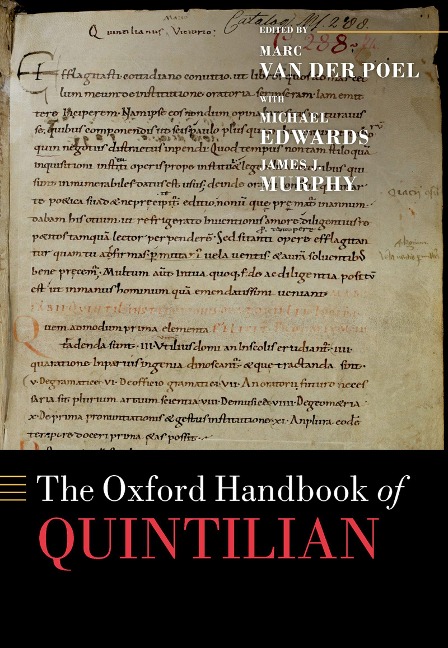
M. Fabius Quintilianus was a prominent orator, declaimer, and teacher of eloquence in the first century CE. After his retirement, he wrote the Institutio oratoria, a unique treatise in antiquity because it is both a handbook of rhetoric and an educational treatise. Quintilian's fame and influence are not only based on the Institutio, but also on the two collections of Declamations which were later attributed to him. The Oxford Handbook of Quintilian aims to present Quintilian's Institutio as a key treatise in the history of Greco-Roman rhetoric and to trace its influence on the theory and practice of rhetoric and education up to the present day. Topics include Quintilian's educational programme, his concepts and classifications of rhetoric, his discussion of the five canons of rhetoric, his style, his views on literary criticism, declamation, and the relationship between rhetoric and law, and the importance of the visual and performing arts in his work. His legacy is presented in successive chapters devoted to Quintilian in late antiquity, the Middle Ages, the Italian Renaissance, Northern Europe during the Renaissance, Europe from the eighteenth to the twentieth century, and the United States of America. Other chapters examine the biographical tradition, the history of printed editions, and modern assessments of Quintilian. The contributors represent a wide range of expertise and scholarly traditions, offering a unique, multidisciplinary perspective.
Marc van der Poel is Professor of Latin language and literature at Radboud Universty, The Netherlands, since 1999, where he teaches classical Latin; he has served in various managent functions, including head of the classics department and associate dean of the faculty of arts. He is currently the President of the international Society for the History of Rhetoric (2019-2022). His expertise includes Latin ancient literature, philological study of Latin texts, ancient rhetoric, and the history of rhetoric. He is preparing a new, critical edition with a commentary of Rudolph Agricola's De inventione dialectica. James J. Murphy is Professor Emeritus of Rhetoric at the University of California, Davis. Throughout his long career, his work has been focused on establishing historical connections and the continuity of classical rhetoric, in particular Latin rhetoric, in the intellectual, educational and political contexts of the postclassical Western world. A substantial part of his work revolves around the instruction of oral and written rhetoric from the Middle Ages in Europe until the present day in the United States of America. Michael Edwards is Honorary Research Fellow at Royal Holloway, University of London. He was formerly Professor of Classics at Queen Mary, University of London, the University of Wales Trinity Saint David, and the University of Roehampton, where he was Head of Humanities. He was Director of the Institute of Classical Studies in the University of London, and was President of the International Society for the History of Rhetoric. His primary research interest is in the Attic Orators, on whom he has published extensively. He is preparing an Oxford Classical Text of Isaeus and a commentary on Aeschines' speech Against Ctesiphon.
- Introduction - Part I: Life of Quintilian, and Quintilian Editions and Translations - 1: Marc van der Poel: Quintilian: The Biographical Tradition - 2: Marc van der Poel: Interpretative Survey of Quintilian Editions and Translations from 1470 until the Present - Part II: Quintilian's Rhetoric: The Institutio oratoria in Detail - 3: James J. Murphy: The Structure and Contents of the Institutio oratoria - 4: Marc van der Poel: Quintilian's Underlying Educational Programme - 5: Gesine Manuwald: Quintilian's Concept and Classifications of Rhetoric - 6: Lucia Calboli Montefusco: Quintilian on Invention and Disposition - 7: Jeanne Fahnestock: Quintilian on Effective Language - 8: D.S. Levene: Quintilian on Memory and Delivery - Part III: Quintilian In Context - 9: Richard Leo Enos: Quintilian in the Greco-Roman Rhetorical Tradition - 10: Thomas Zinsmaier: Quintilian as Master of Prose - 11: Francisco Chico Rico: Quintilian as a Literary Critic - 12: Bé Breij,: Quintilian and Declamation - 13: Olga Tellegen-Couperus: Quintilian and the Law - 14: Lucía Díaz Marroquín: Quintilian and the Performing Arts - 15: Jane Masséglia: Quintilian and Visual Art - Part IV Quintilian in History - 16: Catherine Schneider: Quintilian in Late Antiquity (from Lactantius to Isidore of Seville) - 17: Elizabeth Kuhl: Quintilian in the Renaissance of the Twelfth Century - 18: Virginia Cox: Quintilian in the Italian Renaissance - 19: Peter Mack: Quintilian in Northern Europe during the Renaissance, 1479-1620 - 20: Thomas Schirren: Quintilian in Europe from the Eighteenth to the Twentieth Century - 21: Richard A. Katula and Cleve Wiese: Quintilian in the United States of America - 22: William J. Dominik: Modern Assessments of Quintilian
Dieses eBook wird im PDF-Format geliefert und ist mit einem Adobe Kopierschutz (DRM) versehen. Sie können dieses eBook mit allen Geräten lesen, die das PDF-Format und den Adobe Kopierschutz (DRM) unterstützen.
Zum Beispiel mit den folgenden Geräten:
• tolino Reader
Laden Sie das eBook direkt über den Reader-Shop auf dem tolino herunter oder übertragen Sie das eBook auf Ihren tolino mit einer kostenlosen Software wie beispielsweise Adobe Digital Editions.
• Sony Reader & andere eBook Reader
Laden Sie das eBook direkt über den Reader-Shop herunter oder übertragen Sie das eBook mit der kostenlosen Software Sony READER FOR PC/Mac oder Adobe Digital Editions auf ein Standard-Lesegeräte mit epub- und Adobe DRM-Unterstützung.
• Tablets & Smartphones
Möchten Sie dieses eBook auf Ihrem Smartphone oder Tablet lesen, finden Sie hier unsere kostenlose Lese-App für iPhone/iPad und Android Smartphone/Tablets.
• PC & Mac
Lesen Sie das eBook direkt nach dem Herunterladen mit einer kostenlosen Lesesoftware, beispielsweise Adobe Digital Editions, Sony READER FOR PC/Mac oder direkt über Ihre eBook-Bibliothek in Ihrem Konto unter „Meine eBooks“ - „online lesen“.
Schalten Sie das eBook mit Ihrer persönlichen Adobe ID auf bis zu sechs Geräten gleichzeitig frei.
Bitte beachten Sie, dass die Kindle-Geräte das Format nicht unterstützen und dieses eBook somit nicht auf Kindle-Geräten lesbar ist.