Und dann auf "Zum Home-Bildschirm [+]".

Stöbern
genialokal zum Startbildschirm hinzufügen
Installieren Sie die genialokal App auf Ihrem Startbildschirm für einen schnellen Zugriff und eine komfortable Nutzung.
Installieren Sie die genialokal App auf Ihrem Startbildschirm für einen schnellen Zugriff und eine komfortable Nutzung.
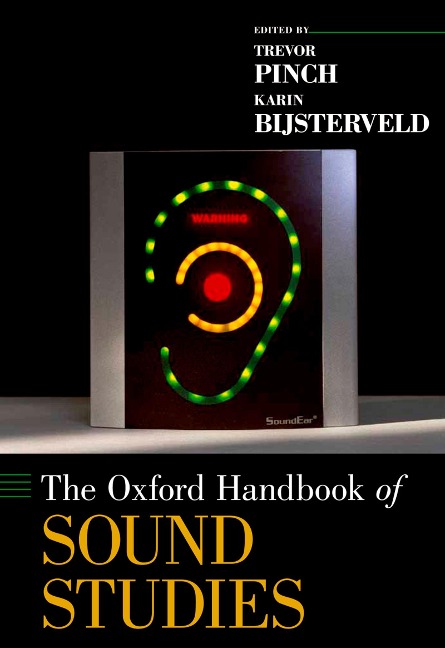
Written by the world's leading scholars and researchers in the emerging field of sound studies, The Oxford Handbook of Sound Studies offers new and fully engaging perspectives on the significance of sound in its material and cultural forms. The book considers sounds and music as experienced in such diverse settings as shop floors, laboratories, clinics, design studios, homes, and clubs, across an impressively broad range of historical periods and national and cultural contexts. Science has traditionally been understood as a visual matter, a study which has historically been undertaken with optical technologies such as slides, graphs, and telescopes. This book questions that notion powerfully by showing how listening has contributed to scientific practice. Sounds have always been a part of human experience, shaping and transforming the world in which we live in ways that often go unnoticed. Sounds and music, the authors argue, are embedded in the fabric of everyday life, art, commerce, and politics in ways which impact our perception of the world. Through an extraordinarily diverse set of case studies, authors illustrate how sounds -- from the sounds of industrialization, to the sounds of automobiles, to sounds in underwater music and hip-hop, to the sounds of nanotechnology -- give rise to new forms listening practices. In addition, the book discusses the rise of new public problems such as noise pollution, hearing loss, and the "end" of the amateur musician that stem from the spread and appropriation of new sound- and music-related technologies, analog and digital, in many domains of life. Rich in vivid and detailed examples and compelling case studies, and featuring a companion website of listening samples, this remarkable volume boldly challenges readers to rethink the way they hear and understand the world.
Trevor Pinch is Professor of Science and Technology Studies at Cornell University, and author or co-author of several books including Analog Days: The Invention and Impact of the Moog Synthesizer (2002, with Frank Trocco) and The Golem at Large: What You Should Know About Technology (1993, 1998, with Harry Collins). Karin Bijsterveld is Professor of Science, Technology and Modern Culture at Maastricht University. She is author of Mechanical Sound: Technology, Culture and Public Problems of Noise in the Twentieth Century (2008), and co-editor of Sound Souvenirs: Audio Technologies, Memory and Cultural Practices (2009, with José van Dijck).
Contributors List of Figures Introduction: New Keys to the World of Sound - Trevor Pinch and Karin Bijsterveld SECTION I: REWORKING MACHINE SOUND: SHOP FLOOR & TEST SITES 1. The Garden in the Machine: Listening to Early American Industrialization - Mark M. Smith 2. Turning a Deaf Ear? Industrial Noise and Noise Control in Germany since the 1920s - Hans-Joachim Braun 3. "Sobbing, whining, rumbling": Listening to Automobiles as Social Practice - Stefan Krebs 4. Selling Sound: Testing, Designing, and Marketing Sound in the European Car Industry - Eefje Cleophas and Karin Bijsterveld SECTION II: STAGING SOUND FOR SCIENCE AND ART: THE FIELD 5. Sound Sterile: Making Scientific Field Recordings in Ornithology - Joeri Bruyninckx 6. Underwater Music: Tuning Composition to the Sounds of Science - Stefan Helmreich 7. A Grey Box: The Phonograph in Laboratory Experiments and Field Work, 1900-1920 - Julia Kursell SECTION III. STAGING SOUND FOR SCIENCE AND ART: THE LAB 8. From Scientific Instruments to Musical Instruments: The Tuning Fork, Metronome, and Siren - Myles W. Jackson 9. Conversions: Sound and Sight, Military and Civilian - Cyrus Mody 10. The Search for the 'Killer Application': Drawing the Boundaries Around the Sonification of Scientific Data - Alexandra Supper SECTION IV: SPEAKING FOR THE BODY: THE CLINIC 11. Inner and Outer Sancta: Ear Plugs and Hospitals - Hillel Schwartz 12. Sounding Bodies: Medical Studies and the Acquisition of Stethoscopic Perspectives - Tom Rice 13. Do Signals Have Politics? Inscribing Abilities in Cochlear Implants - Mara Mills SECTION V: EDITING SOUND: THE DESIGN STUDIO 14. Sound and Player Immersion in Digital Games - Mark Grimshaw 15. The Sonic Playpen: Sound Design and Technology in Pixar's Animated Shorts - William Whittington 16. The Avant-garde in the Family Room: American Advertising and the Domestication of Electronic Music in the 1960s and 1970s - Timothy Taylor SECTION VI: CONSUMING SOUND AND MUSIC: THE HOME AND BEYOND 17. Visibly Audible: The Radio Dial as Mediating Interface - Andreas Fickers 18. From Listening to Distribution: Non-official Music Practices in Hungary and Czechoslovakia from the 1960s to the 1980s - Trever Hagen with Tia DeNora 19.The Amateur in the Age of Mechanical Music - Mark Katz 20. Online Music Sites as Sonic Sociotechnical Communities: Identity, Reputation, and Technology at ACIDplanet.com - Trevor Pinch and Katherine Athanasiades SECTION VII: MOVING SOUND AND MUSIC: DIGITAL STORAGE 21. Analog turns Digital: Hip-hop, Technology, and the Maintenance of Racial Authenticity - Ray Fouche 22. iPod Culture: The Toxic Pleasures of Audiotopia - Michael Bull 23. The Recording that Never Wanted to be Heard, and Other Stories of Sonification - Jonathan Sterne and Mitchell Akiyama Index
Dieses eBook wird im PDF-Format geliefert und ist mit einem Adobe Kopierschutz (DRM) versehen. Sie können dieses eBook mit allen Geräten lesen, die das PDF-Format und den Adobe Kopierschutz (DRM) unterstützen.
Zum Beispiel mit den folgenden Geräten:
• tolino Reader
Laden Sie das eBook direkt über den Reader-Shop auf dem tolino herunter oder übertragen Sie das eBook auf Ihren tolino mit einer kostenlosen Software wie beispielsweise Adobe Digital Editions.
• Sony Reader & andere eBook Reader
Laden Sie das eBook direkt über den Reader-Shop herunter oder übertragen Sie das eBook mit der kostenlosen Software Sony READER FOR PC/Mac oder Adobe Digital Editions auf ein Standard-Lesegeräte mit epub- und Adobe DRM-Unterstützung.
• Tablets & Smartphones
Möchten Sie dieses eBook auf Ihrem Smartphone oder Tablet lesen, finden Sie hier unsere kostenlose Lese-App für iPhone/iPad und Android Smartphone/Tablets.
• PC & Mac
Lesen Sie das eBook direkt nach dem Herunterladen mit einer kostenlosen Lesesoftware, beispielsweise Adobe Digital Editions, Sony READER FOR PC/Mac oder direkt über Ihre eBook-Bibliothek in Ihrem Konto unter „Meine eBooks“ - „online lesen“.
Schalten Sie das eBook mit Ihrer persönlichen Adobe ID auf bis zu sechs Geräten gleichzeitig frei.
Bitte beachten Sie, dass die Kindle-Geräte das Format nicht unterstützen und dieses eBook somit nicht auf Kindle-Geräten lesbar ist.