Und dann auf "Zum Home-Bildschirm [+]".

Stöbern
genialokal zum Startbildschirm hinzufügen
Installieren Sie die genialokal App auf Ihrem Startbildschirm für einen schnellen Zugriff und eine komfortable Nutzung.
Installieren Sie die genialokal App auf Ihrem Startbildschirm für einen schnellen Zugriff und eine komfortable Nutzung.
Ihr gewünschter Artikel ist in 0 Buchhandlungen vorrätig - wählen Sie hier eine Buchhandlung in Ihrer Nähe aus:

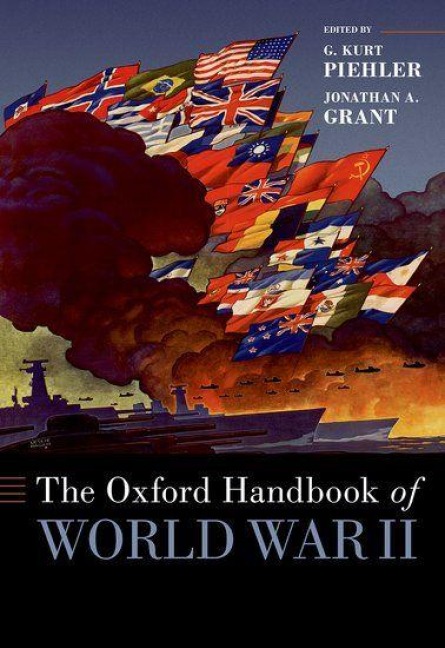
World War II left virtually no nation or corner of the world untouched, dramatically transforming human life and society. It prompted the unprecedented mobilization of whole societies and witnessed a scale of state-sanctioned violence that staggers the imagination, with more than 100 million casualties. The war resulted in an almost complete collapse of any norms geared toward avoiding the unnecessary loss of civilian life and shaped the worldview and psyches of generations. The Oxford Handbook of World War II broadens traditional narratives of the war and in the process changes our understanding of this epic conflict. Organized both chronologically and thematically and with particular attention to the pre- and post-war eras, the Handbook revises and extends existing scholarship. With chapters on the rise and fall of Nazi Germany, the land war in Western Europe, the Battle of Britain, the impact of war on the major combatants (Great Britain, France, the United States, Japan, and China), the Japanese attack on Pearl Harbor, the decision to use the atomic bomb in 1945, and the cultural responses to the war, the chapters span much of the twentieth century. They suggest areas of scholarly consensus, identify interpretative clashes, and propose agendas for further scholarly investigation, with an emphasis on interdisciplinary inquiry. For example, the end of the Cold War had a profound impact on the way World War II was understood. Many formerly closed records in the former Soviet Union and China were opened to scholars, facilitating a more complex view of the Soviet war effort and suggesting that Stalin's army did not simply triumph by overwhelming German forces with sheer numbers but mastered the demands of a vast and logistically demanding front. In conceptualizing the volume, editors Kurt Piehler and Jonathan Grant also sought out contributions on lesser known aspects of the war, such as the Bengal famine in India, the treatment of prisoners of war, the role of Middle Eastern nations, and the activities of non-governmental organizations in ameliorating suffering. Spanning the rise and fall of the Versailles system to the postwar reintegration of veterans and the eventual commemoration of the conflict and its victims, The Oxford Handbook of World War II marks a landmark contribution to the historical literature of war.
G. Kurt Piehler is Director of the Institute on World War II and the Human Experience of World War II and Associate Professor of History at Florida State University. His research centers on war and society with a focus on World War II. As founding director of the Rutgers Oral History Archives (1994-1998) he has interviewed more than 200 veterans of World War II. He is the author of Remembering War the American Way, and A Religious History of the American GI in World War II, and consulting editor for The Oxford Companion to American Military History. Jonathan A. Grant is Professor of Modern Russian History at Florida State University in Tallahassee. His most recent book, Between Depression and Disarmament, examines the armaments business in Eastern Europe 1919-1939.
- Contributors - Introduction - G. Kurt Piehler and Jonathan Grant - Chapter 1: The Collapse of the Versailles System - Michael Creswell - Chapter 2: Ideological Origins of World War II - Vladimir Tismaneanu and Bogdan C. Iacob - Chapter 3: The Spanish Civil War - Peter Garretson and S. P. McVeigh - Chapter 4: The Sino-Japanese War - Gao Bei - Chapter 5: Forging Alliances: The Axis - Ricky W. Law - Chapter 6: German Victories, 1939-1940 - Eugenia C. Kiesling - Chapter 7: The Battle of Britain: Britain and the British Empire Alone - Andrew Stewart - Chapter 8: The Battle of the Atlantic - Marc Milner - Chapter 9: The Axis of the Soviet Union, 1941-1943 - Jonathan Grant - Chapter 10: The Middle East during World War II- Hakan Güngör and Peter Garretso - Chapter 11: Pearl Harbor and Japan Ascendant - Sidney Pash - Chapter 12: The United Nations and the Grand Alliance - David B. Woolner - Chapter 13: The Air War: Germany and Italy - M. Houston Johnson - Chapter 14: North Africa and Italy - Douglas Porch - Chapter 15: Eastern Europe in World War II - Deborah Cornelius and Jonathan A. Grant - Chapter 16: The Eastern Front, 1943-1945 - David Stone - Chapter 17: From D-Day to the Elbe - Peter Mansoor - Chapter 18: The Land War in Asia: China, Burma, and India - Alan Jeffreys - Chapter 19: The Pacific War - Kyle P. Bracken - Chapter 20: The Air War and Conflict Termination in the Pacific - Conrad C. Crane - Chapter 21: Home Fronts at War - Judy Barrett Litoff - Chapter 22: Neutral Powers in a Global War - Neville Wylie - Chapter 23: Western Religious Leaders, Communities, and Organizations before and during the Second World War - Victoria J. Barnett - Chapter 24: Science and Technology - Ronald E. Doel and Kristine C. Harper - Chapter 25: The Environmental Impact - Charles Closmann - Chapter 26: Medicine and Disability - John Kinder - Chapter 27: The Holocaust - Jan Ruth Mills - Chapter 28: The Humanitarian Response - Hillary Sebeny - Chapter 29: Rendering Justice - Michael Bryant and James Sedgwick - Chapter 30: Cultural Responses to Total War - Annika Culver - Chapter 31: Postwar Settlements and Internationalism - Regina Gramer and Yutaka Sasaki - Chapter 32: Reintegrating Veterans and Demobilizing Populations - R. M. Douglas - Chapter 33: The Memory and Commemoration of War - Brian M. Puaca and Shizue Osa