Und dann auf "Zum Home-Bildschirm [+]".

Stöbern
genialokal zum Startbildschirm hinzufügen
Installieren Sie die genialokal App auf Ihrem Startbildschirm für einen schnellen Zugriff und eine komfortable Nutzung.
Installieren Sie die genialokal App auf Ihrem Startbildschirm für einen schnellen Zugriff und eine komfortable Nutzung.
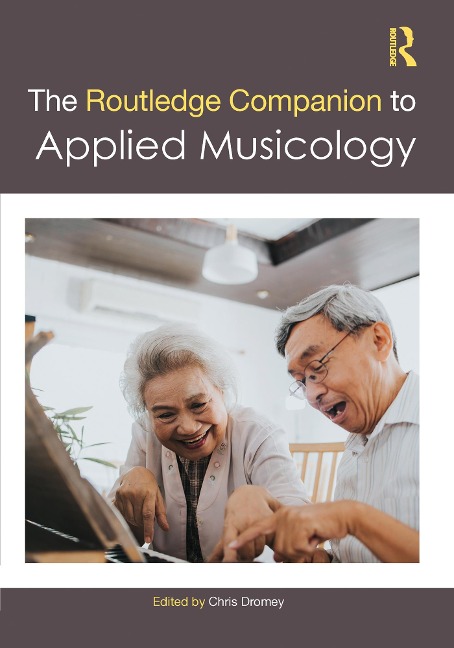
The Routledge Companion to Applied Musicology brings together academics, artist-researchers, and practitioners to provide readers with an extensive and authoritative overview of applied musicology. Once a field that addressed music's socio-political or performative contexts, applied musicology today encompasses study and practice in areas as diverse as psychology, ecomusicology, organology, forensic musicology, music therapy, health and well-being, and other public-oriented musicologies. These rapid advances have created a fast-changing field whose scholarship and activities tend to take place in isolation from each other. This volume addresses that shortcoming, bringing together a wide-ranging survey of current approaches. Featuring 39 authors, The Routledge Companion to Applied Musicology falls into five parts-Defining and Theorising Applied Musicology; Public Engagement; New Approaches and Research Methods; Representation and Inclusion; and Musicology in/for Performance-that chronicle the subject's rich history and consider the connections that will characterise its future. The book offers an essential resource for anyone exploring applied musicology.
Chris Dromey is Associate Professor of Music at Middlesex University, where he has led BA Music Business and Arts Management since 2006. He is co-editor of The Classical Music Industry (Routledge, 2018).
List of Figures List of Contributors Introduction Chris Dromey Part I. Defining and Theorising Applied Musicology 1. From Spitta to Seeger: Early Theories of Applied Musicology Malik Sharif 2. Musicology's Applied Foundations (or, How Music was Musealised) MiloS Zapletal and Chris Dromey 3. The Late Nineteenth-Century Concert as Applied Musicology Natasha Loges 4. "Applied" before Musicology? George Grove, Programme Notes, and the Dictionary Bruno Bower 5. Phenomenology, Practice-led Research, and Applied Musicology Nancy November 6. The Locations of Musical Meaning and Subjectivity Alastair Williams Part II. Public Engagement 7. Shaping the Narrative: Musicology for a Public Leah Broad 8. Exhibiting Ethnomusicology: Curation Across Cultures and Disciplines Frances Wilkins, Barbara Alge and the Aanischaaukamikw Cree Cultural Institute 9. Club Inégales, Curation, and Processes of Public Musicology Helen Julia Minors 10. Cultural and Artistic Citizenship in Classical Music Constanze Wimmer and Chris Dromey 11. Musicology and/as Knowledge Exchange Toby Young 12. 'So wide is the field': Edward Taylor's Public Music Lectures Rachel Johnson Part III. New Approaches and Research Methods 13. The Sound Commons and Applied Ecomusicologies Aaron S. Allen, Taylor Leapaldt, Mark Pedelty and Jeff Todd Titon 14. Perceptions of Melodic Symmetry: A Priming Study Michael Thorpe 15. Opera Virgins at the Movies: Audience Research and the Ontology of Opera Cinema Joe Attard 16. Towards an Applied Health Musicology: Aesthetic Music Therapy and Beyond Colin Andrew Lee and Chris Dromey 17. "Parental Advisory": Making Explicit the Value and Authenticity of a Music Degree Paul Fleet Part IV. Representation and Inclusion 18. Rethinking Representation in Music Education: Strategies to Integrate Pan-African Music Karen Cyrus 19. Whose 'Better World'? Reflections on Applied Music Interventions in the Andes Xabier Etxeberria Adrien and Henry Stobart 20. Rethinking (Self-)Care in Musicology Klisala Harrison 21. The Legality and Morality of Rap at Court Lily E. Hirsch 22. Strategies for Using Music Theory to Inform Music Education, Psychology, and Therapy Research Adam Ockelford Part V. Musicology in/for Performance 23. "Mahler am Tisch": Experimenting with Imagined and Emergent Audiences Ties van de Werff, Veerle Spronck and Imogen Eve 24. On Organology: Taxonomy and Transdisciplinarity Rachael Durkin and Darryl Martin 25. Dialogues with Recordings: Digital Memory and the Archive Neil Heyde 26. Intersections Between Northern Irish Choral Practices and Community Music Principles Sarah-Jane Gibson and Lee Higgins 27. Music for Buildings, Building for Music Neil Thomas Smith and Peter Peters References Index
Dieses eBook wird im PDF-Format geliefert und ist mit einem Adobe Kopierschutz (DRM) versehen. Sie können dieses eBook mit allen Geräten lesen, die das PDF-Format und den Adobe Kopierschutz (DRM) unterstützen.
Zum Beispiel mit den folgenden Geräten:
• tolino Reader
Laden Sie das eBook direkt über den Reader-Shop auf dem tolino herunter oder übertragen Sie das eBook auf Ihren tolino mit einer kostenlosen Software wie beispielsweise Adobe Digital Editions.
• Sony Reader & andere eBook Reader
Laden Sie das eBook direkt über den Reader-Shop herunter oder übertragen Sie das eBook mit der kostenlosen Software Sony READER FOR PC/Mac oder Adobe Digital Editions auf ein Standard-Lesegeräte mit epub- und Adobe DRM-Unterstützung.
• Tablets & Smartphones
Möchten Sie dieses eBook auf Ihrem Smartphone oder Tablet lesen, finden Sie hier unsere kostenlose Lese-App für iPhone/iPad und Android Smartphone/Tablets.
• PC & Mac
Lesen Sie das eBook direkt nach dem Herunterladen mit einer kostenlosen Lesesoftware, beispielsweise Adobe Digital Editions, Sony READER FOR PC/Mac oder direkt über Ihre eBook-Bibliothek in Ihrem Konto unter „Meine eBooks“ - „online lesen“.
Schalten Sie das eBook mit Ihrer persönlichen Adobe ID auf bis zu sechs Geräten gleichzeitig frei.
Bitte beachten Sie, dass die Kindle-Geräte das Format nicht unterstützen und dieses eBook somit nicht auf Kindle-Geräten lesbar ist.