Und dann auf "Zum Home-Bildschirm [+]".

Stöbern
genialokal zum Startbildschirm hinzufügen
Installieren Sie die genialokal App auf Ihrem Startbildschirm für einen schnellen Zugriff und eine komfortable Nutzung.
Installieren Sie die genialokal App auf Ihrem Startbildschirm für einen schnellen Zugriff und eine komfortable Nutzung.
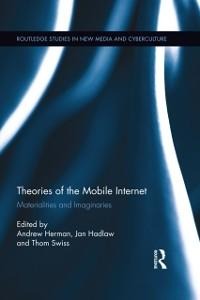
This volume proposes the mobile Internet is best understood as a socio-technical "assemblage" of objects, practices, symbolic representations, experiences and affects. Authors from a variety of disciplines discuss practices mediated through mobile communication, including current phone and tablet devices. The converging concepts of Materialities (ranging from the political economy of communication to physical devices) and Imaginaries (including cultural values, desires and perceptions) are touchstones for each of the chapters in the book.
Andrew Herman is Associate Professor of Communication Studies in the Faculty of Arts at Wilfrid Laurier University in Waterloo, Canada. He has written widely in the field of social theory, media and culture. Among his many publications are The "Better Angels of Capitalism: Rhetoric, Narrative and Moral Identity Among Men of the American Upper Class (1999) and his edited collections, Mapping the Beat: Popular Music and Contemporary Cultural Theory (1997), The World Wide Web and Contemporary Cultural Theory (2000). Jan Hadlaw is an Associate Professor at York University in Toronto, Canada. Her scholarly interests include media history, science and technology studies, and the role of design in everyday life. Her current research examines the role played by technology and design in the construction of Canadian national identity. Her work has appeared in Space and Culture, Design Issues, and Objets et communication, MEI (Médiation et information). Thom Swiss is Professor of Culture and Teaching at the University of Minnesota. Author of two books of poems, Measure and Rough Cut, he is the editor of books on popular music, including Bob Dylan: Highway 61 Revisited (2009) as well as books on new media literature and culture, including New Media Poetics: Contexts, Technotexts, and Theories (2006).
Introduction: Theories of the Mobile Internet: Mobilities, Assemblages, Materialities, and Imaginaries Andrew Herman, Jan Hadlaw, and Thomas Swiss Part I: The Politics of Mobility and Immobility 1. "We Shall Not Be Moved:" On the Politics of Immobility Darin Barney 2. Openness and Enclosure in Mobile Internet Architecture Alison Powell 3. The Materiality of Locative Media: On the Invisible Structure of Mobile Networks Jason Farman 4. Labours of Mobility: Communicative Capitalism and the Smartphone Cybertariat Enda Brophy and Greig de Peuter Part II: Mobile Pasts and Futures 5. Wireless Pasts and Wired Futures Ghislain Thibault 6. The Rise, Fall and Future of BlackBerry (TM) Capitalism Andrew Herman and Vincent Manzerolle 7. Mobile Web 2.0: New Imaginaries of Mobile Internet Gerard Goggin 8. Towards a Future Archaeology of Mobile Telecoms Laura Watts Part III: Living Mobile Lives 9. The Mobile Phone (and Texts) as a Taken for Granted Mediation Rich Ling 10. New and Old, Young and Old: Aging the Mobile Imaginary Barbara Crow & Kim Sawchuk 11. "I'm Melvin, a 4G Hot Spot" Thomas Swiss 12. A Hole in the Hand: Assemblages of Attention and Mobile Screens J. Macgregor Wise 13. Apps and Drive Jodi Dean
Dieses eBook wird im PDF-Format geliefert und ist mit einem Adobe Kopierschutz (DRM) versehen. Sie können dieses eBook mit allen Geräten lesen, die das PDF-Format und den Adobe Kopierschutz (DRM) unterstützen.
Zum Beispiel mit den folgenden Geräten:
• tolino Reader
Laden Sie das eBook direkt über den Reader-Shop auf dem tolino herunter oder übertragen Sie das eBook auf Ihren tolino mit einer kostenlosen Software wie beispielsweise Adobe Digital Editions.
• Sony Reader & andere eBook Reader
Laden Sie das eBook direkt über den Reader-Shop herunter oder übertragen Sie das eBook mit der kostenlosen Software Sony READER FOR PC/Mac oder Adobe Digital Editions auf ein Standard-Lesegeräte mit epub- und Adobe DRM-Unterstützung.
• Tablets & Smartphones
Möchten Sie dieses eBook auf Ihrem Smartphone oder Tablet lesen, finden Sie hier unsere kostenlose Lese-App für iPhone/iPad und Android Smartphone/Tablets.
• PC & Mac
Lesen Sie das eBook direkt nach dem Herunterladen mit einer kostenlosen Lesesoftware, beispielsweise Adobe Digital Editions, Sony READER FOR PC/Mac oder direkt über Ihre eBook-Bibliothek in Ihrem Konto unter „Meine eBooks“ - „online lesen“.
Schalten Sie das eBook mit Ihrer persönlichen Adobe ID auf bis zu sechs Geräten gleichzeitig frei.
Bitte beachten Sie, dass die Kindle-Geräte das Format nicht unterstützen und dieses eBook somit nicht auf Kindle-Geräten lesbar ist.