Und dann auf "Zum Home-Bildschirm [+]".

Stöbern
genialokal zum Startbildschirm hinzufügen
Installieren Sie die genialokal App auf Ihrem Startbildschirm für einen schnellen Zugriff und eine komfortable Nutzung.
Installieren Sie die genialokal App auf Ihrem Startbildschirm für einen schnellen Zugriff und eine komfortable Nutzung.
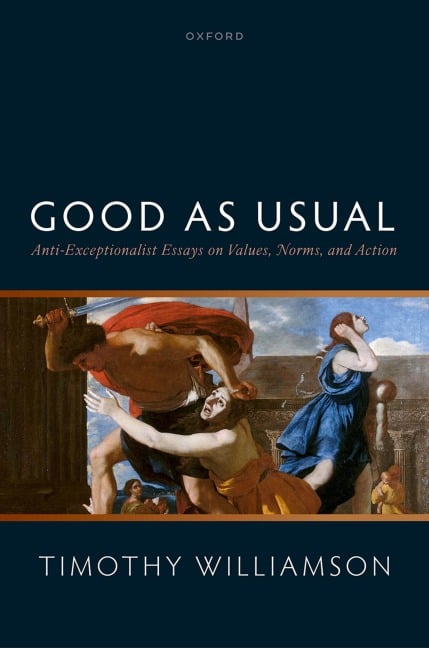
Good as Usual argues that contemporary discussion on the nature of norms and values goes wrong by treating them as exceptional and mysterious, since they do not fit popular philosophical assumptions about metaphysics, epistemology, and the philosophy of language. Timothy Williamson shows that, once we throw out those preconceived and outdated ideas, we can understand moral and evaluative features of reality as similar to its other features, and capable of being known and described in similar ways. The result is a new and anti-reductionist form of moral and evaluative realism and cognitivism. Williamson applies the same approach to practical reasoning about what to do, criticizing the subjectivist assumptions of standard decision theory, showing how the desires as well as the beliefs on which we act can amount to knowledge, and how connections between the justification of belief and the justification of action can benefit epistemology. Light is cast on the nature of rationality by a sharp distinction between rational beliefs and rational believers. Subtle logical fallacies about permissibility, obligation, and reasons are shown to have confused our normative thinking. This volume brings together and expands all of the author's work on normativity and value; it can be understood as the application to practical philosophy of the approach to theoretical philosophy developed in earlier work.
Timothy Williamson is Senior Research and Teaching Fellow in Philosophy at the University of Oxford and Whitney Griswold Visiting Professor at Yale University. He was formerly the Wykeham Professor of Logic at the University and before that Professor of Logic and Metaphysics at the University of Edinburgh. He has also taught at Trinity College Dublin, and as a visitor at MIT, Princeton, the Australian National University, the Chinese University of Hong Kong, and elsewhere. He has published Identity and Discrimination (Wiley-Blackwell, 1990), Vagueness (Routledge, 1994), Knowledge and its Limits (Clarendon Press, 2000), The Philosophy of Philosophy (Wiley-Blackwell, 2007), Modal Logic as Metaphysics (OUP, 2013), Tetralogue: I'm Right, You're Wrong (OUP, 2015), Suppose and Tell (OUP, 2020), Debating the A Priori (with Paul Boghossian, OUP, 2020), and many articles on logic and philosophy.
Dieses eBook wird im PDF-Format geliefert und ist mit einem Adobe Kopierschutz (DRM) versehen. Sie können dieses eBook mit allen Geräten lesen, die das PDF-Format und den Adobe Kopierschutz (DRM) unterstützen.
Zum Beispiel mit den folgenden Geräten:
• tolino Reader
Laden Sie das eBook direkt über den Reader-Shop auf dem tolino herunter oder übertragen Sie das eBook auf Ihren tolino mit einer kostenlosen Software wie beispielsweise Adobe Digital Editions.
• Sony Reader & andere eBook Reader
Laden Sie das eBook direkt über den Reader-Shop herunter oder übertragen Sie das eBook mit der kostenlosen Software Sony READER FOR PC/Mac oder Adobe Digital Editions auf ein Standard-Lesegeräte mit epub- und Adobe DRM-Unterstützung.
• Tablets & Smartphones
Möchten Sie dieses eBook auf Ihrem Smartphone oder Tablet lesen, finden Sie hier unsere kostenlose Lese-App für iPhone/iPad und Android Smartphone/Tablets.
• PC & Mac
Lesen Sie das eBook direkt nach dem Herunterladen mit einer kostenlosen Lesesoftware, beispielsweise Adobe Digital Editions, Sony READER FOR PC/Mac oder direkt über Ihre eBook-Bibliothek in Ihrem Konto unter „Meine eBooks“ - „online lesen“.
Schalten Sie das eBook mit Ihrer persönlichen Adobe ID auf bis zu sechs Geräten gleichzeitig frei.
Bitte beachten Sie, dass die Kindle-Geräte das Format nicht unterstützen und dieses eBook somit nicht auf Kindle-Geräten lesbar ist.