Und dann auf "Zum Home-Bildschirm [+]".

Stöbern
genialokal zum Startbildschirm hinzufügen
Installieren Sie die genialokal App auf Ihrem Startbildschirm für einen schnellen Zugriff und eine komfortable Nutzung.
Installieren Sie die genialokal App auf Ihrem Startbildschirm für einen schnellen Zugriff und eine komfortable Nutzung.
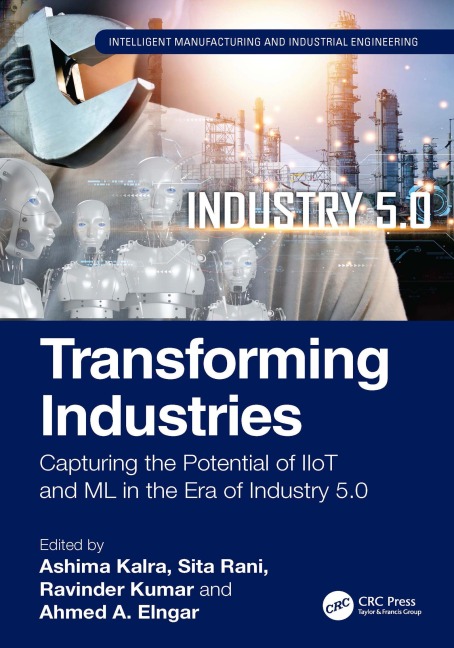
The rapid convergence of the industrial internet of things (IIoT) and machine learning (ML) is propelling us into a new era known as Industry 5.0. This era is defined by unparalleled levels of automation, customization, and sustainability. Despite these advancements, there is a noticeable absence of comprehensive resources that offer a complete understanding of these transformative technologies and their practical applications across various industrial sectors. Transforing Industries: Capturing the Potential of IIoT and ML in the Era of Industry 5.0 aims to fill the void by providing a timely and relevant guide that explores the theoretical foundations of the technologies while also presenting real-world case studies and best practices. This comprehensive text discusses the profound impact of the IIoT and ML on various sectors, including manufacturing, supply chain management, and energy production. It provides a thorough examination of the opportunities and obstacles associated with these cutting-edge technologies. Through real-world case studies and success stories, readers gain insight into how industry leaders have successfully leveraged IIoT and ML solutions to optimize operational efficiency, foster innovation, and achieve unparalleled excellence. Practical strategies and detailed guidelines are also offered to facilitate the seamless integration of these technologies into existing workflows, empowering businesses to navigate the complexities of digital transformation with confidence. The focus of this publication also extends to future trends and potential disruptors in the era of Industry 5.0, equipping readers with the knowledge needed to anticipate and adapt to emerging challenges. Furthermore, the exploration of how IIoT and ML can streamline resource allocation, minimize waste, and promote sustainable practices underscores the alignment of technological advancements with corporate, environmental, and social responsibilities. By equipping industry leaders, professionals, and entrepreneurs with actionable insights, this book will empower businesses to stay ahead of the curve, foster innovation, optimize resource utilization, and ultimately gain a competitive advantage in the ever-evolving manufacturing landscape.
Ashima Kalra is a distinguished academic and researcher currently serving as an Associate Professor in the Electronics & Communication Engineering Department at Chandigarh Engineering College (CGC-CGC), Landran, India with over 21 years of teaching experience at both undergraduate and postgraduate levels. Her research interests encompass artificial intelligence, neural networks, fuzzy systems, and machine learning. Sita Rani works in the Department of Computer Science and Engineering at Guru Nanak Dev Engineering College, Ludhiana. Her research interests include Data Science, Artificial Intelligence, Machine Learning, Blockchain Technology, Healthcare, and Sustainable Development. Ravinder Kumar is a distinguished educator and researcher in Computer Science and Engineering, with over 20 years of excellence in teaching and research. He is currently an Associate Professor at the Thapar Institute of Engineering and Technology (TIET), where he has made significant contributions to academia and research. His research interests span algorithms, combinatorial optimization, and machine learning, bridging theoretical advancements with real-world applications. Ahmed A. Elngar is an Associate Professor and Head of the Computer Science Department at the Faculty of Computers and Artificial Intelligence, Beni-Suef University, Egypt, an Associate Professor of Computer Science at the College of Computer Information Technology, American University in the Emirates, United Arab Emirates, and an Adjunct Professor at School of Technology, Woxsen University, India. He is the Founder and Head of the Scientific Innovation Research Group (SIRG) and is a Director of the Technological and Informatics Studies Center (TISC), Faculty of Computers and Artificial Intelligence, Beni-Suef University. His other research areas include the Internet of Things (IoT), Network Security, Intrusion Detection, Machine Learning, Data Mining, and Artificial Intelligence. Big Data, Authentication, Cryptology, Healthcare Systems, Automation Systems.
1. Unlocking Industry 5.0: The Role of IIoT and Machine Learning. 2. Fundamentals of Industrial Internet of Things (IIoT). 3. A Conceptual Study on the Industrial Revolution (IR) from 1.0 to 5.0. 4. Potential Technologies and Applications of Industry 5.0. 5. Streamlining Operations: The AI Era Production Management. 6. The Impact of Technological Advancement on Society and the Workforce. 7. Optimizing Manufacturing Process Performance Using Contemporary Technologies. 8. Transforming Industry 4.0: The Synergy of IIoT and Machine Learning for Enhanced Production Efficiency. 9. Predictive Maintenance and Asset Management with IIoT and ML. 10. Ensuring Security and Privacy in Internet of Things Deployments for Industry, Training, and Residential Environments: A Comprehensive Investigation. 11. Statistical Analysis of Industrial Activities Using Machine Learning Techniques. 12. HRM 5.0: Transforming Human Capital Management in the Era of Industry 5.0. 13. Autonomous Robotics and Intelligent Automation in Industry 5.0. 14. An Autonomous Mobile Robot Simulation using Navigation (NAV-2) and Simultaneous Localization and Mapping (SLAM) in ROS2. 15. Integrating IIoT and Machine Learning for Enhanced Smart City Development and Urban Infrastructure. 16. IIOT and ML in Smart Cities and Urban Infrastructure. 17. Securing the Future of Industry: A Detailed Analysis of IIoT Cybersecurity Challenges and Solutions. 18. Cybersecurity and Data Privacy Considerations for IIoT. 19. Integrating Industry 5.0 Principles with Machine Learning and the Internet of Things for Biotech Advancements. 20. Implementation of Artificial Neural Networks and Machine Learning Algorithms Using Feature Selection to Predict User Capacity in LTE Networks. 21. Enhancing Quality Control in Industry 4.0: Leveraging Deep Learning and Machine Vision for Defect Detection and Process Optimization. 22. Exploring the Intersection of Machine Learning and Wireless Communications in the Internet of Things: An Extensive Overview. 23. Leveraging Blockchain and Industrial Internet of Things (IIoT) Integration to Enhance Cybersecurity and Data Security in Industrial Environments. 24. An Investigative Study of Recent Advancements in Augmented Reality for Industrial Internet of Things (IIoT) Applications. 25. RFID Integrated with Human Interface System for Autonomous Shopping Tram with Integrated Bill Generator. 26. Vocalizing Retail Innovation: A Qualitative Investigation into the adoption of IOT-Enabled Voice Assistants in Indian Retail. 27. The Autonomous Fermenter: Redefining Microbial Production with Intelligent Automation. 28. Environmental Gas Monitoring using Energy Efficient LoRa based IoT Setup Products.
Dieses eBook wird im PDF-Format geliefert und ist mit einem Adobe Kopierschutz (DRM) versehen. Sie können dieses eBook mit allen Geräten lesen, die das PDF-Format und den Adobe Kopierschutz (DRM) unterstützen.
Zum Beispiel mit den folgenden Geräten:
• tolino Reader
Laden Sie das eBook direkt über den Reader-Shop auf dem tolino herunter oder übertragen Sie das eBook auf Ihren tolino mit einer kostenlosen Software wie beispielsweise Adobe Digital Editions.
• Sony Reader & andere eBook Reader
Laden Sie das eBook direkt über den Reader-Shop herunter oder übertragen Sie das eBook mit der kostenlosen Software Sony READER FOR PC/Mac oder Adobe Digital Editions auf ein Standard-Lesegeräte mit epub- und Adobe DRM-Unterstützung.
• Tablets & Smartphones
Möchten Sie dieses eBook auf Ihrem Smartphone oder Tablet lesen, finden Sie hier unsere kostenlose Lese-App für iPhone/iPad und Android Smartphone/Tablets.
• PC & Mac
Lesen Sie das eBook direkt nach dem Herunterladen mit einer kostenlosen Lesesoftware, beispielsweise Adobe Digital Editions, Sony READER FOR PC/Mac oder direkt über Ihre eBook-Bibliothek in Ihrem Konto unter „Meine eBooks“ - „online lesen“.
Schalten Sie das eBook mit Ihrer persönlichen Adobe ID auf bis zu sechs Geräten gleichzeitig frei.
Bitte beachten Sie, dass die Kindle-Geräte das Format nicht unterstützen und dieses eBook somit nicht auf Kindle-Geräten lesbar ist.