Und dann auf "Zum Home-Bildschirm [+]".

Stöbern
genialokal zum Startbildschirm hinzufügen
Installieren Sie die genialokal App auf Ihrem Startbildschirm für einen schnellen Zugriff und eine komfortable Nutzung.
Installieren Sie die genialokal App auf Ihrem Startbildschirm für einen schnellen Zugriff und eine komfortable Nutzung.
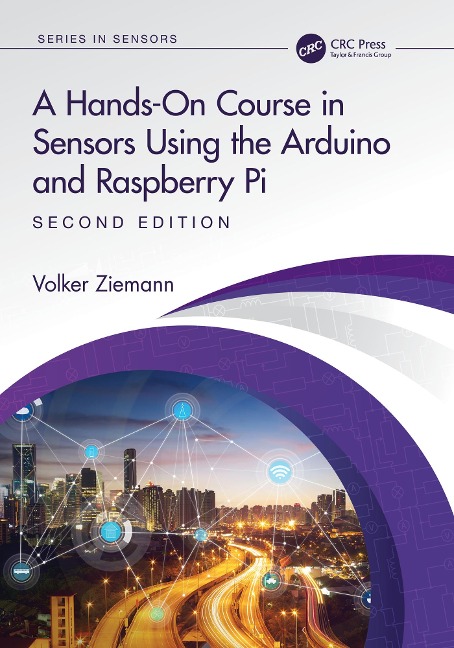
A Hands-On Course in Sensors Using the Arduino and Raspberry Pi is the first book to give a practical and wide-ranging account of how to interface sensors and actuators with micro-controllers, Raspberry Pi and other control systems. The author describes the progression of raw signals through conditioning stages, digitization, data storage and presentation. The collection, processing, and understanding of sensor data plays a central role in industrial and scientific activities. This book builds simplified models of large industrial or scientific installations that contain hardware and other building blocks, including services for databases, web servers, control systems, and messaging brokers. A range of case studies are included within the book, including a weather station, ground-vibration measurements, impedance measurements, interfacing medical sensors to web browsers, the profile of a laser beam, and a remote-controlled and fire-seeking robot. This second edition has been updated throughout to reflect new hardware and software releases since the book was first published. Newly added features include the ESP32 microcontroller, several environmental and medical sensors, actuators for signal generation, as well as a chapter on web sockets; all illustrated in new case studies. This book is suitable for advanced undergraduate and graduate students taking hands-on laboratory courses in physics and engineering. Hobbyists in robotics clubs and other enthusiasts will also find this book of interest. Features: - Includes practical, hands-on exercises that can be conducted in student labs, or even at home - Covers the latest software and hardware, and all code featured in examples is discussed in detail - All steps are illustrated with practical examples and case studies to enhance learning https://github.com/volkziem/HandsOnSensors2ed
Volker Ziemann obtained his PhD in accelerator physics from Dortmund University in 1990. After post-doctoral positions in Stanford at SLAC and in Geneva at CERN, where he worked on the design of the LHC, in 1995 he moved to Uppsala where he worked at the electron-cooler storage ring CELSIUS. In 2005 he moved to the physics department where he has since taught physics. He was responsible for several accelerator physics projects at CERN, DESY and XFEL. In 2014 he received the Thuréus prize from the Royal Society of Sciences in Uppsala.
Chapter 1: Introduction. Chapter 2: Sensors. Chapter 3: Actuators. Chapter 4: Microcontroller: Arduino. Chapter 5: Host computer: Raspberry Pi. Chapter 6: Control System: EPICS. Chapter 7: Messaging system: MQTT. Chapter 8: Websockets. Chapter 9: Example: Weather station with distributed sensors. Chapter 10: Example: Geophones. Chapter 11: Example: Monitor for the Color of Water. Chapter 12: Example: Impedance Measurements. Chapter 13: Example: Data Acquisition System. Chapter 14: Example: Fast Acquisition. Chapter 15: Example: Medical Sensing. Chapter 16: Example: Profile of a Laser Beam. Chapter 17: Example: Fire-Seeking Robot. Chapter 18: Presenting and Writing. Appendix A: Basic Circuit Theory. Appendix B: Least-squares fit. Appendix C: Where to go from here? Bibliography.
Dieses eBook wird im PDF-Format geliefert und ist mit einem Adobe Kopierschutz (DRM) versehen. Sie können dieses eBook mit allen Geräten lesen, die das PDF-Format und den Adobe Kopierschutz (DRM) unterstützen.
Zum Beispiel mit den folgenden Geräten:
• tolino Reader
Laden Sie das eBook direkt über den Reader-Shop auf dem tolino herunter oder übertragen Sie das eBook auf Ihren tolino mit einer kostenlosen Software wie beispielsweise Adobe Digital Editions.
• Sony Reader & andere eBook Reader
Laden Sie das eBook direkt über den Reader-Shop herunter oder übertragen Sie das eBook mit der kostenlosen Software Sony READER FOR PC/Mac oder Adobe Digital Editions auf ein Standard-Lesegeräte mit epub- und Adobe DRM-Unterstützung.
• Tablets & Smartphones
Möchten Sie dieses eBook auf Ihrem Smartphone oder Tablet lesen, finden Sie hier unsere kostenlose Lese-App für iPhone/iPad und Android Smartphone/Tablets.
• PC & Mac
Lesen Sie das eBook direkt nach dem Herunterladen mit einer kostenlosen Lesesoftware, beispielsweise Adobe Digital Editions, Sony READER FOR PC/Mac oder direkt über Ihre eBook-Bibliothek in Ihrem Konto unter „Meine eBooks“ - „online lesen“.
Schalten Sie das eBook mit Ihrer persönlichen Adobe ID auf bis zu sechs Geräten gleichzeitig frei.
Bitte beachten Sie, dass die Kindle-Geräte das Format nicht unterstützen und dieses eBook somit nicht auf Kindle-Geräten lesbar ist.