Und dann auf "Zum Home-Bildschirm [+]".

Stöbern
genialokal zum Startbildschirm hinzufügen
Installieren Sie die genialokal App auf Ihrem Startbildschirm für einen schnellen Zugriff und eine komfortable Nutzung.
Installieren Sie die genialokal App auf Ihrem Startbildschirm für einen schnellen Zugriff und eine komfortable Nutzung.
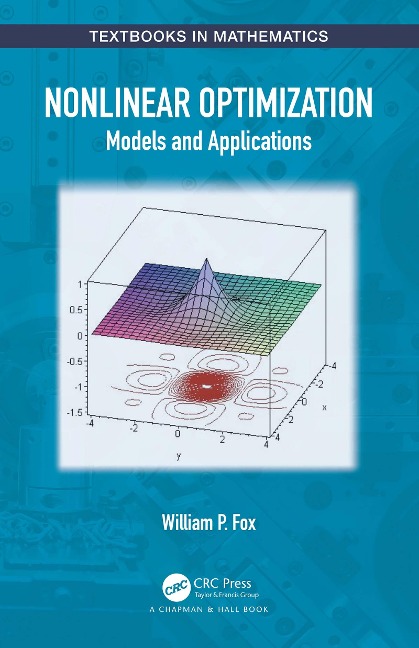
Optimization is the act of obtaining the "best" result under given circumstances. In design, construction, and maintenance of any engineering system, engineers must make technological and managerial decisions to minimize either the effort or cost required or to maximize benefits. There is no single method available for solving all optimization problems efficiently. Several optimization methods have been developed for different types of problems. The optimum-seeking methods are mathematical programming techniques (specifically, nonlinear programming techniques). Nonlinear Optimization: Models and Applications presents the concepts in several ways to foster understanding. Geometric interpretation: is used to re-enforce the concepts and to foster understanding of the mathematical procedures. The student sees that many problems can be analyzed, and approximate solutions found before analytical solutions techniques are applied. Numerical approximations: early on, the student is exposed to numerical techniques. These numerical procedures are algorithmic and iterative. Worksheets are provided in Excel, MATLAB®, and Maple(TM) to facilitate the procedure. Algorithms: all algorithms are provided with a step-by-step format. Examples follow the summary to illustrate its use and application. Nonlinear Optimization: Models and Applications: - Emphasizes process and interpretation throughout - Presents a general classification of optimization problems - Addresses situations that lead to models illustrating many types of optimization problems - Emphasizes model formulations - Addresses a special class of problems that can be solved using only elementary calculus - Emphasizes model solution and model sensitivity analysis About the author: William P. Fox is an emeritus professor in the Department of Defense Analysis at the Naval Postgraduate School. He received his Ph.D. at Clemson University and has taught at the United States Military Academy and at Francis Marion University where he was the chair of mathematics. He has written many publications, including over 20 books and over 150 journal articles. Currently, he is an adjunct professor in the Department of Mathematics at the College of William and Mary. He is the emeritus director of both the High School Mathematical Contest in Modeling and the Mathematical Contest in Modeling.
Dr. William P. Fox is a professor in the Department of Defense Analysis at the Naval Postgraduate School and currently teaches a three course sequence in mathematical modeling for decision making. He received his Ph.D. at Clemson University. He has taught at the United States Military Academy and at Francis Marion University where he was the chair of mathematics for eight years. He has many publications and scholarly activities including sixteen books, one hundred and fifty journal articles, and about one hundred and fifty conference presentations, and workshops. He was Past- President of the Military Application Society of INFORMS and is the current Vice Chair for Programs for BIG SIGMAA.
Chapter 1. Nonlinear Optimization Overview 1.1 Introduction 1.2 Modeling 1.3 Exercises Chapter 2. Review of Single Variable Calculus Topics 2.1 Limits 2.2 Continuity 2.3 Differentiation 2.4 Convexity Chapter 3. Single Variable Optimization 3.1 Introduction 3.2 Optimization Applications 3.3 Optimization Models Constrained Optimization by Calculus Chapter 4. Single Variable Search Methods 4.1 Introduction 4.2 Unrestricted Search 4.3 Dichotomous Search 4.4 Golden Section Search 4.5 Fibonacci Search 4.6 Newton's Method 4.7 Bisection Derivative Search Chapter 5. Review of MV Calculus Topics 5.1 Introduction, Basic Theory, and Partial Derivatives 5.2 Directional Derivatives and The Gradient Chapter 6. MV Optimization 6.1 Introduction 6.2 The Hessian 6.3 Unconstrained Optimization Convexity and The Hessian Matrix Max and Min Problems with Several Variables Chapter 7. Multi-variable Search Methods 7.1 Introduction 7.2 Gradient Search 7.3 Modified Newton's Method Chapter 8. Equality Constrained Optimization: Lagrange Multipliers 8.1 Introduction and Theory 8.2 Graphical Interpretation 8.3 Computational Methods 8.4 Modeling and Applications Chapter 9. Inequality Constrained Optimization; Kuhn-Tucker Methods 9.1 Introduction 9.2 Basic Theory 9.3 Graphical Interpretation and Computational Methods 9.4 Modeling and Applications Chapter 10. Method of Feasible Directions and Other Special NL Methods 10.1 Methods of Feasible Directions Numerical methods (Directional Searches) Starting Point Methods 10.2 Separable Programming 10.3 Quadratic Programming Chapter 11. Dynamic Programming 11.1 Introduction 11.2 Continuous Dynamic Programming 11.3 Modeling and Applications with Continuous DP 11.4 Discrete Dynamic Programming 11.5 Modeling and Applications with Discrete Dynamic Programming
Dieses eBook wird im PDF-Format geliefert und ist mit einem Adobe Kopierschutz (DRM) versehen. Sie können dieses eBook mit allen Geräten lesen, die das PDF-Format und den Adobe Kopierschutz (DRM) unterstützen.
Zum Beispiel mit den folgenden Geräten:
• tolino Reader
Laden Sie das eBook direkt über den Reader-Shop auf dem tolino herunter oder übertragen Sie das eBook auf Ihren tolino mit einer kostenlosen Software wie beispielsweise Adobe Digital Editions.
• Sony Reader & andere eBook Reader
Laden Sie das eBook direkt über den Reader-Shop herunter oder übertragen Sie das eBook mit der kostenlosen Software Sony READER FOR PC/Mac oder Adobe Digital Editions auf ein Standard-Lesegeräte mit epub- und Adobe DRM-Unterstützung.
• Tablets & Smartphones
Möchten Sie dieses eBook auf Ihrem Smartphone oder Tablet lesen, finden Sie hier unsere kostenlose Lese-App für iPhone/iPad und Android Smartphone/Tablets.
• PC & Mac
Lesen Sie das eBook direkt nach dem Herunterladen mit einer kostenlosen Lesesoftware, beispielsweise Adobe Digital Editions, Sony READER FOR PC/Mac oder direkt über Ihre eBook-Bibliothek in Ihrem Konto unter „Meine eBooks“ - „online lesen“.
Schalten Sie das eBook mit Ihrer persönlichen Adobe ID auf bis zu sechs Geräten gleichzeitig frei.
Bitte beachten Sie, dass die Kindle-Geräte das Format nicht unterstützen und dieses eBook somit nicht auf Kindle-Geräten lesbar ist.