Und dann auf "Zum Home-Bildschirm [+]".

Stöbern
genialokal zum Startbildschirm hinzufügen
Installieren Sie die genialokal App auf Ihrem Startbildschirm für einen schnellen Zugriff und eine komfortable Nutzung.
Installieren Sie die genialokal App auf Ihrem Startbildschirm für einen schnellen Zugriff und eine komfortable Nutzung.
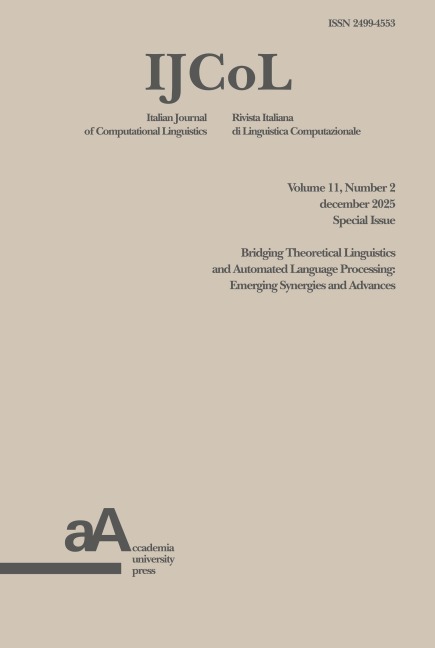

In recent years, Natural Language Processing (NLP) has gone through a radical breakthrough due to the success of Large Language Models (LLMs). These models have demonstrated that an unsupervised inductive approach, based on processing large amounts of raw data, can achieve extraordinary accuracy rates in many NLP-related tasks. This progress seems to have reduced the role of theoretical linguistics in computational approaches to linguistic analysis. For instance, metalinguistic annotation, a central element in supervised learning, which traditionally relies on established linguistic theories, has lost its core place in eveloping trained models for different NLP tasks. In this context, a closer dialogue between theoretical and computational linguistics becomes essential to integrate theoretical and practical perspectives, bridging the gap between these two approaches to language study. This is particularly important for both the practical implementation of linguistic theories in computational models and the theoretical interpretation of results produced by NLP systems. This special issue of the Italian Journal of Computational Linguistics aims to bridge this gap by exploring the emerging synergies between theoretical linguistics and computational linguistics and the implications these have for the future of the two approaches.
Autori vari a cura di Alessandro Lenci, Marco Passarotti, Rachele Sprugnoli, Fabio Tamburini
Preface to the Special Issue Bridging Theoretical Linguistics and Automated Language Processing: Emerging Synergies and Advances Alessandro Lenci, Marco Passarotti, Rachele Sprugnoli, Fabio Tamburini Bridging Linguistics and Computational Linguistics: Insights into Synergies and Challenges from a Case Study Simonetta Montemagni Theoretical Implications of Automated Discourse Parsing in Student Writing Arianna Bienati, Mariachiara Pascucci, Jennifer-Carmen Frey, Alessio Palmero Aprosio The Development of a Medical Dataset in Italian Sign Language (LIS): Theoretical Considerations and Practical Applications Gaia Caligiore Large Language Models Under Evaluation: An Acceptability, Complexity and Coherence Assessment in Italian Cristiano Chesi, Francesco Vespignani, Roberto Zamparelli The Pragmatic Utility of Asking the Right Question in a Recommendation Scenario Martina Di Bratto, Maria Di Maro Italian-based Large Language Models at the Syntax-Semantics Interface: the Case of Instrumental Role Alice Suozzi, Simone Mazzoli, Gianluca E. Lebani