Und dann auf "Zum Home-Bildschirm [+]".

Stöbern
genialokal zum Startbildschirm hinzufügen
Installieren Sie die genialokal App auf Ihrem Startbildschirm für einen schnellen Zugriff und eine komfortable Nutzung.
Installieren Sie die genialokal App auf Ihrem Startbildschirm für einen schnellen Zugriff und eine komfortable Nutzung.
Ihr gewünschter Artikel ist in 0 Buchhandlungen vorrätig - wählen Sie hier eine Buchhandlung in Ihrer Nähe aus:

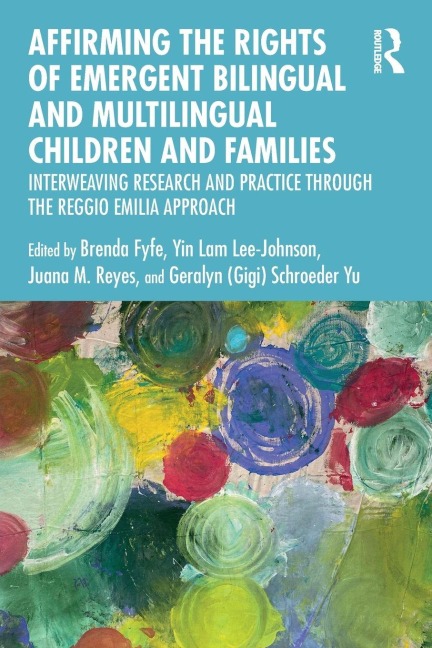
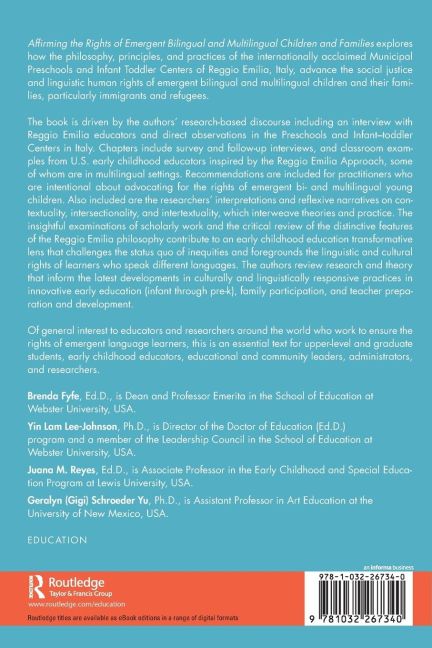
Affirming the Rights of Emergent Bilingual and Multilingual Children and Families explores how the philosophy, principles, and practices of the internationally acclaimed Municipal Preschools and Infant Toddler Centers of Reggio Emilia, Italy, advance the social justice and linguistic human rights of emergent bilingual and multilingual children and their families, particularly immigrants and refugees.
The book is driven by the authors' research-based discourse including an interview with Reggio Emilia educators and direct observations in the Preschools and Infant-toddler Centers in Italy. Chapters include survey and follow-up interviews, and classroom examples from U.S. early childhood educators inspired by the Reggio Emilia approach some of whom are in multilingual settings. Recommendations are included for practitioners who are intentional about advocating for the rights of emergent bi- and multilingual young children. Also included are the researchers' interpretations and reflexive narratives on contextuality, intersectionality, and intertextuality, which interweave theories and practice. The insightful examinations of scholarly work and the critical review of the distinctive features of the Reggio Emilia philosophy contribute to an early childhood education transformative lens that challenges the status quo of inequities and foregrounds the linguistic and cultural rights of learners who speak different languages. The authors review research and theory that inform the latest developments in culturally and linguistically responsive practices in innovative early education (infant through pre-k), family participation, and teacher preparation and development.
Of general interest to educators and researchers around the world who work to ensure the rights of emergent language learners, this is an essential text for upper-level and graduate students, early childhood educators, educational and community leaders, administrators, and researchers.
Brenda Fyfe, Ed.D., is Dean and Professor Emerita in the School of Education at Webster University, USA. Yin Lam (Nicole) Lee-Johnson, Ph.D., is Director of the Doctor of Education (Ed.D.) program and a member of the Leadership Council in the School of Education at Webster University, USA. Juana Reyes, Ed.D., is Associate Professor in the Early Childhood and Special Education Program at Lewis University, USA. Geralyn (Gigi) Schroeder Yu, Ph.D., is Assistant Professor in Art Education at the University of New Mexico, USA.
Contents Acknowledgments About the Editors and Contributors Preface by Carla Rinaldi Section A Framing the Conversation Chapter 1: Introduction to our research, framing constructs, and purposes By Brenda Fyfe, Yin Lam Lee-Johnson, Juana Reyes, and Gigi Yu Chapter 2: What we learned from our conversation with Reggio educators By Gigi Yu, Brenda Fyfe, Baji Rankin, Juana Reyes Section B The theory of the hundred languages: Crossing borders Chapter 3: Breathing New Life: The Graphic Languages, Translanguaging, and Metaphoric Language with Young Children in Multilingual Contexts By Geralyn (Gigi) Yu and Juana Reyes Chapter 4: Multimodal Translanguaging and Assisted Intersemiotic Translation in the Reggio Emilia Approach: Applications to Multilingual Learners By DJ Kaiser, PhD Chapter 5: Studio art teachers' perspectives on multimodality and the hundred languages in early childhood multilingual contexts By Jesus Oviedo and Gigi Yu Section C Pedagogical Implications: Interweaving Research, Theory, and Practice Chapter 6: The Beginnings of Language: Exploring the Language Strengths of Infants and Toddlers By Cheryl Breig-Allen, Baji Rankin and Jennifer Strange Chapter 7: Words Unspoken: Pedagogical documentation and linguistically minoritized young children By Juana Reyes and Gigi Yu Chapter 8: The Principle of Progettazione in Supporting the Language Development of Multilingual Children by Cheryl Breig-Allen and Jennifer Strange Chapter 9: Family engagement and participation: Learning from and with emergent bilingual and multilingual children and families By Brenda Fyfe and Nahid Nader-Hashemi Section D Transformative Lens for Affirming the Rights of Emergent Bi- and Multilingual Language Learners in the United States. Chapter 10: Transforming the Reggio-inspired Approach in the USA: Critical Chronotopic Analysis for Restoring What's Radically "Reggio" By Yin Lam Lee-Johnson Chapter 11: The Metaphorical Context of the Atelier as a Border Crossing Space: Exploring Relationships in Young Children's Languaging and Translanguaging Processes By Geralyn (Gigi) Yu, Yin Lam (Nicole) Lee-Johnson, and Juana Reyes Chapter 12: What Does It Mean to Be Emergent Bi- and Multilingual Language Learners? Self-Stories and Counternarratives from Educational Researchers By Juana Reyes, Nahid Nader-Hashemi, Yin Lam (Nicole) Lee-Johnson Chapter 13: Teacher education and professional development to support emergent bilingual and multilingual children by Brenda Fyfe and Baji Rankin Section E Pushing the boundaries of our conversation Chapter 14: Teaching in cultural and Linguistic super-diverse Australian classrooms: A north - south exploration of Reggio Emilia. By Lester-Irabinna Rigney and Carla Rinaldi Chapter 15: Conclusions: Moving the Conversation Forward By Brenda Fyfe, Gigi Yu, Juana Reyes, and Yin Lam Lee-Johnson Appendix A Questionnaire Appendix B Follow up Interview questions Index