Und dann auf "Zum Home-Bildschirm [+]".

Stöbern
genialokal zum Startbildschirm hinzufügen
Installieren Sie die genialokal App auf Ihrem Startbildschirm für einen schnellen Zugriff und eine komfortable Nutzung.
Installieren Sie die genialokal App auf Ihrem Startbildschirm für einen schnellen Zugriff und eine komfortable Nutzung.
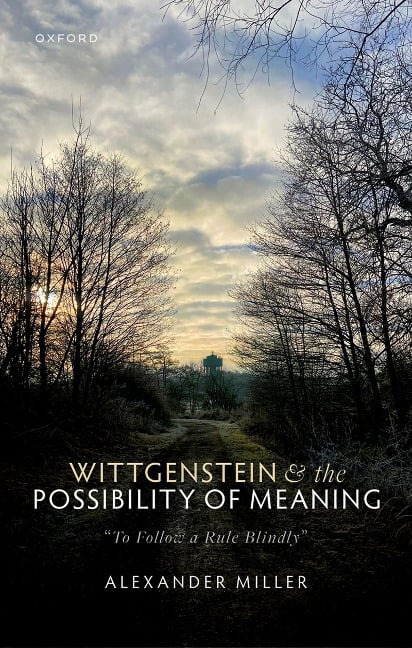
Wittgenstein and the Possibility of Meaning develops a new, non-reductionist, response to the sceptical argument about meaning famously developed in Saul Kripke's book Wittgenstein on Rules and Private Language. Inspired by Ludwig Wittgenstein's later philosophy, it begins by outlining an intuitive notion of following a rule, explaining its relationship to the notions of linguistic meaning and intentional content. It then gives an outline and development of Kripke's Wittgenstein's sceptical argument, going into detail on the arguments against reductive dispositional accounts of meaning. It also explains Kripke's Wittgenstein's objections to non-reductionist views which take semantic and intentional facts to be primitive and sui generis and argues against views (such as error theories and forms of non-factualism) which attempt to respond to the argument by conceding that there are no meaning facts. The position advocated in the book emerges from a response to recent arguments developed by Paul Boghossian ("The Inference Problem") and Crispin Wright ("The Minor Premise Problem") which appear to imply that rule-following and competent language use are impossible. The arguments of Boghossian and Wright are then blocked via a new account of Wittgenstein's remarks on the notion of "following a rule blindly" or "blind rule-following" that connects it to the Wittgensteinian idea that there is a way of following a rule that does not involve interpretation. In turn, this is used to generate a response to Kripke: understanding an expression is a matter of having an intention to exercise one's ability to use it in accord with its meaning or correctness condition.
Alexander Miller is Professor of Philosophy at the University of Otago, New Zealand. He was educated at the universities of Glasgow, St. Andrews, and Michigan (Ann Arbor). He has previously held teaching positions at Nottingham, Birmingham, Cardiff, and Macquarie. He is an associate editor of the Australasian Journal of Philosophy.
- Introduction - 1: Rule-Following, Meaning, and Content - 2: Kripkeâs Wittgensteinâs Sceptical Argument - 3: Boghossian and Wright on Blind Rule-Following - 4: Blind Rule-Following, Properly Construed - 5: A Non-Reductionist Response to Kripkeâs Wittgensteinâs Sceptical Argument - Epilogue
Dieses eBook wird im PDF-Format geliefert und ist mit einem Adobe Kopierschutz (DRM) versehen. Sie können dieses eBook mit allen Geräten lesen, die das PDF-Format und den Adobe Kopierschutz (DRM) unterstützen.
Zum Beispiel mit den folgenden Geräten:
• tolino Reader
Laden Sie das eBook direkt über den Reader-Shop auf dem tolino herunter oder übertragen Sie das eBook auf Ihren tolino mit einer kostenlosen Software wie beispielsweise Adobe Digital Editions.
• Sony Reader & andere eBook Reader
Laden Sie das eBook direkt über den Reader-Shop herunter oder übertragen Sie das eBook mit der kostenlosen Software Sony READER FOR PC/Mac oder Adobe Digital Editions auf ein Standard-Lesegeräte mit epub- und Adobe DRM-Unterstützung.
• Tablets & Smartphones
Möchten Sie dieses eBook auf Ihrem Smartphone oder Tablet lesen, finden Sie hier unsere kostenlose Lese-App für iPhone/iPad und Android Smartphone/Tablets.
• PC & Mac
Lesen Sie das eBook direkt nach dem Herunterladen mit einer kostenlosen Lesesoftware, beispielsweise Adobe Digital Editions, Sony READER FOR PC/Mac oder direkt über Ihre eBook-Bibliothek in Ihrem Konto unter „Meine eBooks“ - „online lesen“.
Schalten Sie das eBook mit Ihrer persönlichen Adobe ID auf bis zu sechs Geräten gleichzeitig frei.
Bitte beachten Sie, dass die Kindle-Geräte das Format nicht unterstützen und dieses eBook somit nicht auf Kindle-Geräten lesbar ist.