Und dann auf "Zum Home-Bildschirm [+]".

Stöbern
genialokal zum Startbildschirm hinzufügen
Installieren Sie die genialokal App auf Ihrem Startbildschirm für einen schnellen Zugriff und eine komfortable Nutzung.
Installieren Sie die genialokal App auf Ihrem Startbildschirm für einen schnellen Zugriff und eine komfortable Nutzung.
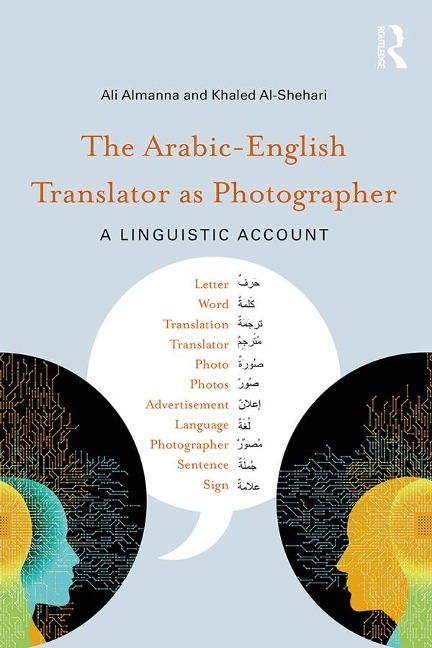
By choosing to use different linguistic approaches as a theoretical basis of their study of translation as a process of picture-taking, The Arabic-English Translator as Photographer: A Linguistic Account offers readers an original view of the translator's work. In addition to laying emphasis on the importance of giving full consideration to the mental image(s) conjured up in the mind of the translators, the book provides an accessible introduction to structural semiotics, interpretive semiotics, functional grammar, semantics and cognitive linguistics for students and researchers who are new to the field. The book can be used as a basis for (post)graduate students, especially students of MA and PhD in Translation Studies as well as students in modern languages schools. The book focuses on a specific pair of languages, English and Arabic, and presents the relationships generated by texts' translation, including adverts and other types of texts, between these two languages.
Ali Almanna has a PhD in Translation Studies from Durham University (UK) and MA in Linguistics and Translation from Westminster University (UK). Currently, he is the head of English department, Al-Zahra College for Women where he teaches Linguistics and Translation. His recent publications include The Routledge Course in Translation Annotation, Semantics for Translation Students and The Nuts and Bolts of Arabic-English Translation. Khaled Al-Shehari is Assistant Professor at Sultan Qaboos University, Oman. He holds an MSc (1998) and a PhD (2001) in Translation Studies from the University of Manchester, UK. He has published articles in The Interpreter and Translator Trainer, Translation Studies in the New Millennium, and edited collections.
Contents Acknowledgements Note on Transliteration List of abbreviations Chapter 1: Setting the scene: introductory matters Who is the book for? Why is it different? Structure of the book Hypotheses & research questions Significance of the book Theoretical background Key technical terms Warming up exercises Further reading Chapter 2: Signs & syntagmatic and paradigmatic axes Semiotics Signified versus signifier Syntagms and paradigms Commutation test Key technical terms Exercises Further reading Chapter 3: Sign's functions & intertextuality Peirce's interpretive semiotics Iconic function Indexical function Symbolic function Intertextuality Key technical terms Exercises Further reading Chapter 4: Transitivity system Transitivity Material processes Mental processes Verbal processes Behavioural processes Relational processes Existential Processes Circumstances Key technical terms Exercises Further reading Chapter 5: Semantic roles and energy transfer Arguments & types of semantic roles Verb-specific semantic roles Grammatical relations and semantic roles Energy transfer & mental contact Key technical terms Exercises Further reading Chapter 6: Imaging systems I: The configurational system Plexity State of boundedness State of dividedness Degree of extension Pattern of distribution Axiality Scene partitioning Key technical terms Exercises Further reading Chapter 7: Imaging systems II: attention, perspective & force dynamics Distribution of attention Force dynamics Deployment of perspective Location Distance Mode Direction Key technical terms Exercises Further reading Index
Dieses eBook wird im PDF-Format geliefert und ist mit einem Adobe Kopierschutz (DRM) versehen. Sie können dieses eBook mit allen Geräten lesen, die das PDF-Format und den Adobe Kopierschutz (DRM) unterstützen.
Zum Beispiel mit den folgenden Geräten:
• tolino Reader
Laden Sie das eBook direkt über den Reader-Shop auf dem tolino herunter oder übertragen Sie das eBook auf Ihren tolino mit einer kostenlosen Software wie beispielsweise Adobe Digital Editions.
• Sony Reader & andere eBook Reader
Laden Sie das eBook direkt über den Reader-Shop herunter oder übertragen Sie das eBook mit der kostenlosen Software Sony READER FOR PC/Mac oder Adobe Digital Editions auf ein Standard-Lesegeräte mit epub- und Adobe DRM-Unterstützung.
• Tablets & Smartphones
Möchten Sie dieses eBook auf Ihrem Smartphone oder Tablet lesen, finden Sie hier unsere kostenlose Lese-App für iPhone/iPad und Android Smartphone/Tablets.
• PC & Mac
Lesen Sie das eBook direkt nach dem Herunterladen mit einer kostenlosen Lesesoftware, beispielsweise Adobe Digital Editions, Sony READER FOR PC/Mac oder direkt über Ihre eBook-Bibliothek in Ihrem Konto unter „Meine eBooks“ - „online lesen“.
Schalten Sie das eBook mit Ihrer persönlichen Adobe ID auf bis zu sechs Geräten gleichzeitig frei.
Bitte beachten Sie, dass die Kindle-Geräte das Format nicht unterstützen und dieses eBook somit nicht auf Kindle-Geräten lesbar ist.