Und dann auf "Zum Home-Bildschirm [+]".

Stöbern
genialokal zum Startbildschirm hinzufügen
Installieren Sie die genialokal App auf Ihrem Startbildschirm für einen schnellen Zugriff und eine komfortable Nutzung.
Installieren Sie die genialokal App auf Ihrem Startbildschirm für einen schnellen Zugriff und eine komfortable Nutzung.
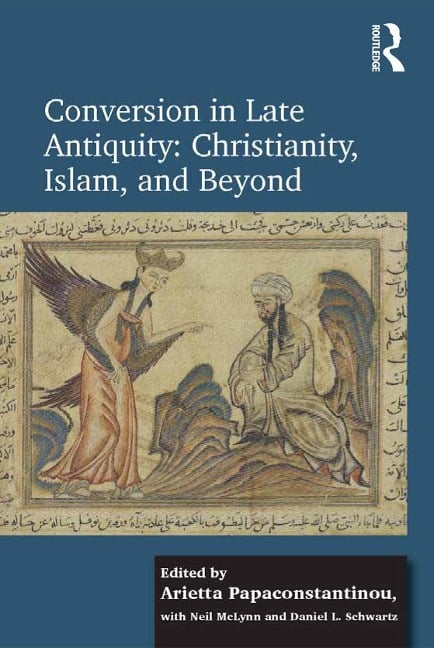
The papers in this volume were presented at a Mellon-Sawyer Seminar held at the University of Oxford in 2009-2010, which sought to investigate side by side the two important movements of conversion that frame late antiquity: to Christianity at its start, and to Islam at the other end. Challenging the opposition between the two stereotypes of Islamic conversion as an intrinsically violent process, and Christian conversion as a fundamentally spiritual one, the papers seek to isolate the behaviours and circumstances that made conversion both such a common and such a contested phenomenon. The spread of Buddhism in Asia in broadly the same period serves as an external comparator that was not caught in the net of the Abrahamic religions. The volume is organised around several themes, reflecting the concerns of the initial project with the articulation between norm and practice, the role of authorities and institutions, and the social and individual fluidity on the ground. Debates, discussions, and the expression of norms and principles about conversion conversion are not rare in societies experiencing religious change, and the first section of the book examines some of the main issues brought up by surviving sources. This is followed by three sections examining different aspects of how those principles were - or were not - put into practice: how conversion was handled by the state, how it was continuously redefined by individual ambivalence and cultural fluidity, and how it was enshrined through different forms of institutionalization. Finally, a topographical coda examines the effects of religious change on the iconic holy city of Jerusalem.
Arietta Papaconstantinou is Associate Professor in the Department of Classics, University of Reading, UK; Neil McLynn is University Lecturer and Fellow in Later Roman History at Corpus Christi College, University of Oxford, UK; Daniel L. Schwartz is Assistant Professor in the Department of History at Texas A&M University, USA.
Contents: In Memoriam: Thomas Sizgorich (1970-2011); Introduction, Arietta Papaconstantinou. Principles: Christian conversion in late antiquity: some issues, Averil Cameron; Christians and others: the conversion ethos of late antiquity, Polymnia Athanassiadi; Competing religious conversions and re-conversions in contemporary Mongolia, Vesna A. Wallace. Practice I Raison d'Ã0/00tat: From unholy madness to right-mindedness: or how to legislate for religious conformity from Decius to Justinian, Simon Corcoran; From Constantine the Great to Emperor Wu of the Liang: the rhetoric of imperial conversion and the divisive emergence of religious identities in late antique Eurasia, Antonello Palumbo; The diffusion, persecution and transformation of Manichaeism in late antiquity and pre-modern China, Samuel N.C. Lieu. Practice II Human Ambiguities: Narratives of violence: confronting pagans, Christopher Kelly; Mind the gap: accidental conversion and the hagiographic imaginary in the first centuries A.H., Thomas Sizgorich ; Rural converters among the Arabs, Elizabeth Key Fowden; Conversion, apostasy, and penance: the shifting identities of Muslim converts in the early Islamic period, Uriel Simonsohn. Practice III Symbols and Institutions: The Rabbinic conversion to Judaism; The Rabbinic conversion of Judaism, Mosche Lavee; How to get rid of Venus: some remarks on Jerome's Vita Hilarionis and the conversion of Elusa in the Negev, Konstantin M. Klein; Conversion and environment in East Asia - The case of Buddhism, Max Deeg. Building Jerusalem: The conversion of Aelia Capitolina to Christianity in the 4th century, Jan Willem Drijvers; A Christian city with a major Muslim shrine: Jerusalem in the Umayyad period, Robert Schick. References; Primary sources; Bibliography; Index.
Dieses eBook wird im PDF-Format geliefert und ist mit einem Adobe Kopierschutz (DRM) versehen. Sie können dieses eBook mit allen Geräten lesen, die das PDF-Format und den Adobe Kopierschutz (DRM) unterstützen.
Zum Beispiel mit den folgenden Geräten:
• tolino Reader
Laden Sie das eBook direkt über den Reader-Shop auf dem tolino herunter oder übertragen Sie das eBook auf Ihren tolino mit einer kostenlosen Software wie beispielsweise Adobe Digital Editions.
• Sony Reader & andere eBook Reader
Laden Sie das eBook direkt über den Reader-Shop herunter oder übertragen Sie das eBook mit der kostenlosen Software Sony READER FOR PC/Mac oder Adobe Digital Editions auf ein Standard-Lesegeräte mit epub- und Adobe DRM-Unterstützung.
• Tablets & Smartphones
Möchten Sie dieses eBook auf Ihrem Smartphone oder Tablet lesen, finden Sie hier unsere kostenlose Lese-App für iPhone/iPad und Android Smartphone/Tablets.
• PC & Mac
Lesen Sie das eBook direkt nach dem Herunterladen mit einer kostenlosen Lesesoftware, beispielsweise Adobe Digital Editions, Sony READER FOR PC/Mac oder direkt über Ihre eBook-Bibliothek in Ihrem Konto unter „Meine eBooks“ - „online lesen“.
Schalten Sie das eBook mit Ihrer persönlichen Adobe ID auf bis zu sechs Geräten gleichzeitig frei.
Bitte beachten Sie, dass die Kindle-Geräte das Format nicht unterstützen und dieses eBook somit nicht auf Kindle-Geräten lesbar ist.