Und dann auf "Zum Home-Bildschirm [+]".

Stöbern
genialokal zum Startbildschirm hinzufügen
Installieren Sie die genialokal App auf Ihrem Startbildschirm für einen schnellen Zugriff und eine komfortable Nutzung.
Installieren Sie die genialokal App auf Ihrem Startbildschirm für einen schnellen Zugriff und eine komfortable Nutzung.
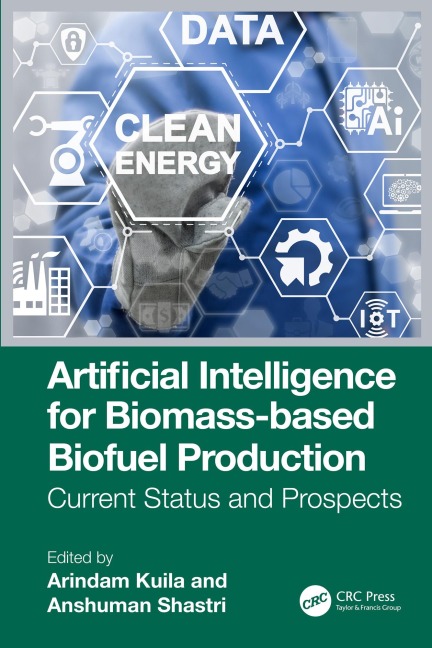
This book covers all current technological, industrial status, and future prospects of biofuel production with the concept of artificial intelligence including environmental and socioeconomic impact assessment of biofuel production from lignocellulosic biomass. It discusses the status and future scope of artificial intelligence for the advancement of biofuel research. It summarizes machine learning models in addressing the issues of biofuel supply chains, case studies, scientific challenges, and future directions. Features: - Covers the use of machine learning within the context of the processing of advanced biofuel feedstocks for biofuel production - Includes larger alcohols, ethers, levulinates, GTL fuels, and furans production using machine learning approach - Discusses how machine learning and biomass-based biofuel production can be integrated - Reviews sustainability and cost analysis of artificial intelligence-based biofuel production - Explores prediction of the potentiality of lignocellulosic biomass for biofuel applications This book is aimed at researchers and graduate students in energy and fuels, chemical engineering, and machine learning.
Arindam Kuila is currently working as Assistant Professor at the Department of Bioscience & Biotechnology, Banasthali Vidyapith, Rajasthan, India. Previously, he worked as a research associate at Hindustan Petroleum Green R&D Centre, Bangalore, India. He did his PhD from Agricultural & Food Engineering Department, the Indian Institute of Technology Kharagpur, India, in 2013 in the area of lignocellulosic biofuel production. He was awarded Petrotech Research Fellowship in 2008. He has completed one Indo-Brazil collaborative project funded by DBT, India. Presently, he is handling another project on scale-up study of lignocellulosic bioethanol production funded by DST. He has guided eight PhD students, currently five PhD students are working under his guidance. He has published 15 edited books, 20 book chapters, 40 papers in high-impact peer-reviewed journals, and filled 6 patents (2 patents granted). He is editorial board member and acted as a guest editor for several high-impact journals. He is a member of the Biotech Research Society of India and the Association of Microbiologists of India. Anshuman Shastri is currently working as Director at the Centre for Artificial Intelligence, Banasthali Vidyapith, Rajasthan, India. He has vast experience in the area of artificial intelligence. He did his PhD from Kent University, United Kingdom. Along with five additional nominations for major honors, he was awarded the International Young Scientist Award in 2020 and the International Young Researcher Award in 2021. Before the age of 28, each of them was accomplished. In addition, his profile is filled with accolades from extracurricular and academic pursuits, and he has won over 30 more medals, prizes, and recognitions for his outstanding work in quizzes, academics, cricket, and violin. He has published several high-impact peer-reviewed papers in the area of artificial intelligence.
Chapter 1. A overview of lignocellulosic biomass. Chapter 2. Lignocellulosic biomass-based biofuel production. Chapter 3. Present Status and Future Scope of Lignocellulosic Biomass-based Biofuel Production. Chapter 4. An Overview of Artificial Intelligence and Machine Learning. Chapter 5. Artificial intelligence and its application in biofuel production. Chapter 6. Machine learning and its application in biodiesel production. Chapter 7. Machine learning and its application in bioethanol production. Chapter 8. Artificial Intelligence in enhancement of bioethanol production from lignocellulosic biomass. Chapter 9. Current status of artificial intelligence-based biofuel research. Chapter 10. Life Cycle Assessment and Cost Analysis of Artificial Intelligence-Based Biofuel Production. Chapter 11. Artificial intelligence based microalgal biofuel production: Future prospect, limitation, and challenges. Chapter 12. Artificial Intelligence and Machine Learning in Biofuels as Tools for Advancing Efficiency and Sustainability. Chapter 13. AI-Driven Optimization Strategies for Enhanced Biobutanol Production. Chapter 14. Harnessing the potential of Microbial Electrochemical Systems with AI and ML
Dieses eBook wird im PDF-Format geliefert und ist mit einem Adobe Kopierschutz (DRM) versehen. Sie können dieses eBook mit allen Geräten lesen, die das PDF-Format und den Adobe Kopierschutz (DRM) unterstützen.
Zum Beispiel mit den folgenden Geräten:
• tolino Reader
Laden Sie das eBook direkt über den Reader-Shop auf dem tolino herunter oder übertragen Sie das eBook auf Ihren tolino mit einer kostenlosen Software wie beispielsweise Adobe Digital Editions.
• Sony Reader & andere eBook Reader
Laden Sie das eBook direkt über den Reader-Shop herunter oder übertragen Sie das eBook mit der kostenlosen Software Sony READER FOR PC/Mac oder Adobe Digital Editions auf ein Standard-Lesegeräte mit epub- und Adobe DRM-Unterstützung.
• Tablets & Smartphones
Möchten Sie dieses eBook auf Ihrem Smartphone oder Tablet lesen, finden Sie hier unsere kostenlose Lese-App für iPhone/iPad und Android Smartphone/Tablets.
• PC & Mac
Lesen Sie das eBook direkt nach dem Herunterladen mit einer kostenlosen Lesesoftware, beispielsweise Adobe Digital Editions, Sony READER FOR PC/Mac oder direkt über Ihre eBook-Bibliothek in Ihrem Konto unter „Meine eBooks“ - „online lesen“.
Schalten Sie das eBook mit Ihrer persönlichen Adobe ID auf bis zu sechs Geräten gleichzeitig frei.
Bitte beachten Sie, dass die Kindle-Geräte das Format nicht unterstützen und dieses eBook somit nicht auf Kindle-Geräten lesbar ist.