Und dann auf "Zum Home-Bildschirm [+]".

Stöbern
genialokal zum Startbildschirm hinzufügen
Installieren Sie die genialokal App auf Ihrem Startbildschirm für einen schnellen Zugriff und eine komfortable Nutzung.
Installieren Sie die genialokal App auf Ihrem Startbildschirm für einen schnellen Zugriff und eine komfortable Nutzung.
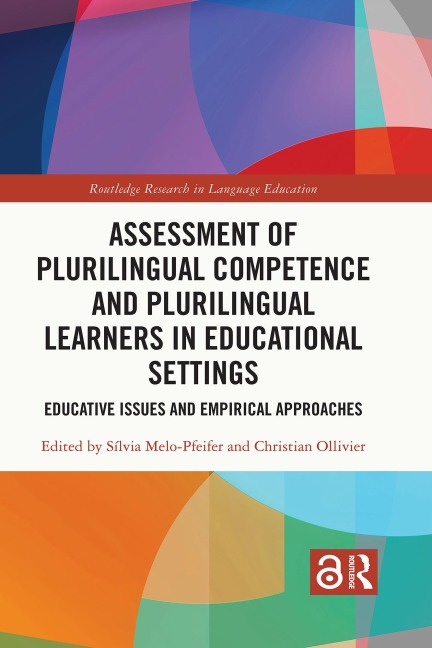
This book addresses contemporary issues in the assessment of plurilingual competence and plurilingual learners. Offering theoretical and practical lenses, it contributes towards an integrated and holistic assessment of plurilingual competence and plurilingual learners. The book provides both theoretical considerations and empirical approaches around how the specificities of plurilingual learners can be considered when assessing their various competences. It covers topics relating to learners in a variety of plurilingual settings: from the education of adult immigrants, assessment of young refugees and assessment of students in school and university, to the assessment of plurilingual competence in foreign language education. Showcasing a wide range of international authors, the book provides cutting-edge research in the domain of multilingual foreign, second and heritage language assessment, and assessment of content knowledge of plurilingual students. It bridges the gap between the fields of language policies and practices, research on plurilingual competence, and assessment in language education. Providing new insights into a crucial and contentious issue, this volume will be an essential reading for researchers and postgraduate students in the fields of educational language policies, applied linguistics and multilingualism, in particular those involved in the assessment of plurilingual competence. Chapter 3 of this book is freely available as a downloadable Open Access PDF at http://www.taylorfrancis.com under a Creative Commons Attribution- NonCommercial-ShareAlike (CC-BY-NC-SA) 4.0 license.
Sílvia Melo-Pfeifer is Professor of Foreign Language Teacher Education, University of Hamburg, Germany. Christian Ollivier is Professor of Linguistics and Language Education, University of Reunion Island, Research group Icare, France.
Introduction: On the unbearable lightness of monolingual assessment practices in education (Sílvia Melo-Pfeifer & Christian Ollivier) Part I: Considering the specificities of plurilinguals in assessment: Theoretical framework, policy and educative issues 1. Assessing multilinguals: Critical "wh-" questions about testing multiple language speakers in (non)educational contexts (Gessica De Angelis & Anat Stavans) 2. Latinx bilingual students' translanguaging and assessment: A unitary approach (Laura Ascenzi-Moreno, Ofelia García & Alexis A. López) 3. Examining plurilingual repertoires: A focus on policy, practice, and assessment in the Australian context (Jacqueline D'warte & Yvette Slaughter) 4. Evaluating the effectiveness of digital tools for the assessment of young plurilingual students (Emmanuelle Le Pichon, Mai Naji, Dania Wattar, and Vivian Lee) 5. Functional multilingualism in educational assessment (Fauve De Backer, Wendelien Vantieghem, & Piet Van Avermaet) 6. Assessing language competences of multilingual speakers - a brief review of two test approaches: C-tests and TBLA (task-based language assessment) (Barbara Hinger) 7. Assessing the first language skills of plurilingual secondary school students: An analysis of students' and evaluators' perspectives (Isabelle Audras) 8. Developing a multilingual perspective in language assessment: Multilinguality and interculturality (Anthony J. Liddicoat & Angela Scarino) Part II: Assessing plurilingual competence: Principles and empirical approaches 9. Assessing the multiple acquisitions from bi-/plurilingual learning - the questions to ask (Marisa Cavalli) 10. Crosslinguistic teacher education: How self-assessment and reflection tools can support plurilingual student teachers (Lukas Bleichenbacher, Anna Schröder-Sura, Christof Chesini, Mara De Zanet, Cornelia Gantenbein, & Robert Hilbe) 11. Plurilingualism and assessment: Some issues and options (Enrica Piccardo & Brian North) 12. EVAL-IC: An integrated approach to plurilingual competences (Elisabetta Bonvino, Filomena Capucho, & Margareta Strasser) 13. Towards an assessment of intercomprehension competences in coherence with plurilingual approaches (Maddalena De Carlo & Ana Isabel Andrade) 14. Using the European Language Portfolio for the assessment of plurilingual students in the foreign language classroom (Lisa Marie Brinkmann & Sílvia Melo-Pfeifer) 15. Evaluation and plurilingual competence: Between epistemological consistency and ethical vigilance (Emmanuelle Huver) Conclusion: Somewhere over the rainbow ... a place for multilingual assessment? (Sílvia Melo-Pfeifer & Christian Ollivier)
Dieses eBook wird im PDF-Format geliefert und ist mit einem Adobe Kopierschutz (DRM) versehen. Sie können dieses eBook mit allen Geräten lesen, die das PDF-Format und den Adobe Kopierschutz (DRM) unterstützen.
Zum Beispiel mit den folgenden Geräten:
• tolino Reader
Laden Sie das eBook direkt über den Reader-Shop auf dem tolino herunter oder übertragen Sie das eBook auf Ihren tolino mit einer kostenlosen Software wie beispielsweise Adobe Digital Editions.
• Sony Reader & andere eBook Reader
Laden Sie das eBook direkt über den Reader-Shop herunter oder übertragen Sie das eBook mit der kostenlosen Software Sony READER FOR PC/Mac oder Adobe Digital Editions auf ein Standard-Lesegeräte mit epub- und Adobe DRM-Unterstützung.
• Tablets & Smartphones
Möchten Sie dieses eBook auf Ihrem Smartphone oder Tablet lesen, finden Sie hier unsere kostenlose Lese-App für iPhone/iPad und Android Smartphone/Tablets.
• PC & Mac
Lesen Sie das eBook direkt nach dem Herunterladen mit einer kostenlosen Lesesoftware, beispielsweise Adobe Digital Editions, Sony READER FOR PC/Mac oder direkt über Ihre eBook-Bibliothek in Ihrem Konto unter „Meine eBooks“ - „online lesen“.
Schalten Sie das eBook mit Ihrer persönlichen Adobe ID auf bis zu sechs Geräten gleichzeitig frei.
Bitte beachten Sie, dass die Kindle-Geräte das Format nicht unterstützen und dieses eBook somit nicht auf Kindle-Geräten lesbar ist.