Und dann auf "Zum Home-Bildschirm [+]".

Stöbern
genialokal zum Startbildschirm hinzufügen
Installieren Sie die genialokal App auf Ihrem Startbildschirm für einen schnellen Zugriff und eine komfortable Nutzung.
Installieren Sie die genialokal App auf Ihrem Startbildschirm für einen schnellen Zugriff und eine komfortable Nutzung.
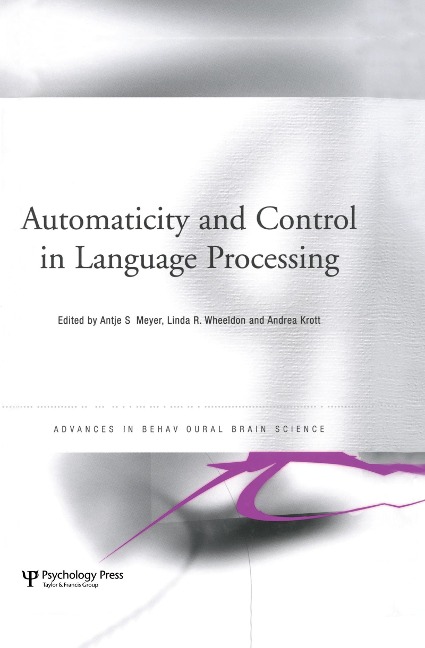
The use of language is a fundamental component of much of our day-to-day life. Language often co-occurs with other activities with which it must be coordinated. This raises the question of whether the cognitive processes involved in planning spoken utterances and in understanding them are autonomous or whether they are affected by, and perhaps affect, non-linguistic cognitive processes, with which they might share processing resources. This question is the central concern of Automaticity and Control in Language Processing. The chapters address key issues concerning the relationship between linguistic and non-linguistic processes, including: - How can the degree of automaticity of a component be defined? - Which linguistic processes are truly automatic, and which require processing capacity? - Through which mechanisms can control processes affect linguistic performance? How might these mechanisms be represented in the brain? - How do limitations in working memory and executive control capacity affect linguistic performance and language re-learning in persons with brain damage? This important collection from leading international researchers will be of great interest to researchers and students in the area.
Antje S. Meyer is Professor of Psycholinguistics at the School of Psychology at the University of Birmingham, UK. Linda Wheeldon is Senior Lecturer in the School of Psychology at the University of Birmingham, UK. Andrea Krott is Lecturer in the School of Psychology at the University of Birmingham, UK.
Preface. S. Garrod, M.J. Pickering Automaticity of language production in monologue and dialogue. K. Bock, G.S. Dell, S.M. Garnsey, A.F. Kramer, T.T. Kubose Car talk, car listen. J. Rayner, A.W. Ellis The control of bilingual language switching. V.S. Ferreira How are speakers' linguistic choices affected by ambiguity? R.J. Hartsuiker Studies on verbal self-monitoring: The perceptual loop model and beyond. A. Roelofs, M. Lamers Modelling the control of visual attention in Stroop-like tasks. G.W. Humphreys, E.M.E. Forde, E. Steer, D. Samson, C. Connelly. Executive functions in name retrieval: evidence from neuropsychology. R.C. Martin. Semantic short-term memory, language processing, and inhibition. M.A. Lambon Ralph, J.K. Fillingham. The importance of cognitive impairments in aphasia: evidence from the treatment of anomia using errorless and errorful learning. F. Pulvermüller, Y. Shtyrov Language outside the focus of attention: The Mismatch Negativity as an objective tool for studying higher language functions. P. Hagoort The memory, unification, and control (MUC) model of language.
Dieses eBook wird im PDF-Format geliefert und ist mit einem Adobe Kopierschutz (DRM) versehen. Sie können dieses eBook mit allen Geräten lesen, die das PDF-Format und den Adobe Kopierschutz (DRM) unterstützen.
Zum Beispiel mit den folgenden Geräten:
• tolino Reader
Laden Sie das eBook direkt über den Reader-Shop auf dem tolino herunter oder übertragen Sie das eBook auf Ihren tolino mit einer kostenlosen Software wie beispielsweise Adobe Digital Editions.
• Sony Reader & andere eBook Reader
Laden Sie das eBook direkt über den Reader-Shop herunter oder übertragen Sie das eBook mit der kostenlosen Software Sony READER FOR PC/Mac oder Adobe Digital Editions auf ein Standard-Lesegeräte mit epub- und Adobe DRM-Unterstützung.
• Tablets & Smartphones
Möchten Sie dieses eBook auf Ihrem Smartphone oder Tablet lesen, finden Sie hier unsere kostenlose Lese-App für iPhone/iPad und Android Smartphone/Tablets.
• PC & Mac
Lesen Sie das eBook direkt nach dem Herunterladen mit einer kostenlosen Lesesoftware, beispielsweise Adobe Digital Editions, Sony READER FOR PC/Mac oder direkt über Ihre eBook-Bibliothek in Ihrem Konto unter „Meine eBooks“ - „online lesen“.
Schalten Sie das eBook mit Ihrer persönlichen Adobe ID auf bis zu sechs Geräten gleichzeitig frei.
Bitte beachten Sie, dass die Kindle-Geräte das Format nicht unterstützen und dieses eBook somit nicht auf Kindle-Geräten lesbar ist.