Und dann auf "Zum Home-Bildschirm [+]".

Stöbern
genialokal zum Startbildschirm hinzufügen
Installieren Sie die genialokal App auf Ihrem Startbildschirm für einen schnellen Zugriff und eine komfortable Nutzung.
Installieren Sie die genialokal App auf Ihrem Startbildschirm für einen schnellen Zugriff und eine komfortable Nutzung.
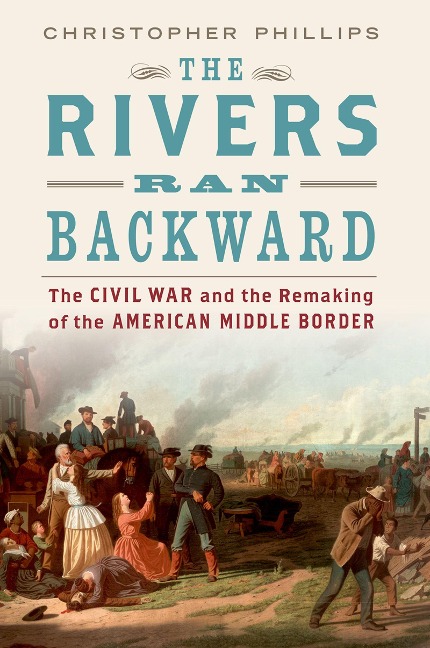
Most Americans imagine the Civil War in terms of clear and defined boundaries of freedom and slavery: a straightforward division between the slave states of Kentucky and Missouri and the free states of Illinois, Indiana, Ohio, and Kansas. However, residents of these western border states, Abraham Lincoln's home region, had far more ambiguous identities-and contested political loyalties-than we commonly assume. In The Rivers Ran Backward, Christopher Phillips sheds light on the fluid political cultures of the "Middle Border" states during the Civil War era. Far from forming a fixed and static boundary between the North and South, the border states experienced fierce internal conflicts over their political and social loyalties. White supremacy and widespread support for the existence of slavery pervaded the "free" states of Ohio, Indiana, and Illinois, which had much closer economic and cultural ties to the South, while those in Kentucky and Missouri held little identification with the South except over slavery. Debates raged at every level, from the individual to the state, in parlors, churches, schools, and public meeting places, among families, neighbors, and friends. Ultimately, the pervasive violence of the Civil War and the cultural politics that raged in its aftermath proved to be the strongest determining factor in shaping these states' regional identities, leaving an indelible imprint on the way in which Americans think of themselves and others in the nation. The Rivers Ran Backward reveals the complex history of the western border states as they struggled with questions of nationalism, racial politics, secession, neutrality, loyalty, and even place-as the Civil War tore the nation, and themselves, apart. In this major work, Phillips shows that the Civil War was more than a conflict pitting the North against the South, but one within the West that permanently reshaped American regions.
Christopher Phillips is Professor of History and Department Head at the University of Cincinnati. He is the author of seven books, including Damned Yankee: The Life of General Nathaniel Lyon; Freedom's Port: The African American Community of Baltimore, 1790-1860; Missouri's Confederate: Claiborne Fox Jackson and the Creation of Southern Identity in the Border West; and The Civil War in the Border South.
Prologue "There is a West" Introduction Interstice-White Salt, Black Servitude Chapter One: White Flows the River-Freedom and Unfreedom in the Early National West Interstice-North of Slavery, West of Abolition Chapter Two: Babel-Changed Persistence on Slavery's Borderland Interstice-Vox Populi Chapter Three: The Ten Year War-Sectional Politics in a Dividing Region Interstice-House of Cards Chapter Four: No North-No South-No East-No West-The Fiction of the Wartime Middle Ground Interstice-The Gates of Zion Chapter Five: Netherworld of War-Civilians, Soldiers, and the Dominion of War Interstice-War of Another Kind Chapter Six: Bitter Harvest-Emancipation and the Politics of Loyalty Interstice-The Art of Retaliation Chapter Seven: Shadow Wars-The Crucible of Social Violence Interstice-A River Between Them Chapter Eight: North Star, Southern Cross-The Politics of Irreconciliation Epilogue Rally Round the Flag Conclusion Abbreviations Notes Bibliography Acknowledgments Index
Dieses eBook wird im PDF-Format geliefert und ist mit einem Adobe Kopierschutz (DRM) versehen. Sie können dieses eBook mit allen Geräten lesen, die das PDF-Format und den Adobe Kopierschutz (DRM) unterstützen.
Zum Beispiel mit den folgenden Geräten:
• tolino Reader
Laden Sie das eBook direkt über den Reader-Shop auf dem tolino herunter oder übertragen Sie das eBook auf Ihren tolino mit einer kostenlosen Software wie beispielsweise Adobe Digital Editions.
• Sony Reader & andere eBook Reader
Laden Sie das eBook direkt über den Reader-Shop herunter oder übertragen Sie das eBook mit der kostenlosen Software Sony READER FOR PC/Mac oder Adobe Digital Editions auf ein Standard-Lesegeräte mit epub- und Adobe DRM-Unterstützung.
• Tablets & Smartphones
Möchten Sie dieses eBook auf Ihrem Smartphone oder Tablet lesen, finden Sie hier unsere kostenlose Lese-App für iPhone/iPad und Android Smartphone/Tablets.
• PC & Mac
Lesen Sie das eBook direkt nach dem Herunterladen mit einer kostenlosen Lesesoftware, beispielsweise Adobe Digital Editions, Sony READER FOR PC/Mac oder direkt über Ihre eBook-Bibliothek in Ihrem Konto unter „Meine eBooks“ - „online lesen“.
Schalten Sie das eBook mit Ihrer persönlichen Adobe ID auf bis zu sechs Geräten gleichzeitig frei.
Bitte beachten Sie, dass die Kindle-Geräte das Format nicht unterstützen und dieses eBook somit nicht auf Kindle-Geräten lesbar ist.