Und dann auf "Zum Home-Bildschirm [+]".

Stöbern
genialokal zum Startbildschirm hinzufügen
Installieren Sie die genialokal App auf Ihrem Startbildschirm für einen schnellen Zugriff und eine komfortable Nutzung.
Installieren Sie die genialokal App auf Ihrem Startbildschirm für einen schnellen Zugriff und eine komfortable Nutzung.
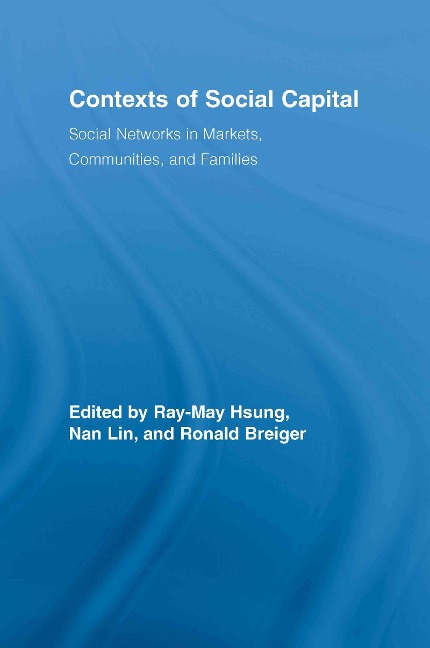
The concept of social capital refers to the ways in which people make use of their social networks in "getting ahead." Social capital isn't just about the connections in networks, but fundamentally concerns the distribution of resources on the basis of exchanges. This volume focuses on how social capital interacts with social institutions, based on the premise that markets, communities, and families are the major contexts within which people meet and build up social networks and the foci to create social capital. Featuring innovations in thinking about exchange mechanisms, resource distribution, institutional logics, resource diversity, and the degree of openness or closure of social networks, these chapters present some of the most important advances in this essential field. Paralleling these theoretical developments, the chapters also improve practical methodological work on social capital research, using new techniques and measurement methods for the uncovering of social logics.
Ray-May Hsung is Professor of Sociology at the National Chengchi University, Taiwan. Nan Lin is Professor of Sociology at Duke University, USA. Ronald L. Breiger is Professor of Sociology at the University of Arizona, USA.
Part 1: Advances on Theory and Methods of Social Capital 1. Position Generators, Affiliations, and the Institutional Logics of Social Capital: A Study of Taiwan Firms and Individuals Ray-May Hsung and Ronald L. Breiger 2. Changing Places: The Influence of Meeting Places on Recruiting Friends Beate Völker, Henk Flap and Gerald Mollenhors 3. Does the Golden Rule Rule? Rochelle R. Côté, Gabriele Plickert and Barry Wellman 4. Making Democracy Work via the Functioning of Heterogeneous Personal Networks: An Empirical Analysis based on a Japanese Election Study Ken'ichi Ikeda and Tetsuro Kobayashi Part 2: Markets And Social Capital 5. The Context Challenge: Generalizing Social Capital Processes Across Two Different Settings Bonnie H. Erickson 6. The Transaction Cost: Embeddedness Approach to Studying Chinese Outsourcing Jar-Der Luo and Yung-Chu Yeh 7. Constructed Network as Social Capital: The Transformation Of Taiwan's Small And Medium Enterprise Organization Chieh-Hsuan Chen Part 3: Social Capital in Communities 8. Production And Returns Of Social Capital: Evidence From Urban China Nan Lin, Dan Ao And Lijun Song 9. The Distribution and Return of Social Capital in Taiwan Chih-Jou Jay Chen 10. Social Capital in Communities, Development and Integration: The Four-Village Case Study in Hungary, 2000 Róbert Tardos 11. Distinctiveness and Disadvantage among the Urban Poor: Is Low Network Capital Really the Problem Jeanne S. Hurlbert, John J. Beggs and Valerie A. Haines Part 4: Families and Social Capital 12. Parental Closure Effects on Learning: Coleman's Theory of Social Capital on Learning Revisited Ly-Yun Chang 13. Childcare Networks and Embedded Experiences Joseph Galaskiewicz, Beth M. Duckles and Olga Mayorova 14. The Immediate Returns on Time Investment in Daily Contacts: Exploring the Network-Overlapping Effects from Contact Diaries Yang-Chih Fu
Dieses eBook wird im PDF-Format geliefert und ist mit einem Adobe Kopierschutz (DRM) versehen. Sie können dieses eBook mit allen Geräten lesen, die das PDF-Format und den Adobe Kopierschutz (DRM) unterstützen.
Zum Beispiel mit den folgenden Geräten:
• tolino Reader
Laden Sie das eBook direkt über den Reader-Shop auf dem tolino herunter oder übertragen Sie das eBook auf Ihren tolino mit einer kostenlosen Software wie beispielsweise Adobe Digital Editions.
• Sony Reader & andere eBook Reader
Laden Sie das eBook direkt über den Reader-Shop herunter oder übertragen Sie das eBook mit der kostenlosen Software Sony READER FOR PC/Mac oder Adobe Digital Editions auf ein Standard-Lesegeräte mit epub- und Adobe DRM-Unterstützung.
• Tablets & Smartphones
Möchten Sie dieses eBook auf Ihrem Smartphone oder Tablet lesen, finden Sie hier unsere kostenlose Lese-App für iPhone/iPad und Android Smartphone/Tablets.
• PC & Mac
Lesen Sie das eBook direkt nach dem Herunterladen mit einer kostenlosen Lesesoftware, beispielsweise Adobe Digital Editions, Sony READER FOR PC/Mac oder direkt über Ihre eBook-Bibliothek in Ihrem Konto unter „Meine eBooks“ - „online lesen“.
Schalten Sie das eBook mit Ihrer persönlichen Adobe ID auf bis zu sechs Geräten gleichzeitig frei.
Bitte beachten Sie, dass die Kindle-Geräte das Format nicht unterstützen und dieses eBook somit nicht auf Kindle-Geräten lesbar ist.