Und dann auf "Zum Home-Bildschirm [+]".

Stöbern
genialokal zum Startbildschirm hinzufügen
Installieren Sie die genialokal App auf Ihrem Startbildschirm für einen schnellen Zugriff und eine komfortable Nutzung.
Installieren Sie die genialokal App auf Ihrem Startbildschirm für einen schnellen Zugriff und eine komfortable Nutzung.
Ihr gewünschter Artikel ist in 0 Buchhandlungen vorrätig - wählen Sie hier eine Buchhandlung in Ihrer Nähe aus:

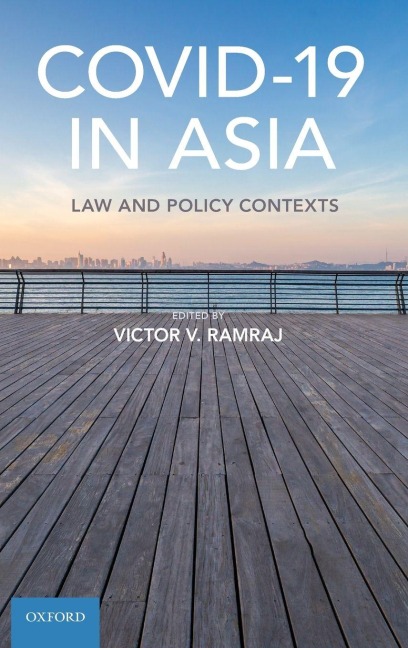
This is a book for an extraordinary time, about a pandemic for which there is no modern precedent. It is an edited collection of original essays on Asia's legal and policy responses to the Covid-19 pandemic, which, in a matter of months, swept around the globe, infecting millions. It transformed daily life in almost every corner of the planet: lockdowns of cities and entire countries, physical distancing and quarantines, travel restrictions and border controls, movement-tracking technology, mandatory closures of all but essential services, economic devastation and mass unemployment, and government assistance programs on record-breaking scales. Yet a pandemic on this scale, under contemporary conditions of globalization, has left governments and their advisors scrambling to improvise solutions, often themselves unprecedented in modern times, such as the initial lockdown of Wuhan. This collection of essays analyzes law and policy responses across Asia, identifying cross-cutting themes and challenges. It taps the collective knowledge of an interdisciplinary team of sixty-one researchers both in the service of policy development, and with the goal of establishing a scholarly baseline for research after the storm has passed. The collection begins with an epidemiological overview and survey of the law and policy themes. The jurisdiction-specific case studies and cross-cutting thematic essays cover five topics: first wave containment measures; emergency powers; technology, science, and expertise; politics, religion, and governance; and economy, climate, and sustainability. Chapter 20: Cambodia: Public Health, Economic, and Political Dimensions by Ratana Ly, Vandanet Hing, & Kimsan Soy is available for free.
Victor V. Ramraj a Professor of Law and Chair in Asia-Pacific Legal Relations at the University of Victoria in British Columbia, Canada. Since 2017, he has been the Director of the of the Centre for Asia-Pacific Initiatives. Earlier in his career, he spent sixteen years at the National University of Singapore, and served as a co-director of the Centre for Transnational Legal Studies in London in 2010-2011. His research interests span comparative constitutional law, transnational regulation, emergency powers, and the state-company relationship. He has edited and co-edited several collections of essays and his research has been published in leading journals around the world.
- Introduction and Background - 1. A Short History and Thematic Overview Victor V. Ramraj and Matthew Little - Part I: First Wave Containment Measures - 2. China: Community Policing, High-tech Surveillance, and Authoritarian Durability Feng Xu and Qian Liu - 3. Taiwan: Democracy, Technology and Civil Society Wen-Chen Chang and Chun-Yuan Lin - 4. Vietnam: Marshalling State and Non-State Actors Cuong Nguyen and Thanh Phan - 5. Spread of Information versus Spread of Virus: China, Taiwan, and Hong Kong Guoguang Wu - 6. Borders and Entry Controls in Asia Jaclyn L. Neo and Darius Lee - 7. Central Banks and their Limits in a Pandemic Christian Hofmann - Part II: Emergency Powers - 8. Governing through Contagion Lynette J. Chua and Jack Jin Gary Lee - 9. Pandemics and Emergency Powers in Asia Victor V. Ramraj and Arun K. Thiruvengadam - 10. Japan: Keeping the Death Toll to the Minimum Tomoya Ono and Shigenori Matsui - 11. Thailand: Emergency Responses or More Social Turbulence? Rawin Leelapatana and Chompunoot Tangthavorn - 12. India: Federalism, Majoritarian Nationalism, the Vulnerable and Marginalized Reeta Chowdhari Tremblay and Namitha George - Part III: Technology, Science and Expertise - 13. International Health Regulation and Compliance Susan Carolyn Breau and Preethi Lolaksha Nagaveni - 14. Can Technology and Privacy Co-Exist in a Pandemic? Ze Shi Li, Visakha Phusamruat, Tony Clear, and Daniela Damian - 15. Singapore: Technocracy and Transition Maartje De Visser and Paulin Straughan - 16. South Korea: Democracy, Innovation, and Surveillance Sunghee Chung and Sujin Lee - 17. Hong Kong: The Healthcare Professions and the Outbreak Calvin W.L. Ho and Daisy Cheung - Part IV: Part IV: Politics, Religion and Governance - 18. Religion amid the Pandemic: A Buddhist Case Study Benjamin Schonthal and Tilak Jayatilake - 19. Bhutan: The Role of the Constitutional Monarch in a Public Health Crisis Sonam Tshering and Nima Dorji - 20. Cambodia: Public Health, Economic, and Political Dimensions Ratana Ly, Vandanet Hing, and Kimsan Soy (this chapter is available for free at http://fdslive.oup.com/www.oup.com/academic/pdf/law/RamrajCO VID19AsiaCH20.pdf) - 21. Indonesia's Response to the Pandemic: Too Little, Too Late? Nadirsyah Hosen and Nurussyariah Hammado - 22. Malaysia: Improvised Pandemic Policies and Democratic Regression Azmil Tayeb and Por Heong Hong - 23. Myanmar: Pandemic in a Time of Transition Kai Ostwald and Tun Myint - 24. Sri Lanka: Pandemic-Catalysed Democratic Backsliding Bhavani Fonseka, Luwie Ganeshathasan, and Asanga Welikala - Part V: Economy, Climate and Sustainability - 25. Governments and Business Tan Cheng Han and Jiangyu Wang - 26. Nationalism, Consolidation and Rationalization in the Aviation Industry Jae Woon Lee and Michelle Dy - 27. Asian Trade and Supply Chain Linkages Philip Calvert and Dan Ciuriak - 28. Mongolia: After Successful Containment, Challenges Remain Charles Krusekopf and Mendee Jargalsaikhan - 29. Reset or Revert in the New Climate Normal Navraj Singh Ghaleigh and Louise Burrows - 30. Southeast Asian Workers in a Just-in-Time Pandemic Helen Lansdowne and James Lawson