Und dann auf "Zum Home-Bildschirm [+]".

Stöbern
genialokal zum Startbildschirm hinzufügen
Installieren Sie die genialokal App auf Ihrem Startbildschirm für einen schnellen Zugriff und eine komfortable Nutzung.
Installieren Sie die genialokal App auf Ihrem Startbildschirm für einen schnellen Zugriff und eine komfortable Nutzung.
Ihr gewünschter Artikel ist in 0 Buchhandlungen vorrätig - wählen Sie hier eine Buchhandlung in Ihrer Nähe aus:

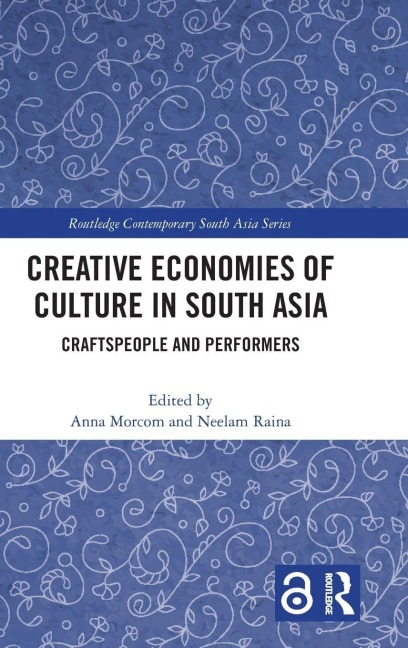

This book explores crafts and performing arts of South Asia through a focus on labour and livelihood and will contribute to Ethnomusicology, Crafts and Design, Economic Anthropology, (Historical) Sociology and (Historical) Economics, Cultural History, Human Geography, and Creative Industries and Economies.
Anna Morcom is the Mohindar Brar Sambhi Chair of Indian Music in the Department of Ethnomusicology at UCLA. She studies the performing arts of India and Tibet from diverse perspectives analysing shifting configurations of social power and has published on courtesans, bar girls, queer performers, and classical musicians in India. Neelam Raina is an Associate Professor of International Development and Design at Middlesex University London. Her grant-funded research focusses on conflict and post-conflict economic reconstruction, material cultures, indigenous knowledge, displacement, and gender. Her interest lies in intersectional inequalities and inequities in fragile settings.
Creative Vocabularies of Work and Value in South Asia: A Foreword; Living, Adapting, and Creating: Craftspeople and Performers in South Asia: A Foreword; Introduction Living, Adapting, and Creating: Craftspeople and Performers in South Asia; Chapter 1. Musical Unfreedom and the Drummers' Dilemma: Cultural Labour and the Value of Music in Indian Caste Society; Chapter 2. U-aippu: Performance as Labour in a Tamil Theatre Tradition; Chapter 3. Narratives of Craft and Power in Sindh, Pakistan; Chapter 4. Artistic Labour at Stake: The Case of South Indian Courtesans' Changing Patterns of Professionalism in Colonial and Post-Colonial India; Chapter 5. Women, Crafts and Landscapes; Acknowledging Cultural Rights for Sustainable Development; Chapter 6. The Performance of Payment: Differentiating Devotional, Erotic and Classical Performing Arts in India; Chapter 7. Materializing Insurgency: Walnut-Wood Carving and the Material Culture of Conflict; Chapter 8. The Tawa'if in Colonial India: Changing Livelihoods and Emerging Technologies (1790s - 1920s); Chapter 9. Remaking Labouring Lives through Crisis: Artisan Weaponsmiths in Colonial North India; Chapter 10. Court Music Outside the Court: Defining the 'Professional' Musician in Nineteenth-Century Bengal; Chapter 11. The Hand in the Song: Understanding Performative Labour, Gender, and Livelihood in the Arts of Chitrakar Women of West Bengal; Chapter 12. Kashmir's Crafts Women: Tacit, Embodied Knowledge and its value in Post Conflict Reconstruction; Chapter 13. Kanchipuram as Brand Value: Weaving, Marketing Tradition in South India; Chapter 14. Drumming, Value, and Patronage in a Himalayan Village Economy; Chapter 15. Globalities and Temporalities of Artisanship: Lessons from an Indian Wood Art Industry; Chapter 16. The Gramophone, The Concert Stage and the Hindustani Musician as Commodity-Fetish; Chapter 17. The Business of Kollywood Dance in Chennai, India; Chapter 18. Surviving Revivals: Or Why the Work of Resuscitating Indian Crafts is Never Done; Index